


Slack’s Brad Armstrong on setting up the right systems and the importance of your reputation.

By Sean Blanda
March 24, 2020
Perhaps the best career advice of the 21st century can be attributed to former Google CEO Eric Schmidt: “If you’re offered a seat on a rocket ship, don’t ask what seat. Just get on.”

Brad Armstrong is one of those rare people that has been on two rocket ships.
Earlier in his career, Armstrong led strategic partnerships and programs at Salesforce. And since 2015, he’s been the VP of business & corporate development at Slack. Which, if you’re keeping track at home, means that Armstrong has had a front-row seat to two of the fastest-growing SaaS companies ever.
Slack is uniquely positioned to leverage the partner ecosystem—it’s main value proposition is that it ties together all of the software we use for work. Building a vibrant partner ecosystem is hard enough. Building it with the pressures of breakneck user growth at a company that is defining its generation of startups is even harder. We spoke with Brad about the lessons he’s learned along the way and what we can learn from his time at Slack and Salesforce.
Lesson #1: Prepare your partner org for growth: Keep it centralized
One thing we learned in our State of the Partner Ecosystem report is that reporting structures for partnerships vary.
As a company grows, it can be easy to place tech partnerships under product; or to require that your channel partnerships team report to sales leaders. But Armstrong has seen the effects of that fractional approach.
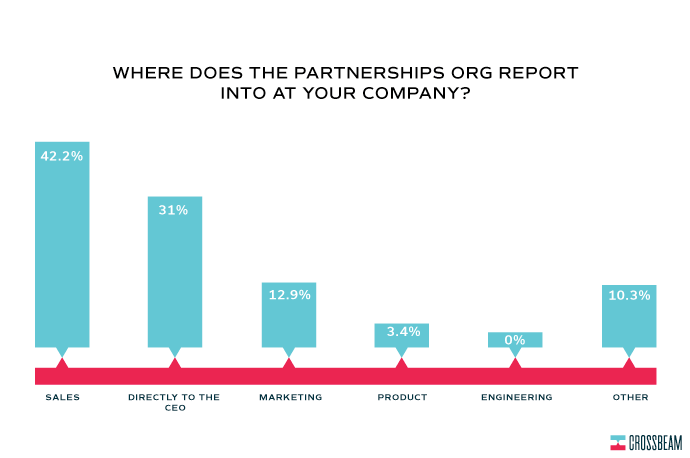
“You don’t get to scale doing that. You get more leverage having all of your partnerships together under one roof. You get more insight, leverage, and collaboration. I feel strongly about that,” he says. “I’ve seen it attempted the other way, and it’s not great.”
At Slack, their partnerships organization is split between business development, partnerships, and corporate development—including a partner marketing and partner operations role. While the group works closely with other leaders, all of the partnership strategy and execution happens as part of a single team, all reporting to a single leader.
Lesson #2: Brace yourself, partnerships are becoming table stakes:
It’s easier to build a software company than ever. Cloud hosting is cheap and venture capitalists are generally eager to fund software above other kinds of businesses—especially in the B2B space. As a result, the market share of monolithic all-in-one tools is being chipped away by smaller companies that do one thing well.
“There’s more software out there in more niche categories than ever,” Armstrong says. “And that creates sprawl. People are bouncing in and out of more tools every day. People want the data from those tools to flow and be kept in sync.”
Customers expect that the integrations are easy to find, easy to install, and easy to understand. Racking up a bunch of partnerships is only step one. Your ability to easily integrate with the tools most important to your customers may be just as important as your product.
Lesson #3: Know the THREE phases of hyper-growth partnerships
Part one, getting traction: The early days of a startup can be a slog. New partnerships are all done manually. Customers are won one at a time. “It’s really hand-to-hand combat,” says Armstrong.
But then you’ll see some signs things are picking up. You’ll have a few die-hard customers who work with you to make your product better. They start asking for one or two integrations. And you work with them so they can serve as examples of success for future customers. You start to realize successful patterns and that helps you know where you and your team should be spending their time.
Step two, setting up structures: You quickly move from propping up partnerships to scaling and setting up systems. Armstrong says to ask: “How do we make this thing real? How do we scale? How do we set up systems? How do we make sure we engage with the right partners at the right time?”
Working on any startup is like running dozens of science experiments at once. Once you find a repeatable, scalable way of delivering results you’ll need to make it into a system as soon as you can—and partnerships are no exception (read more about EcosystemOps and why they are important here).
Step three, prioritize: At this stage, you must become active rather than passive. You’ll be receiving numerous inbound requests for partnerships. If you accept them all you’ll always be reactive. Accept none and you’ll be leaving opportunities on the table.
“That balance is tricky and hard and it happens faster than you think,” says Armstrong. “You want to manage the inbound to have time to focus on the important, long-term tasks,” he adds.
Additionally, remember that integrations can take more than a year to fully take hold. As your company grows, you’ll naturally move a little slower. You’ll need to start developing points of view of what the market will look like in the next one-to-two years and acting on that—because that’s the environment your work will be shipped into.
Lesson #4: Use the same systems as your sales team
For a small partnerships team, using a full-fledged CRM system may seem like overkill. But if you don’t align your team and workflows with where your company is keeping customer data, you’re going to eventually have to adjust later. Go through a little pain now to set yourself up for future growth. At Slack, they use Salesforce.
“I really look at partnerships like a sales process and forecast that way.” says Armstrong. “Ultimately, you have to marry what’s happening in your partner ecosystem with what your sales team is seeing in the field and you need a system that ties those in.”
If you don’t tie partner records to sales and accounts you’ll have trouble creating your strategy and getting attribution for your work — which makes it harder to get the resources you need to scale.
Slack also uses Salesforce to:
- Flag when the lack of an integration is holding up a deal
- Forecasting upcoming integrations that are in the works
- Seeing what partnerships are getting stuck
- Searching out common patterns in the partner journey
Lesson #5: Your career is built on your credibility
We’ve written before how partnerships are based on “soft power” — partnership professionals often have to rely on internal politics and getting buy-in from their counterparts in marketing, sales, and product.
Externally, no one will want to work with you if you fail to deliver on your half of a partnership.
“This is a small world. If you’re early in your career look around you. The people that you are working with and partnering with? They will be the same people around later. That’s the ecosystem,” he says.
Especially when you rise to a senior level, your credibility is the most important tool you have. Can you influence the stakeholders on your side to actually execute on the things that you’re saying? Do you have that credibility? You’re always sniffing that out. “If [Slack] partners with you, we’re making a bet on you to be able to fulfill your end of the partnership,” he says.
Especially as your company grows, your list of personal collaborators will shrink. “There are only so many companies at a certain scale,” he says. “If you’re one of the major nodes in the ecosystem, the nodes have to have a relationship with one another. You’re gonna be in a relationship with each other indefinitely. They’re not going away. You’re not going away. Your customer overlap is only getting stronger. You have to take the long view.”


