


You Should be Account Mapping at Every Stage of the Customer Lifecycle


How to use partner data to fuel attribution, sales enablement, product-led growth, and more.

Remember the day you shed tears of joy because you no longer had to account map with spreadsheets? It was like getting past a challenge that never should have stolen hours from your workday in the first place.
And there was no turning back.
Now that you’re account mapping like a pro with a partner ecosystem platform (PEP) like Crossbeam, you’re starting to think creatively about your account mapping abilities (We see your superhero cape blowing in the wind). In our chats with partnerships professionals from all walks of SaaS, we’ve heard about some really exciting ways people are using real-time account mapping. It’s time to share that wisdom with you, and it starts with this:
You should be account mapping at every stage of the customer lifecycle to maximize revenue from partnerships.

At every stage, there are opportunities to accelerate sales, increase deal sizes, drive integration adoption, boost renewals, and expand your existing accounts. The earlier you can jump on these opportunities — and get your internal teams to help out — the bigger the rewards you’ll see.
For example:
- RollWorks increased integration adoption by 17% by account mapping at the “Activation” Stage (and they noticed their customers with at least one integration renew at a rate 30% higher than those without 🏆)
- Airship has seen a significant increase in the number of opportunities qualified by its partners after just three months of account mapping at the “Engagement” stage
Here’s how you can set the bar higher with real-time account mapping at every stage of the customer lifecycle:
Stage 1: Awareness
Map accounts to generate leads
During the Awareness stage, you’re throwing sparklers into the ether (think: cute Tweets and brainy thought leadership content) to help potential buyers notice your brand (for example: You just published a white paper that can help your potential prospect earn more revenue through their Google Ads strategy. The potential prospect finds your content valuable and is interested in seeing how else your brand can benefit them). This is when co-marketing with partners is critical for accessing new audiences and bringing leads into the pipeline.
The goal: Getting ecosystem qualified leads (EQLs) from your partner ecosystem to grow pipeline.
The tactic: Map accounts with your partner to identify overlaps between your “leads” or “prospects” with your partner’s “leads” or “prospects.” If there’s a high overlap count and/or if a shortlist of your most strategic target accounts overlap — consider a co-marketing play. You and your partner are targeting similar accounts, and you’ll be more likely to engage these and similar accounts by inviting them to co-hosted webinars with your partner or creating thought leadership content the account is likely to be interested in.

Stage 2: Engagement
Map accounts to engage prospects
During the Engagement stage, you’re leveling up those sparklers to make fireworks. Think: you’re running co-marketing campaigns featuring targeted advertising, blog content, and e-mail marketing with your partner to turn those “prospect” accounts into “opportunities.” Your outbound sales team is also reaching out to these leads to see if they’re ready for a product demo. At this stage, co-marketing and co-selling with partners is a winning strategy.
The goal: Getting more information about your EQLs and kicking off the sales cycle.
The tactic:Map accounts with your partner to identify overlaps between your “leads” or “prospects” with your partner’s “opportunities” or “customers.”

If you have overlaps between your “leads” or “prospects” and your partner’s “opportunities,” you can:
- Ask your partner for more context about the account (e.g. who the stakeholders with the most buying power are or what their budget looks like)
- Ask your partner about selling your joint solution together through a co-selling motion
- Ask your partner to include your solution as part of their request for proposal (RFP), if applicable
- Develop a co-marketing campaign with your partner to engage your mutual target accounts through a co-hosted webinar, a blog swap, and other co-marketing motions
If you have overlaps between your “leads” or “prospects” and your partner’s “customers,” you can:
- Ask for an intro into the account
- Ask your partner for a referral (Your prospects may trust the word of their customer success reps at the partner company and be interested in how your product can provide them with more value)
- Ask your partner to educate the prospect about various use cases for using your products together and the success stories they’ve seen
- Consider developing an integration to attract more of your partner’s customers who may be interested in using your products together
Your partner can accelerate your sales cycle simply because the account exists further along in their sales cycle (as an opportunity or a customer). Your partner has built trust with the account that you simply haven’t yet. Your partner’s influence can make all the difference between a lead going dark and a lead requesting a demo.
Consider enabling your marketing team and outbound sales team to own or support account mapping at this stage.
Stage 3: Consideration
Map accounts to qualify opportunities
During the Consideration stage, you’re looking to turn “prospects” into “opportunities” in an active sales conversation. This is when your partner can help move the needle significantly on your target accounts — but you should be tactical about which accounts you should involve a given partner in accelerating. Not all partners are created equal, and your partners’ time is valuable. Now’s the time to get strategic with your co-selling and set your sales team and partners up for success.
The goal:Transitioning your prospects to qualified opportunities ripe for the sale.
The tactic: Map accounts between a shortlist of strategic “prospects” and your partner’s “customers”. The resulting overlaps will show you which accounts your partner has the most influence in helping you close.
Bonus: Create a new list of accounts from the resulting overlaps (prospects that exist in your partner’s customer list) ☝ and then map accounts with your partner again to compare these prospects with your partner’s “opportunities” list. This will show you which of your “prospect accounts that are also your partner’s customer” your partner is currently cross-selling into.
In other words, even though the account is currently a customer, your partner may be selling into other departments or selling additional products to that customer. This means your partner has a high level of engagement with the account. They’re likely speaking with a number of influential stakeholders at the company — stakeholders you may need access to but would have a hard time engaging without the help of your partner. You should engage your partner in helping you to qualify and accelerate these opportunities.
(Keep in mind: your partner will need to be sharing opportunity-level data with you to complete this step.)
Check out how Forest Yule at Airship uses an 8-step “partner impact score methodology” to:
- Narrow down and rank their most strategic target accounts for co-selling with a given partner

Airship narrows down a list of ABM-sourced accounts that match closely with their ICP and then assigns the accounts points according to a set of factors (including the partner’s engagement with the account).
- Plot the resulting accounts into a four-quadrant matrix to determine next steps with or without partners

As a result of the “partner impact score methodology” Airship maps their target accounts for potential co-selling with a given partner into a four-quadrant matrix. The accounts in the right-hand quadrant are target accounts that have the best ICP score and the biggest potential impact from the partner.
Consider enabling your outbound sales team to own or support account mapping at this stage. Your outbound sales team can also take advantage of Crossbeam’s Chrome Extension to see account mapping results in real time as they prospect.
Stage 4: Purchase
Map accounts to close opportunities
During the Purchase stage, your partners can help you accelerate and increase the deal size of your opportunities. This stage is about shortening the sales cycle, increasing the annual recurring revenue (ARR) from the account, and pushing the account into the customer journey phase faster so they can start getting value from your product.
The goal: Driving revenue.
The tactic: Map accounts between your “prospects” or “opportunities” and your partner’s “opportunities” or “customers.” If your target accounts overlap with your partner’s “opportunities” list, ask your partner about teaming up to pitch your joint solution to the account.

If your target accounts overlap with your partner’s “opportunities” list, ask your partner about teaming up to pitch your joint solution to the account.

If your target accounts overlap with your partner’s “customers,” ask your partner:
- Context about the account (like relevant stakeholders with power over budget)
- A referral
- An introduction into the account
- To serve as a subject matter expert in educating the account about your product and various use cases the partner’s customers have seen success in
Consider enabling your account executive team to own or support account mapping at this stage.
Stage 5: Activation
Map accounts to deliver immediate value while onboarding new customers
During the Activation stage, your onboarding team needs to help your new customers get immediate value from your product. Account mapping can help your team know exactly which tools exist in their new customers’ tech stacks. With this knowledge, your team can make critical integration recommendations for your customers to unlock value from the product and lessen the customers’ time to first value (TTFV).
The faster your new customers experience value firsthand, the faster they’ll be on their way to accelerating their usage of the product, adopting more integrations to streamline their workflows, and building an appetite for other functionalities and products in your repertoire. This is when driving strategic integration adoption to get your customers off on the right foot is a top priority
The goal: Driving adoption, retention, and renewal
The tactic: Map accounts between your list of “new customers” (according to a specified date range) and your partner’s “customers.” The resulting overlaps will show you which tools exist in your new customers’ tech stacks.

Use this data to lessen the TTFV for your new customers by recommending the integrations that would help those customers achieve their respective business goals the fastest. The TTFV is the amount of time it takes the onboarding specialist to help the customer achieve their first business objective — in this case, less is better!
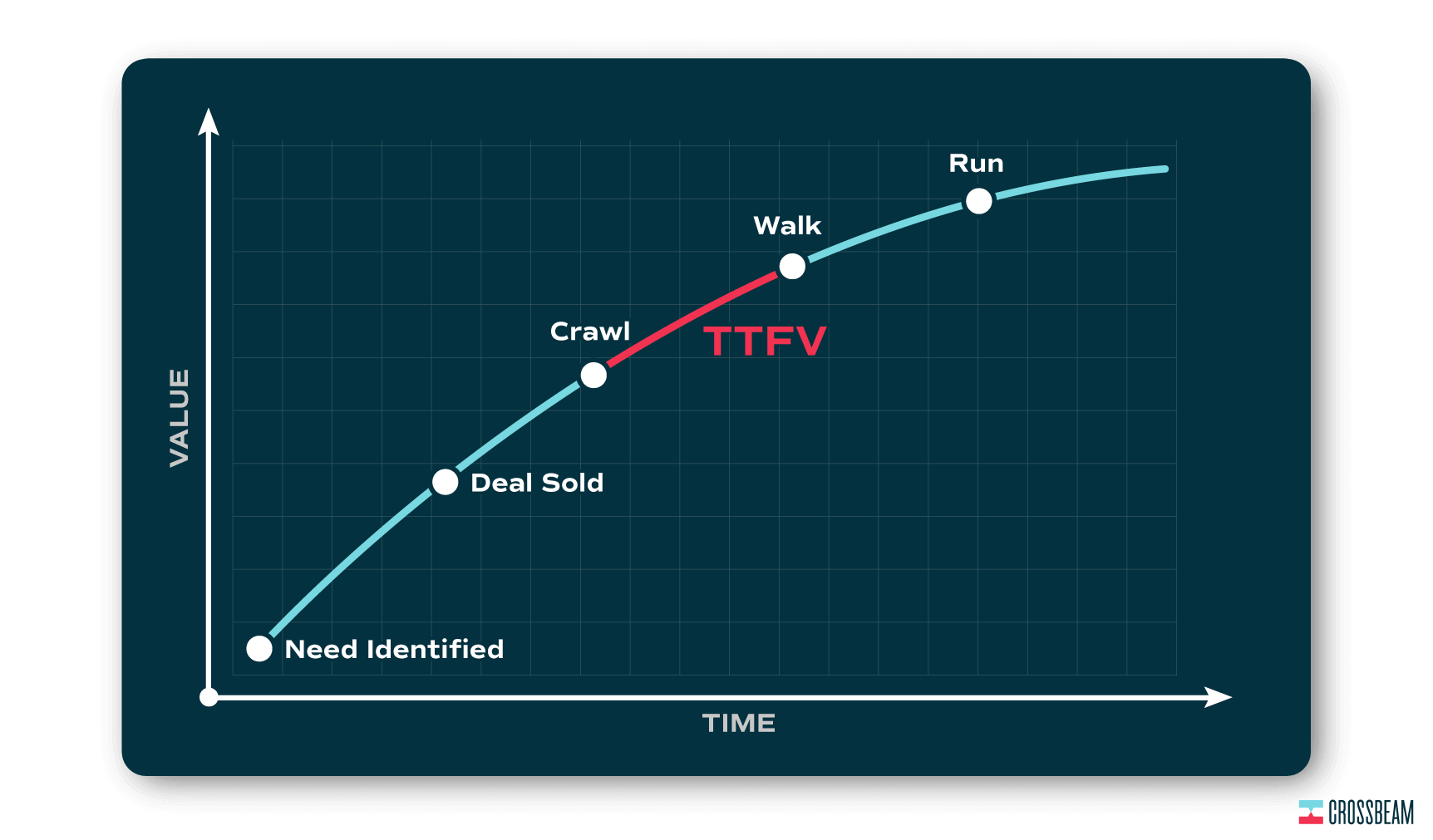
Remember: you’re making recommendations for the best integration(s) your customers should adopt right away — not all of the integrations they should adopt throughout their customer journey. Consider plotting other integration adoption recommendations into an “integration and feature adoption roadmap” like RollWorks does for their new customers.

Stage 6: Retention
Map accounts to deliver ongoing value to your customers
During the Retention stage, your customers are likely in the hands of your customer success (CS) team. Your CS reps are the ones in the trenches chatting with customers about their challenges, successes, and needs every day. Account mapping at this stage can help you:
- Identify integrations your customers should adopt to fill product gaps and/or provide additional value according to their long-term and immediate business goals
- Determine which tools exist in your customers’ tech stacks that you don’t have integrations with but should
The “stickier” your product is for your customers, the more likely they are to renew their contracts and build loyalty towards your brand.
The goal: Driving adoption, and thus retention and renewal.
The tactic: Never stop account mapping. Map accounts between your “customers” and your partner’s “customers” to gain knowledge about your customers’ growing tech stacks. Continue making integration recommendations to your customers depending on their changing business needs.
You can get more granular by mapping accounts between a subset of “customers most likely to churn” and your partner’s “customers.” Consider developing new integrations to streamline your customers’ existing workflows or improving your integrations with existing partners in their tech stacks to increase your product’s “stickiness.”
Getting ahead of churning can help you flip the conversation to something more positive like, “We now integrate with your sales team’s most-used platform!” Rather than churning customers, you’ve got renewals on the horizon.
Consider enabling your customer success team to own or support account mapping at this stage
Stage 7: Advocacy
Map accounts to expand accounts through upselling and cross-selling
During the Advocacy stage, your customers have adopted a number of integrations and find your product to be an integral part of their workflow. You’ve achieved “stickiness” and loyalty among your customers, and now it’s time to get creative with increasing the value you’re providing them with and expanding the accounts through additional product functionalities, integrations, and complementary products or services
The goal: Expanding the account through integration adoption, upselling, and cross-selling.
The tactic: Look for opportunities to create and improve functionalities for the integrations your customers are using. In this case, consider mapping accounts between a list of customers your team has the best relationships with and who have been with your company for the longest and a list of your partner’s customers. The resulting overlaps are the accounts you should look to for integration feedback and may be most interested in new feature and integration adoption.
Map your “customer” list to multiple partners’ “customer” lists to identify which tools exist in your customers’ tech stacks that those customers didn’t use previously or which integrations they simply haven’t adopted yet. An example where there’s room for improvement:
Hm, that should be higher!
Keep driving these numbers up by:
- Aligning with your marketing team and your partner’s marketing team to evaluate, pivot, and expand your co-marketing strategy to educate your customers about new products and functionalities that can help you expand the account
- Aligning with your customer success team to identify product gaps your existing integration (or a new integration) could help fill for specific customers and anticipate those customer’s needs throughout the customer lifecycle for upselling and cross-selling
- Aligning with your product and engineering teams to identify opportunities for charging for additional functionalities within your existing products or creating complementary products
The more loyalty your customers have towards your brand, the more likely they’ll be interested in what else you have to offer. Account map to anticipate these opportunities and meet their needs earlier
Consider enabling your customer success team to own or support account mapping at this stage.
—
You may have noticed: at the Advocacy Stage, a new version of the sales cycle begins again. Only this time, you’re identifying value-adds for your customers. Keep in mind: your customers don’t want to feel like they’re your prospects all over again.
Look to account mapping to initiate an honest dialogue about how your integrations, new functionalities, or complementary products can maximize your customers’ changing business goals. The more value you can provide your customers and faster — the greater the impact real-time account mapping will have on your business.


