Discover how to turn AI from a noisy gimmick into a true GTM engine. Bob Moore’s playbook shows how Crossbeam’s ecosystem data fuels your AI with the context it needs to generate pipeline, accelerate deals, and protect revenue at scale.

Most companies adopting “AI SDRs” or co-pilots have seen too much hype and too few results. Quality is low, expertise is expensive, and the get-rich-quick tech bros have created a noise bubble around the space.
And yet AI is still reshaping the way countless types of information work are done around the globe. How can it be so good at everything else and so bad at helping B2B companies sell?
The limiter isn’t model quality — it’s context. You can make AI the backbone of your GTM playbook this year and have your mind blown by the results. This playbook shows you how.
Here’s the key:
- Your first-party data (CRM, product usage, marketing touchpoints) is the baseline.
- The force-multiplier is second-party partner data: what your ecosystem knows about the very same accounts. That second-party layer is proprietary, actionable, and many times the size of your first-party data asset. Think of it as high-octane fuel poured into the engine of your AI GTM stack.
Critically, you don’t have to stitch that ecosystem layer together yourself. Crossbeam does the hard work: secure ingestion, identity resolution and matching, cleansing and normalization, continuous change detection, and turning that firehose into ranked, explainable signals delivered to humans and AI via MCP connectors, APIs, copilots, and extensions in traditional tools like CRMs.
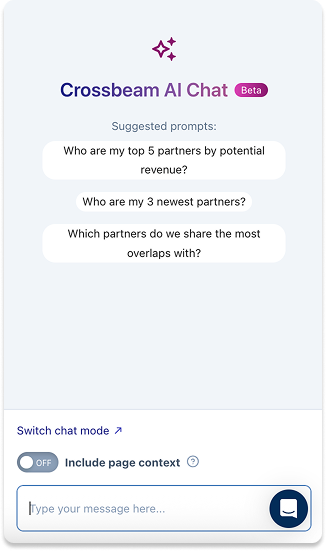
Done right, this leapfrogs AI from a disappointing email‑drafting tool to a real GTM engine. By feeding agents and humans a continuously updating firehose of second‑party partner signals, combined with your first‑party truth, your AI GTM stack can prioritize, trigger, and execute the right moves in real time. The compounding result is more qualified pipeline, faster cycles, higher win rates and ACVs, at lower cost and higher speed.
What follows is a practical playbook you can run to make AI actually move revenue by using your partner ecosystem's data as a secret weapon.
Step 1: Cultivate a high‑impact partner ecosystem
Goal: Focus your effort on growing the right partner relationships; Crossbeam handles the aggregation, matching, and change detection behind the scenes.
- Connect and receive data from partners in an account‑mapping platform like Crossbeam, starting with those most represented in your pipeline and top accounts.
- Identify your highest‑impact partners by analyzing where their customers most strongly overlap with your ideal customer profile (ICP) and your happiest, most successful customers.
- Measure impact, not just overlap by drilling into lift signals (win rate, cycle time, ASP) associated with each partner’s presence on accounts and opportunities.
- Evaluate prospective partners the same way, testing for footprint and outcome impact before you invest. Repeat this process continuously to double down on what works and prune what doesn’t.
- Let AI and Crossbeam do the heavy lifting. Instead of asking end users to standardize populations or improve match quality, rely on Crossbeam’s continuous data ops to keep the ecosystem map accurate and the signals flowing.
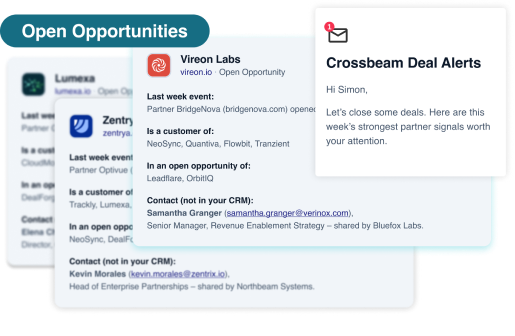
Outcome: A curated, compounding ecosystem where the size and quality of your partner data network multiplies over time, feeding your AI with ever‑richer context that turns into pipeline and revenue.
Step 2: Put ecosystem signals where your AI can use them
There are two reliable paths to get Crossbeam’s partner context into your AI systems. Use one or both, depending on how your org is set up:
Path A: Put signals where AI already looks
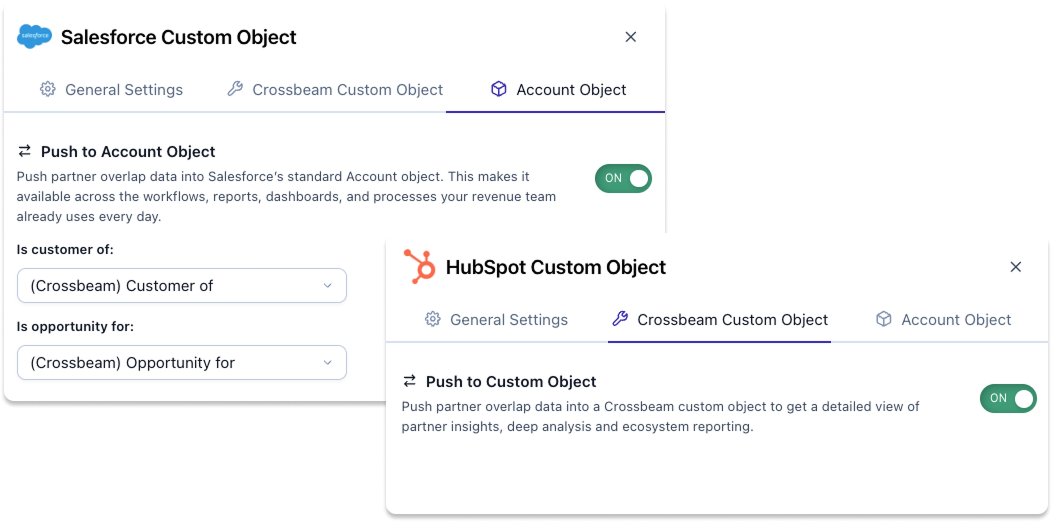
- CRM: Write Crossbeam fields to Account/Opportunity (e.g., “Is customer of [Partner]”, partner list, overlap strength, last-change timestamp) so copilots and workflows that read from CRM have the context at generation time.
- Data warehouse: Land enriched, partner‑aware tables for retrieval, ranking, modeling, and agent planning alongside product usage and CS data.
Path B: Let your AI talk directly to Crossbeam
- Crossbeam MCP / APIs: Enable agents to query overlaps, recent changes, and recommended actions on demand directly on Claude, ChatGPT, and Glean.
- Orchestrators (e.g., n8n): Compose Crossbeam calls with other systems inside agentic flows.
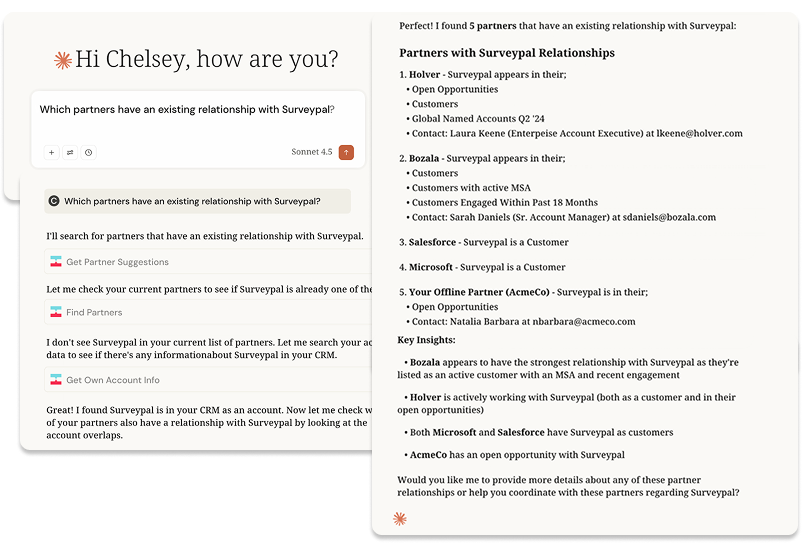
Outcome: AI has consistent access to ecosystem context so it can reason, plan, and act without human babysitting.
Step 3: Example patterns and signals your AI can drive
Start by defining outcomes, then let AI monitor signals and reason alongside your other context. Signals are combinations of your first-party data, second-party partner data from Crossbeam, and (where relevant) trusted third‑party context. The point isn’t to hard‑code rules, it’s to give AI a rich stream of evidence so it can recommend, act, and write back to systems continuously.
Here are some examples:
Generate new pipeline
Here are the key signals to be tracked for new pipeline generation:
- Partner CRM data shows a target account just moved to customer for a key partner, a new opportunity was opened by that partner for the same logo, or there’s forward progress (stage advanced or new key contact) on a related deal. Crossbeam adds context that this partner reliably serves accounts matching your ICP and has a history of high‑quality customers and positive outcome lift when present on similar accounts.
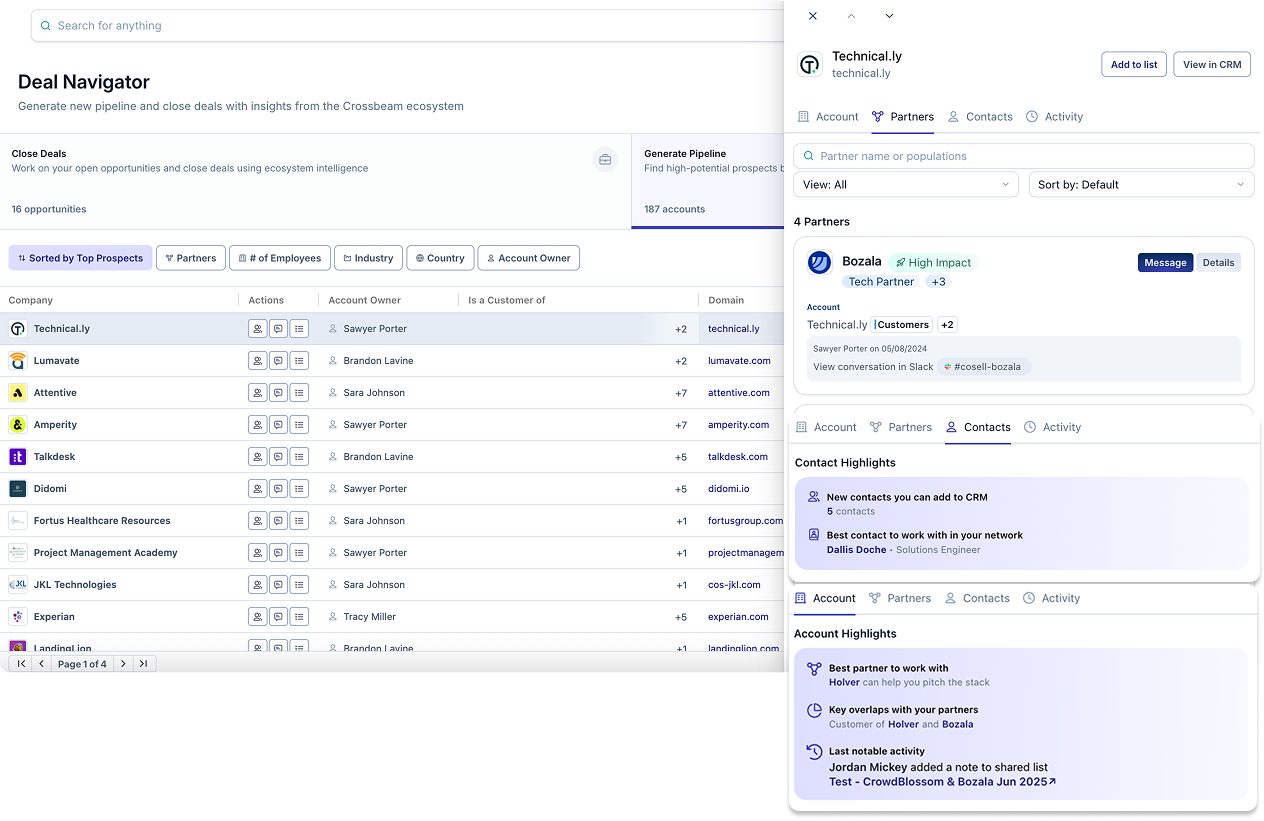
From those signals, the following AI actions can be taken:
- Continuously re‑rank and score prospects
- Generate Ecosystem‑Qualified Leads (EQLs)
- Auto‑assign leads and accounts to the right SDRs/AEs based on ecosystem overlap, coverage, and historical lift
- Tailor first‑touch messaging and qualification notes to the partner context (recent customer/opportunity events, integration fit)
- Assemble a short list of adjacent lookalikes with similar partner footprints
- Write back recommended targets, territory/queue assignments, and next steps to CRM or planning tools
Accelerate active deals
Signals:
- For an open opportunity in your CRM, partner CRM shows a new opp opened with the same account, stage advancement or closed‑won adjacent deal, or a net‑new expansion at that logo. Crossbeam context indicates this partner’s presence has historically correlated with faster cycles and higher win rates for your ICP.
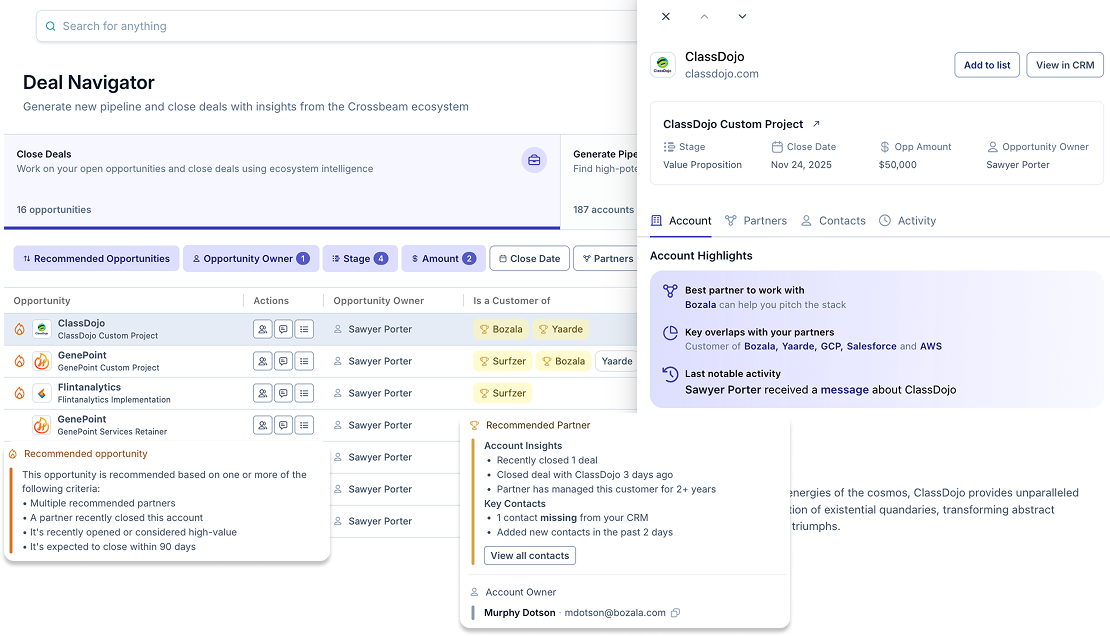
AI actions:
- Re‑score the opportunity and update stage probabilities by factoring ecosystem presence and momentum
- Improve forecast accuracy with expected time‑to‑close and fit estimates derived from partner signals, propose multi‑threading paths by identifying likely stakeholders and roles observed in partner contexts (without waiting on partner actions)
- Generate partner‑aware talk tracks for the buying center
- Open and sequence tasks and write back rationale to CRM for transparency
Protect customers and expand intelligently
Signals:
- Your customer shows early health risk or renewal approaching while the partner’s CRM records expansion or closed‑won at the same logo, or a new opportunity that touches an adjacent product line. Crossbeam context confirms the partner’s installed base aligns with your ICP and that their presence at similar customers has driven expansion lift.
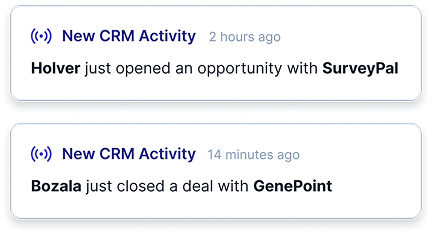
AI actions:
- Prioritize save/expansion motions based on partner momentum at the account
- Tailor offers and messaging to the installed‑base context
- Surface concrete cross‑sell candidates that mirror the partner’s footprint
- Adjust health scores and renewal risk
- Create CSM/RevOps tasks and timelines automatically
- Record expected expansion likelihood and forecast impact
Outcomes for all three: Fewer cold starts, smarter prioritization, and measurable lift where partners matter most. All delivered by AI that monitors signals continuously and acts without rigid, hand‑coded rules.
Step 4: Make signals explainable (or they won’t be used)
Every signal should ship with:
- Evidence: Which partner event fired, and when
- Reasoning: The historical pattern (“Deals with this partner closed 17% faster here”)
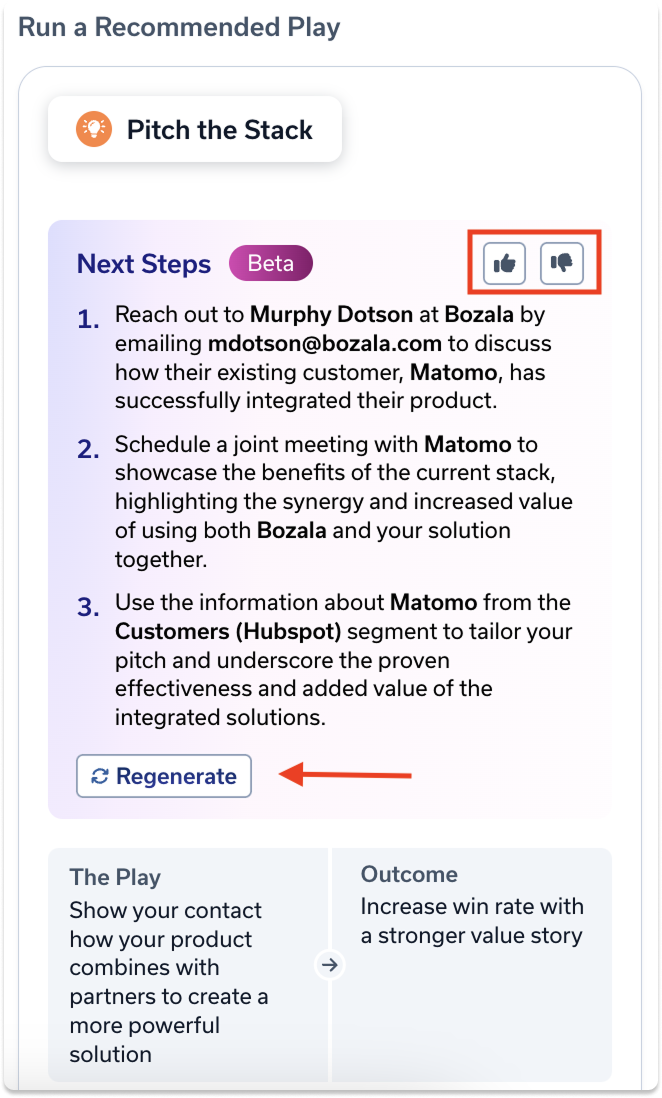
- Next best action: Intro, add partner to opp team, launch a co-sell step, etc.
- Owner + SLA: So nothing dies in Slack, Teams, or task lists
Outcome: Trust. And trust is what turns signals into action.
Step 5: Close the loop and finetune
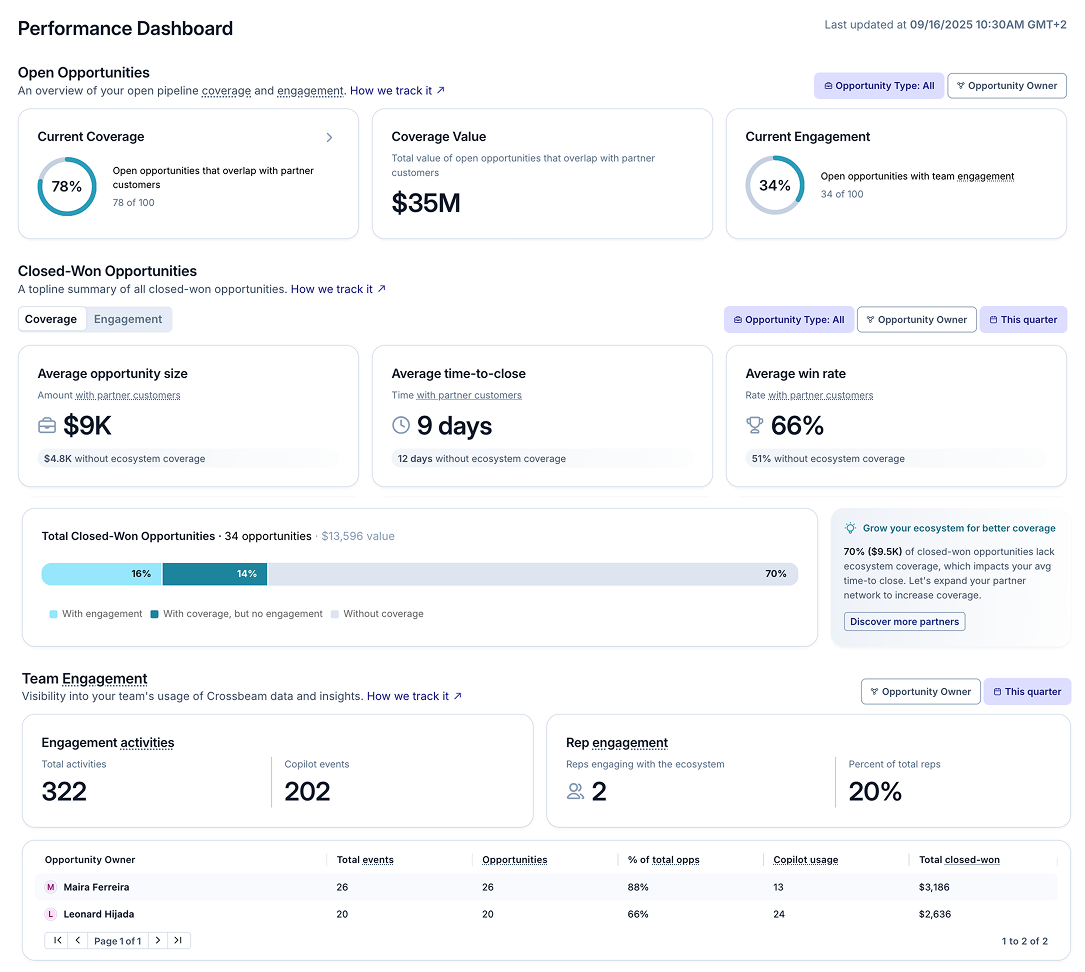
Use Crossbeam’s Performance Dashboard as the brain center to see how ecosystem context and AI‑driven signals are impacting pipeline, deal velocity, win rates, and ROI — centralized and tied back to the exact accounts and opportunities.
- Attribute and track Ecosystem-Qualified Leads and partner-assisted stages through to Closed Won.
- Measure lift (win rate, ASP, cycle time) versus baselines and feed outcomes back to your prioritization logic.
- Prune ruthlessly to cut noisy signals, raise thresholds, and re-weight partners based on observed impact.
Outcome: A compounding system where signals get sharper and ROI grows quarter over quarter.
Why this playbook works
Most AI GTM projects stall because they’re starved for credible, differentiating context. First-party data tells your side of the story. Second-party partner data tells what’s happening in the rest of the buyer’s world. Crossbeam does the hard operational work, from secure aggregation and matching to change detection and signal generation, so both humans and AI can act with confidence.
This isn’t a one-off pilot, it’s the new operating system for go‑to‑market. As you add more partners, more second‑party context, and finetune your AI, the flywheel gets better, faster, stronger: signals get richer, prioritization sharper, forecasts steadier, and outcomes bigger. If you’ve spun up siloed AI copilots and felt underwhelmed, this is why. Without Crossbeam’s partner data, they’re guessing. Plug Crossbeam’s partner data into your stack and your AI GTM is fixed for good.
Ready to see AI that actually moves revenue?
Book an ELG Strategy call and experience how Crossbeam’s ecosystem-powered AI delivers smarter signals, faster cycles, and bigger wins.