


Partnerships 101: What Is Co-Selling?


Co-selling is when two sales teams from two partner companies join forces and resources to convert prospective and/or existing customers. It is the act of empowering your salespeople with more data, resources, introductions, and contacts to help them close more deals, faster.

Co-selling is when two sales teams from two partner companies join forces and resources to convert prospective and/or existing customers. It is the act of empowering your salespeople with more data, resources, introductions, and contacts to help them close more deals, faster. Or as we like to call it, the “alley-oop”. Co-selling gives your sales team the opportunity to provide prospective clients with increased confidence and protection — all through the power of your partner.

Caption:
Much like Han Solo enlisted the help of Chewbacca to restore freedom to the galaxy (apologies for the spoilers), teaming up with your partner’s sales team can help you restore your sales targets. Unless, of course, your partner’s sales team consists solely of Chewbacca. In that case, best to leave him on the sidelines.
An increasing number of companies are leaning on co-selling strategies. Our 2021 State of the Partner Ecosystem Report found that twice as many companies are using co-selling tactics (71%) than are using PRMs (35%) — an increase from 62% in 2020. And co-selling increased by nine percentage points from 2020 to 2021.
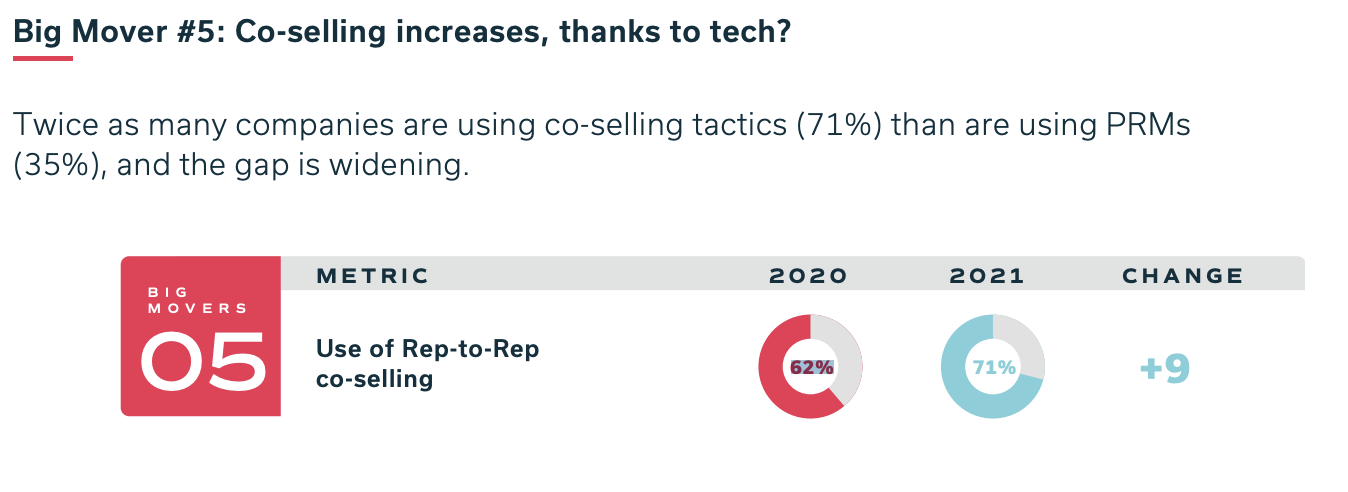
Co-selling is on the rise because, well, it’s easier than in the past. Real-time account mapping has eliminated the need for tedious hours of data entry and spreadsheet analysis, and made it possible to tap into your partner’s resources and co-sell together. These relationship-centric strategies can help businesses:
If the concept of co-selling is still fuzzy, this episode of Crossbeam Explains breaks it down in 90 seconds:
How modern co-selling happens
The first step of co-selling requires you and a partner to map accounts.
Account mapping involves taking a list of your customers or potential customers (“target accounts”) and cross-referencing (“mapping”) it against a partner’s list of existing or potential customers. When overlaps occur, each partner can choose how much data they want to share about each account, (ie., the sales manager or account rep in charge of the account). In other words, with second-party partner data augmenting your data, you’ve now got the golden ticket to accelerate an existing deal or find a brand new pipeline.
As part of account mapping, you and your partner must choose which lists (or as we call them, “populations”) they want to compare. Typical populations include:
Customers – The people who are actively paying for your product
Opportunities – Potential customers who are in an active deal conversation
Prospects – Potential customers who are not yet participating in any active sales process
Historically, this was done with each side bringing spreadsheets full of these populations. Then, someone would take days to manually find common contacts (or “overlaps”) in both. With the help of a Partner Ecosystem Platform (PEP), however, you can skip the spreadsheets and get to the good stuff faster.
Once you’ve completed the account mapping exercise, you can take a look at your overlaps. Depending on where the overlaps occur, you can determine the co-selling tactics that work best for you. For example, if you have a high number of overlaps between your customers and their opportunities, a common next step would be the “warm introduction” (see co-selling tactic #1).

After completing your account mapping, there are typically two next steps:
Co-selling tactic #1: The warm introduction
The play: If you look back at the account mapping matrix, several of the intersects result in a “get” or “give” warm introductions action:
- Your customers overlap with your partner’s opportunities
- Your opportunities overlap with your partner’s customers
- Your prospects overlap with your partner’s customers
- Your customers overlap with your partner’s prospects

In this scenario, your partner gives you a warm introduction to a prospect/opportunity that they have a connection to (their customer) or vice versa.
Example: Austin Park, Enterprise Account Executive at Botify, an SEO tool for marketers, shares how after attempting cold outreach with a prospect for an extended period of time, Park connected with one of Botify’s partners. It turns out Park’s prospect was his partner’s customer, and that partner was able to give him a direct line to the chief marketing officer.
“All of a sudden, I went from being frustrated and not being able to break into this account to being able to go straight to the top through this partnership we had,” he said.
A vocabulary note: when a partner helps you sell into another department of an existing customer (or vice versa), this is often referred to as “cross-selling”.
Co-selling tactic #2: The team-up
The play: Take another look at the account mapping matrix and scope out any overlaps that result in a “co-selling” or “solution selling” motion:
- Your opportunities overlap with your partner’s opportunities
- Your opportunities overlap with your partner’s prospects
- Your prospects overlap with your partner’s opportunities
- Your prospects overlap with your partner’s prospects
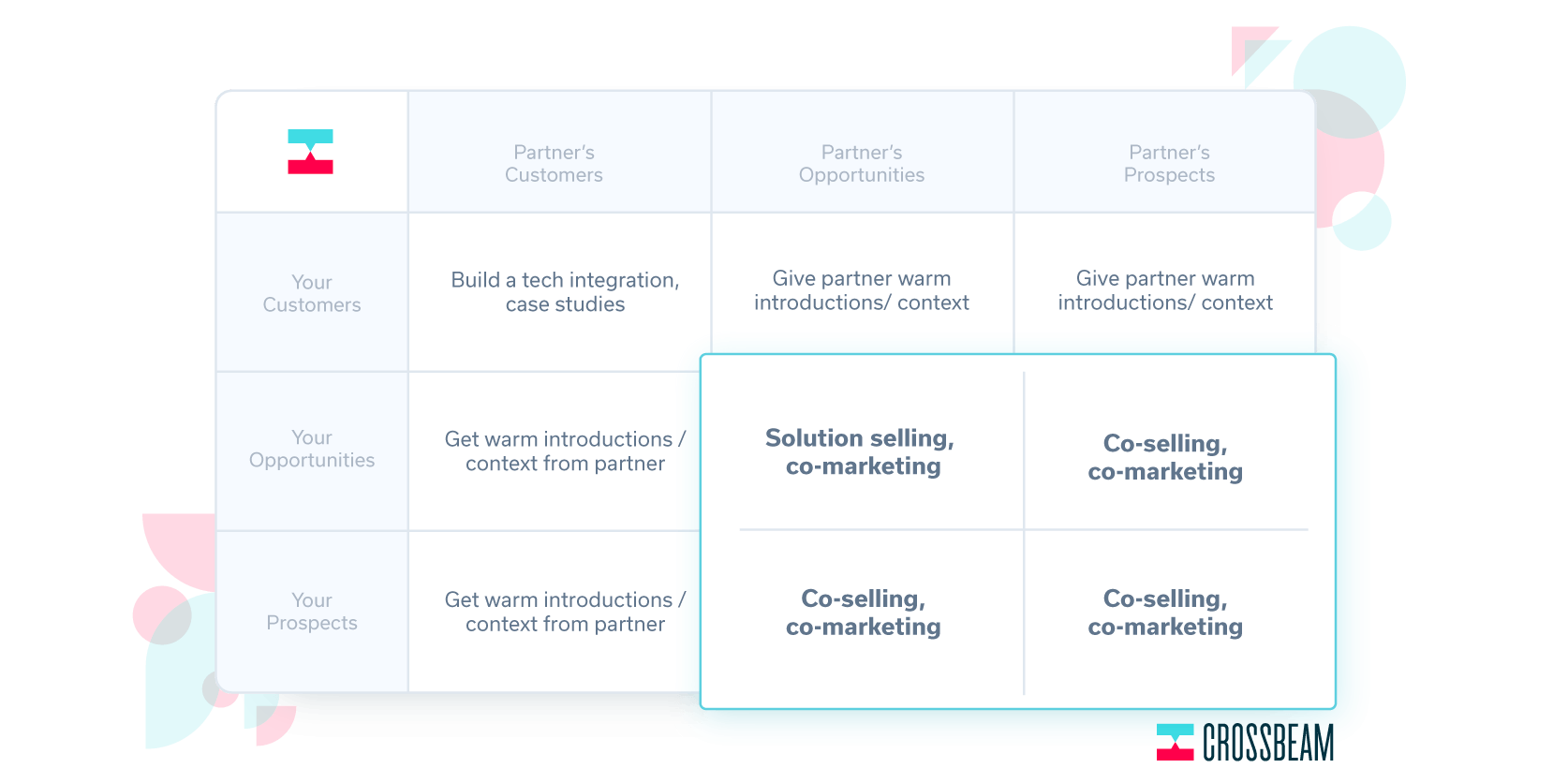
These account mapping intersections are opportunities for you and your partner to team up for a co-selling motion together, whether it’s closing an integration gap or pitching a joint offering.
Example: A sales rep at DigitalOcean, a cloud infrastructure provider, was selling cloud services and decided to loop in an implementation partner (to conduct analysis and show the benefits of the migration) and a tech partner (to satisfy a custom use case for the potential client). Bringing in the two partners gave the prospective client access to better service and better support — often called a “better together” story. The co-selling motion resulted in an increased deal size for DigitalOcean.
Whichever co-selling tactic applies, you can lean heavily on your partner’s intel to close. Consider asking your partners questions like:
- Which internal stakeholders are involved in the decision-making process at the account?
- What’s the company’s current tech stack, and how is it evolving?
- What is the budgeting process at the account?
- Does the key decision maker at the account have control over the budget and can they actually sign the contract?
Even finding out which sports teams an internal stakeholder roots for can make all the difference in adding that extra level of personalization.
Tips for building a successful co-selling strategy
Tip 1: Find the right partner fit
While your account mapping exercise might have yielded a high number of partners for co-selling possibilities, early-stage vetting can make the difference between high-quality leads and wasted time for your sales team. Here’s a four-criteria vetting process you can implement to decide which partners you should focus on for your co-selling.
Tip 2: Get your sales team on board

According to our 2021 State of the Partner Ecosystem Report, managing the sales team’s execution of partner team strategies remains a challenge for businesses. To get your sales team on board, consider adopting an incentives program tied to partnerships-focused objectives and key results (OKRs). Other incentive options include sales program incentive funds (SPIFs) or management by objectives (MBO) bonuses.
You can also incentivize your sales team to meet with your partner’s sales team — a successful tactic employed by CM Group’s Director of Partnerships Mike Barnes and Hawke Media’s Vice President of Partnerships Ashley Scorpio.
Tip 3: Get your partner’s team on board
Getting your sales team on board is only one half of the equation. The other half requires participation from your partner’s account managers (AMs). Again, an incentive program is helpful here.
Hatch, a sales tool for easy follow-ups, saw success when its partner team created an easy-to-roll-out incentive program: their partner’s AMs get $50 if one of their clients takes a demo with Hatch. They get another $250 if the deal closes. The incentive program resulted in a 70% close rate, compared to 46% with quick form-fill digital referrals.
Tip 4: Ask your partner the right questions
Time is a precious resource. Make the most of everyone’s time by enlisting your sales team with these 15 questions that accelerate co-selling. Answers to these questions can help you position your product competitively and get a leg up on the sales pitch.
Tip 5: Track your co-selling KPIs/OKRs
According to the 2021 State of the Partner Ecosystem Report, getting the proper attribution for partnership-driven revenue is a common challenge for partnerships professionals. You can’t evaluate the success of a co-selling program without knowing which metrics to track, and the earlier you set up a partner attribution tracking model, the better.
Here are co-selling KPIs/OKRs your team should track:
- The number of calls your sales team has with partners
- The number of partner-influenced and/or partner-sourced deals your sales team closes with a partner
- The amount of partner-sourced revenue your sales team is responsible for
- The amount of opportunities qualified by partners
- The amount of deals your sales team supported partners in closing
Unsure of the difference between partner-influenced and partner-sourced deals? Here’s a breakdown:
Partner-sourced revenue is direct revenue from a partner. For example: your partner thinks their customer would benefit from your product, and gives a warm introduction to your sales team. In this scenario, your partner is responsible for sourcing the deal if it closes.
Partner-influenced revenue is indirect revenue from one or any number of partners. For example: your partner gives your sales team critical information about the decision-maker at a prospect account. Your sales team is able to establish direct contact to the decision-maker, which ultimately leads to a demo that closes the deal. The revenue from that close is partner-influenced.


