Partnerships 101: ISVs, VARs, SIs, MSPs, and the Glue that Holds them Together
Partnerships 101: What is Cross-Selling?
Partnerships 101: Strategic Alliances Explained (Finally!) Plus Examples
Don’t Fall Behind: Get Your Partner Data in Your Data Warehouse (Part 1 of 2)
What Partner Ecosystem Maturity is and Why it Matters
The nearbound.com manifesto: Trust is the new data
How RingCentral Built an Internal Culture of Partnerships
It’s Happening! Crossbeam and Reveal are Joining Forces to Disrupt Go-to-Market Strategy as We Know It.
Just Because It’s Partnership Tech Doesn’t Mean It’s a PRM
The Beginner’s Guide to SaaS Tech Partnerships
Everything You Ever Wanted to Know About Channel Partnerships
Nearbound Podcast #051: Day Zero Mentality - How Rob Brewster Went from Partner Chief to Company Chief
Navigating Partnership Ecosystems: Channel, Tech, and Strategic
Partnerships 101: What Is a System Integrator (SI), and Should You Partner With One?
How to Build Your Agency Partner’s Reputation While Protecting Your Own
2022 State of the Partner Ecosystem Report
Nearbound Podcast #048: The Fear & Greed Index - Right Now Every Partner Pro Needs to Stand Tall
25 Articles Showing the Business Impact of Partnerships (Bring These to Your CEO)
The Case for a Co-Marketing-First Approach
Growing Your Partnerships Team? Here are 3 Skills You Should Look for in Your New Hires
Does Partnerships Have a Boredom Problem?
A 5-Step Guide for Scoping and Qualifying Your First Tech Partners
Secrets to Building a High-Impact Partner Program
How to Ensure Accurate Ecosystem Data
A recommended ecosystem AI strategy: Take an integrated rather than a top-down approach
A Primer: 3 Things to Lookout for as a Partnership Leader
Your Guide to Preparing for Your Next Partner Pitch Meeting
How to Launch a Strategic Partner Program (And Not Take Forever to Deliver Value)
How to Guide: Partnership Alignment with Internal Stakeholders
How to measure and attribute nearbound impact
Balancing AI, automation, and the human touch in partner management in 2024
Tech Ecosystem Maturity: Scaling Your Integration Program Via Your API
The Inside Track: How to Accelerate Crossbeam Onboarding for Your Partners
Tech Ecosystem Maturity: 4 Ways Most Partner Programs Fall Short
You Have Dormant Partners. Here’s How to Get Their Interest
How to nail co-marketing events in 2024 with nearbound
How to Gain Internal Buy-in to Build New Integrations | Connector Summit 2022
Track Churn and You’re 3.6x More Likely to Have Dedicated Budget for Integrations
The State of the Partner Ecosystem 2022 Webinar
Crossbeam Explains: What are System Integrators?
The Awkward Dance: Should You or Your Partner Build the Integration?
Building the Flywheel Starts with Your Partners
Remote, In-Office, or Hybrid? Where Partnership Professionals Worked in 2021
Four Signs it’s Time to Expand Your API Docs
7 Tips for Co-Selling Like a Supernode
Nearbound Podcast #039: Dancing with Elephants — The Art of Strategic Partnering
Tech Ecosystem Maturity: How to Level Up Your Co-Marketing Motions
20+ Interview Questions for Hiring Your First Tech Partner Manager
3 Reasons to Get Certified in Your Partners’ Tech and Become Indispensable to Your Team
Tech Ecosystem Maturity: How to Level Up Your “Better Together” Messaging
Partner Ecosystems 101
Dave Goldstein: Ecosystem-Led Sales for the Enterprise: How Braze Leveraged Alliances to Fuel Robust Growth | Supernode 2023
8 Times a Partnership Impacted an “Exit Event” (And Why Acquisitions are on The Rise)
5 Signs Your Tech Partner's About to Get Acquired (And How to Prepare for Change)
Tech Ecosystem Maturity: How to Level Up Your Integrations Team
The Inside Track: Crossbeam Security 101 with CISO Chris Castaldo
Six Tips for Expanding Internationally Using Channel Partners
10 steps to develop a co-marketing strategy
How Typeform Went from 30 Integrations to 100+ in Just One Year
How Typeform Improved Their Revenue by 40% with ELG and PLG
Partnerships 101: What Is Co-Selling?
Partnerships 101: Inbound vs Outbound Integrations and Why They Matter for Your Partnerships
How to Communicate Effectively With Your Entire GTM Team and The C-Suite
Partnerships 101: What Is an Ecosystem and How Is It Redefining Partnerships?
The Inside Track: Get to know the Crossbeam Salesforce App
The 7 Metrics That Prove the Business Impact of Your Tech Integrations
8 Times Sales Reps Won the Deal by Co-Selling With Partners
6 Ways Sales Professionals Can Use Partnerships to Advance Their Careers (and Get Promoted)
How Co-Selling & Co-Marketing Build Revenue
How Demandbase Acquired DemandMatrix in Seven Months After Launching a Partnership
The Intersection of Partnerships and Product Development with Pandium’s Cristina Flaschen
The 4 Levels of Tech Ecosystem Maturity
8 Tips for Surfacing the Business Impact of Partnerships and Driving Partner-Sourced Revenue Earlier
Tech Ecosystem Maturity: How to Level Up Your Co-selling Workflows
Despite The Economy, Gartner Projects Double-Digit Growth As Companies Find Ways to Do More with Less
The 5 Things to Do in Your First 90 Days as a Partnership Leader
Ecosystem is Everything: How to Embrace Second Party Data with Crossbeam
Vetting 100s of Channel Partners? Use This Four-Criteria Checklist to Speed Up the Process
8 Ways to Treat Your Co-Selling Partners With R-E-S-P-E-C-T
Nearbound Podcast #026: Building Trust in Channel Partnerships
Partnership KPIs For Marketing, Sales, Customer Success + More
No More Silos: 4 New Ways to Use Partner Data
Account mapping. How to (finally) do it without giant, cumbersome spreadsheets
15+ Questions to Help Your Sales Reps Master Their Co-Selling Motions
How We Foster Collaboration Remotely at Crossbeam
21 Partnerships People You Should Follow on LinkedIn
A Fill-in-the-Blanks Exercise for Evaluating Your Partner Program
How to Use CRM Data & Automation to Nurture Your Co-Selling Relationships
How to Use Partner Data In Your Sales and Marketing Dashboards (Part 2 of 2)
How CallRail Increased Integration Adoption by 167% Through Strategic Partnership with HubSpot and Reveal
3-step strategy for partnership managers
How to Execute an Effective Nearbound Channel Strategy
Don't Try To Fit Ecosystem Partners into a Channel Hole
Nearbound Podcast #022: Build, Buy, or Partner
You Should be Account Mapping at Every Stage of the Customer Lifecycle
5 Ways to Incentivize Your Sales Team to Live, Eat, and Breathe Partnerships
How to Learn the Partnerships Love Languages
How to Learn Your Customer’s Tech Stack and Increase Integration Adoption by 17%
The 9-Step Partner Impact Score Methodology for Strategic Co-Selling With Partners
Catherine Brodigan: Effective Co-Selling* (*because you have no other choice) | Supernode 2023
ELG Channel

From Pitch to Program: Winning Internal Buy-In for Channel Success

by
Jared Smith
SHARE THIS

Ready to launch your reseller partner program but struggling to get your leadership on board? Read on to get the 4 tactical steps for securing buy in from your C-suite.

by
Jared Smith
SHARE THIS

In this article

Join the movement

Subscribe to ELG Insider to get the latest content delivered to your inbox weekly.

Before you can launch a successful channel reseller program, you need one crucial thing: buy-in.

This is not just a polite nod from your leadership team, but true commitment from your C-suite, your sales leaders, and your key internal stakeholders. It can sound intimidating, but don’t worry, we’ll walk you through it.

Getting buy-in is more than just pitching a good idea; it’s about presenting a solid business case that proves why investing time, resources, and trust into a reseller channel is the right move now. You’ll learn from Jared Smith, former Senior Director of Vendor Strategy and Acquisition at Pax8 and current Co-Founder at RampFuel, how to frame the opportunity in a way that resonates with executives and creates real momentum.

Let’s begin. 

Building your business case: The MVP of partnerships

A well-executed reseller program can transform your market reach, accelerate growth, and reduce CAC. But the biggest advantage? Access to a network you wouldn’t be able to reach otherwise.

For example, Software Vendors (SVs) that join Pax8’s reseller ecosystem gain exposure to hundreds of thousands of SMB customers, significantly reducing sales and marketing costs while increasing distribution efficiency.

However, before launching a reseller program, you need to sell the vision internally, especially if leadership or other departments are unfamiliar with the economics and strategic value of reseller partnerships.

Jared has honed the art of partner selection and business case development. With over 40k partners in Pax8’s ecosystem and 500 to 600 new ones joining monthly, Jared’s insights will help you cut through the noise and build reseller partnerships that actually move the needle. 

[Highlight as quote format: Thanks to Pax8’s network of resellers, the appropriate vetting process, and the use of ecosystem data to deploy a strategic vetting and go-to-market strategy, the SVs that belong to the Pax8 ecosystem reduced their sales cycle from six months to six weeks — an almost 75% decrease.] 

Demonstrating ROI to gain internal buy-in

If you’re pitching a reseller program to executives or stakeholders, here’s what Jared advises you to focus on to drive decision-making:

1. Customer Acquisition Cost (CAC) reduction

Acquiring customers through direct sales and marketing is expensive. According to HubSpot, B2B companies spend an average of $536 to acquire a new customer, and, more broadly, SaaS companies often spend $239 per customer.

How a reseller program helps:

  • Shifts CAC burden to partners who already have established customer relationships
  • Leverages existing trust and networks, shortening sales cycles, just like Pax8 SVs, who went from a six months sales cycle to six weeks.
  • Reduces marketing spend — resellers drive awareness at a lower cost

For example, when Brad Coffey was the Chief of Strategy Office at HubSpot, they had a LTV:CAC ratio of five selling through the channel, versus a LTV:CAC ratio of 1.5 selling direct.

2. Revenue expansion opportunities

Reseller partnerships create new revenue streams while expanding into untapped markets.

How a reseller program helps:

  • Co-selling and referrals: Resellers can sell complementary products, creating bundled solutions.
  • Faster market penetration: Local or vertical-focused resellers can unlock new geographies or industries.
  • Cross-sell and upsell potential: Use Crossbeam to identify and quantify potential overlapping customers and new revenue opportunities.
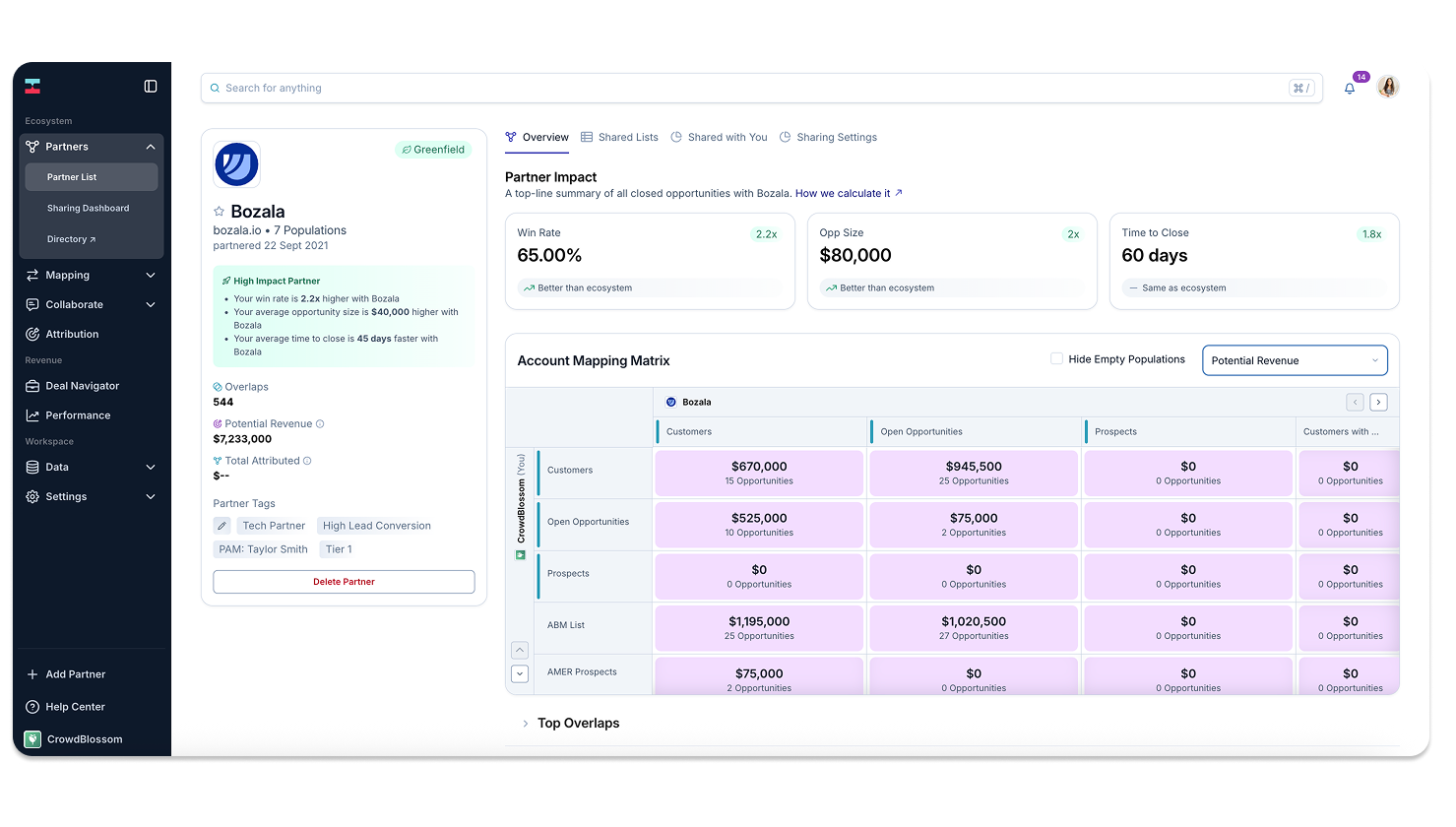
Potential Revenue view in Crossbeam

Distributors and resellers typically drive 70% or more of a tech vendor’s revenue. Additionally, Canalys predicts that by next year, 30% of cloud marketplace sales will flow through channel partners. They’ve since updated that estimate to 50% by 2027

Example: If 15% of a reseller’s existing customers are also a great fit for your product, you now have a direct pipeline to warm leads.

3. Ease of doing business

Resellers won’t push your product if the pricing model, training, or onboarding is too complex. Here’s how a reseller program helps:

  • Simplifies procurement: Partners prefer products that fit into existing billing models.
  • Shortens training and onboarding: A frictionless start means faster sales.
  • Supports partner success: Providing co-marketing funds, MDFs (Market Development Funds), and easy-to-access deal registration increases reseller engagement.

Resellers favor SVs that offer transparent margins, deal protection, and low-friction enablement.

4. Competitive parity and industry benchmarking

Stakeholders will ask: Are our competitors doing this?”

If competitors already have reseller programs, you risk losing mindshare by not participating. If they don’t, you can gain an early-mover advantage and dominate reseller ecosystems. Over 70% of B2B technology sales now involve indirect channels, according to Forrester Research.

Who should be in the room?

The right audience for your pitch depends on your company’s size and decision-making structure:

  • Startups: The CEO, Founder, or Head of Growth will likely have the final say.
  • Mid-sized companies: The VP of Strategic Partnerships, Alliances, or Sales will be the primary stakeholder.
  • Enterprises: Gaining buy-in from the Chief Revenue Officer (CRO), Channel Chief, Chief Partnership Officer (CPO) or Partnerships Lead is essential.

Each role has different priorities when evaluating a reseller program:

  • Executives (CEO, CRO): Focus on the revenue impact, strategic alignment, and scalability.
  • Sales leadership: Concerned about potential channel conflict and how the partnership will affect existing sales teams.
  • Marketing teams: Need clarity on co-marketing efforts, branding consistency, and lead attribution.
  • Finance teams: Require proof of return on investment (ROI), cost structure, and profitability projections.

Set the foundation before you scale

Building a reseller program doesn’t start with recruiting partners, it starts in your own boardroom. Without internal buy-in, even the best reseller strategy will stall. But when leadership understands the potential for CAC reduction, accelerated sales cycles, and untapped revenue, they won’t just approve the plan, they’ll champion it.

Pitching your business case might be complicated, but once you’ve done that, you’re no longer pitching an idea. You’re leading a movement.

Want to build a reseller motion?

Download our free ebook, The Playbook for Winning with Channel Reseller Partners, to get step-by-step guidance, real-world case studies, and templates for building a high-impact reseller program from the ground up.

You’ll also be interested in these

The Anatomy of a Channel Reseller Program
What Is a Reseller Program? A Modern Guide for GTM Leaders
How Suppeco Built their Reseller Program with WeTransact, Crossbeam, and ELG