


When you’re held accountable for partner-sourced revenue, speed is your best friend — but you can’t optimize the timing of your next deal when you’re knee deep in spreadsheets. You need processes, workflows, and tools that allow you to move faster and cover as much ground as possible with your partners.
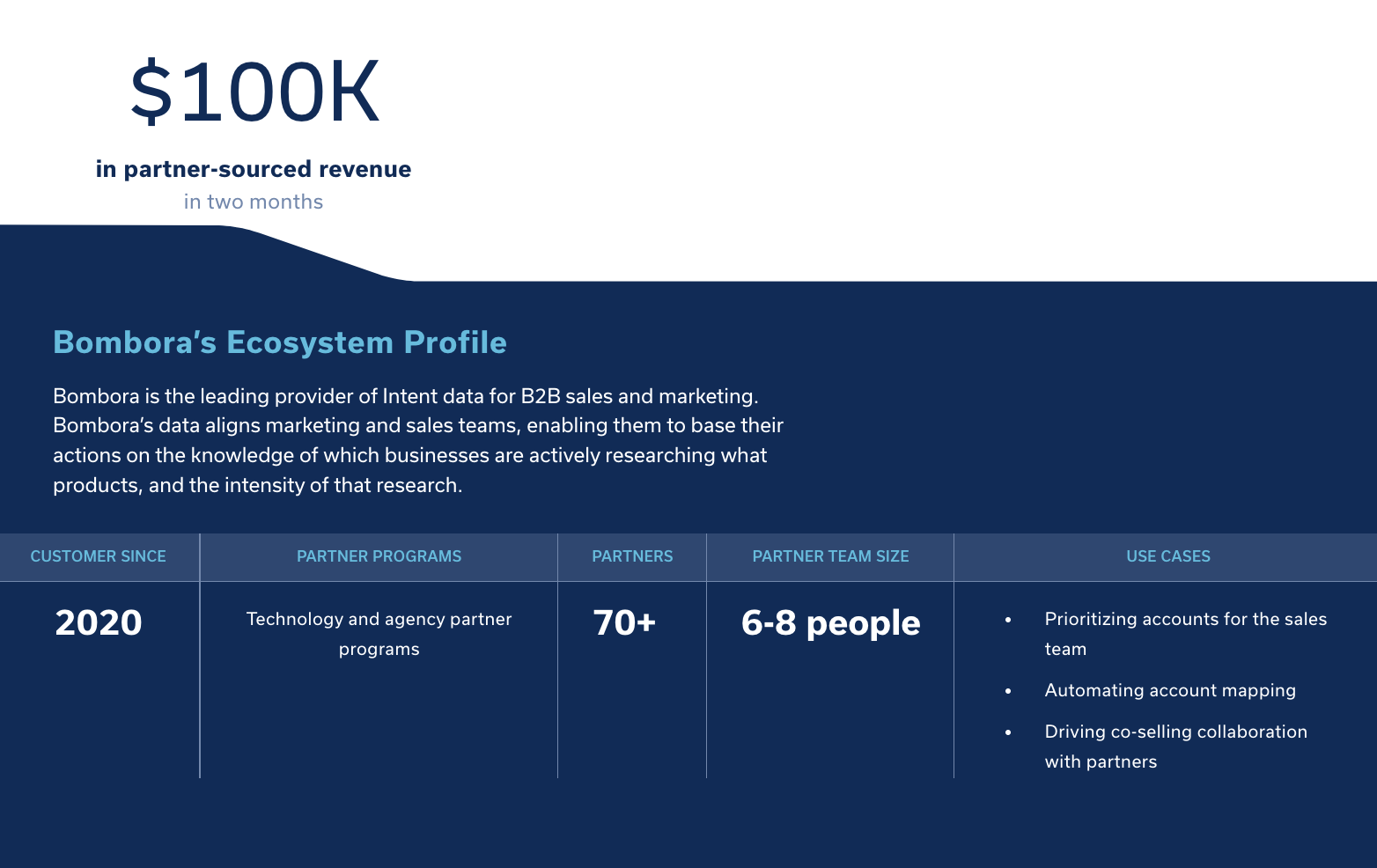
When Bombora’s partnership team saw an opportunity to work more efficiently with their channel partners, they adopted Crossbeam’s partner ecosystem platform. In just two months of using Crossbeam, Ryan Klekas, Director of Channel Partnerships at Bombora, a B2B intent data company, closed $100,000 worth of new business.

“What Crossbeam does really well is it allows you to see and organize real-time data against your partners quickly. This increases the probability you’re going to recognize deals you may not have otherwise noticed in a more manual workflow like [using] spreadsheets,” says Klekas.
“We’re running and gunning now, and it’s a lot faster without these 10,000 pound jackets on which are spreadsheets,” he says.
In this case study, you’ll get an inside look at how Bombora works with its channel partners and learn the exact internal workflows and co-selling processes Ryan Klekas used to drive six-figure-revenue numbers in just two months.
1. Get set up
To get started on Crossbeam, Klekas followed these three steps:
- Step 1: He connected Bombora’s Salesforce CRM to Crossbeam as a data source
- Step 2: He created populations (groups of peoples or companies) like Bombora’s customers or prospects that fit Bombora’s ideal customer profile.
- Step 3: Klekas defined what information he was willing to share about Bombora’s respective populations. He could choose to share the overlap count (the number of accounts Bombora has in common with a partner) or specific data fields like the account name and Bombora’s assigned account executive’s contact information.
From there, Klekas connected with other channel and integration (platforms that have a portion of Bombora intent data natively embedded) partners on Crossbeam, requested those partners to share data about their respective populations, and invited them to do real-time account mapping.
“You’ve just removed a layer of annoyance for them in terms of making it more manageable for them to upload the same data. They were going to upload with me anyways [by sharing spreadsheets], but at least there’s no longer that step of having to go in and remove all the things that they didn’t want me to see,” says Klekas.
“Before I had to go into multiple accounts on spreadsheets, I wasn’t sure how fresh the data was and it was just a pain. Now, I run a report. I know [the data] is fresh. And boom — I have the accounts that I can focus on and I know exactly what I’m going to do with my time,” he says.
2. Build real-time reports to spot joint opportunities
Today, Klekas and his partners build different reports to compare their populations in real time and determine which partnership motions to run. Including:
- Bombora’s customers + partner’s customers (to evaluate new partners and determine if a partnership discussion is worth exploring or to strategize upselling or cross-selling motions).
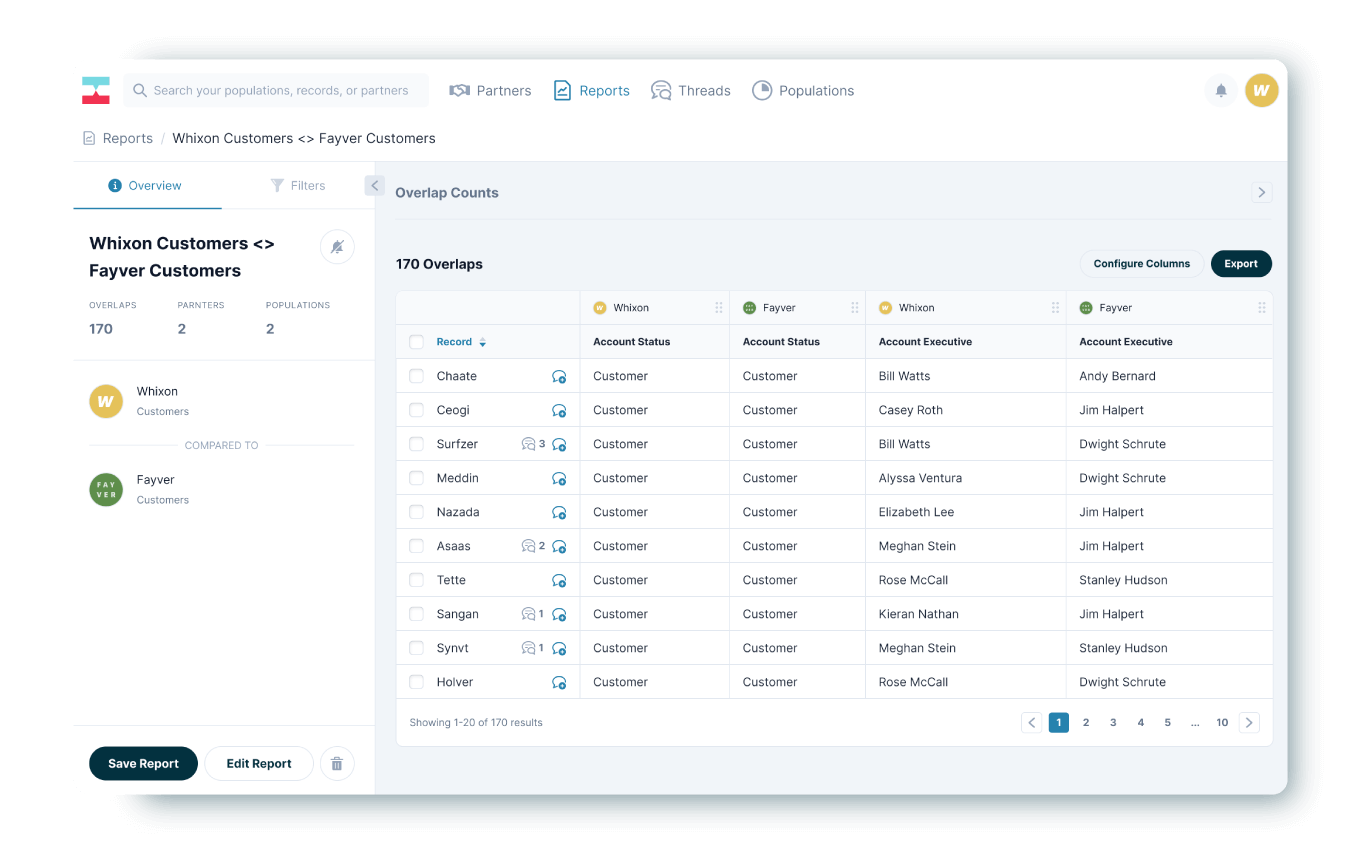
- Bombora’s customers + partner’s opportunities (to determine ways Bombora can influence its partner’s existing deals or vice versa if comparing the partner’s customers with Bombora’s opportunities).
- Bombora’s opportunities + partner’s opportunities (to craft joint offerings or discuss co-marketing motions).
- Bombora’s prospects + partner’s customers (to brainstorm co-selling strategies or find opportunities to get warm intros into specific accounts).
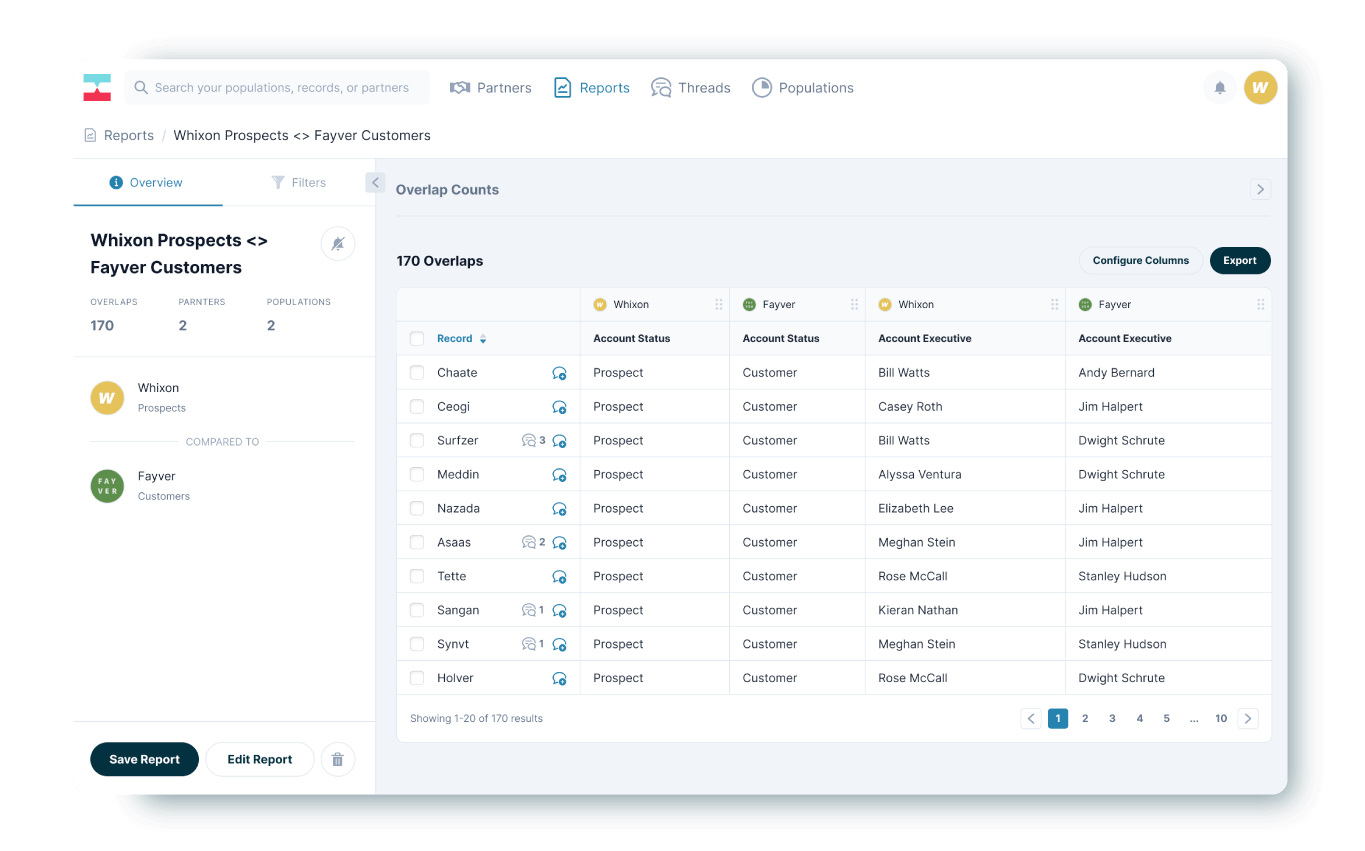
Klekas regularly reviews Crossbeam reports during his partner check-ins and can rest assured knowing the information is up-to-date. “Being able to very clearly see a partner’s customers that overlap with our ideal customer profile list is very important. And in Crossbeam, it’s really simple,” says Klekas.
He uses that overlap data to engage Bombora’s sales team and help them break into strategic accounts — accounts the sales team would otherwise be pursuing through cold outreach.
“When I can show a specific account executive the opps under their name vs. a generalized list that applies to the entire team, it better sets them up for success,” he says.
3. Infuse Crossbeam reports with B2B intent data to prioritize accounts for your sales team
Klekas also shares these reports with his sales team. He’ll filter each report according to the Bombora account executive’s name and then export it to a CSV file.
Then he puts one finishing touch on the reports before handing them to his sales team: He adds Bombora’s B2B intent data (information about a buyer’s online behaviors, like what content they’re reading or the terms or topics they’re researching) for each account.
With the final reports in hand, Bombora’s sales team can glean the following information:
- Which of their assigned accounts are a customer, open opportunity, or lead of Bombora’s partners
- Account information like the account name and the account website
- The account executive’s contact information at the partner’s organization
- Whether or not the account is showing intent based on topics that Bombora is tracking and how much “intent” or interest those accounts are showing in Bombora’s solutions. Some relevant topics for Bombora include “intent data”, “B2B sales”, or “marketing”.
This information helps Bombora’s account executives not only prioritize their accounts, but it also allows them to contextualize their conversations with prospects. Rather than reaching out to prospects completely cold, the Bombora account executive can leverage its partner for a warm intro and lean on Bombora’s intent data to craft a more targeted message.
4. Create a simple co-selling process
From a channel perspective, Bombora makes money two ways:
- Indirect revenue: Some of Bombora’s integration partners embed a limited amount of Bombora’s intent data as a free or paid feature in their platforms. (Think: an account-based marketing or “ABM” platform including intent data as part of its value proposition for customers running targeted marketing campaigns.) When a customer signs up with an integration partner, it opens the door to future direct revenue opportunities for Bombora.
- Direct revenue: After recognizing the value of Bombora in its integration partner platforms, those customers may purchase additional intent data directly from Bombora and use the data with Bombora’s other integration partners. For example, a customer using Bombora’s integration with an ABM platform might want to purchase more intent data or use the data within the customer’s sales intelligence platform.
In many ways, Bombora’s partners serve as a lead generation “channel” for Bombora to drive direct revenue — and that’s what Klekas is held accountable for.
So when co-selling, Bombora follows this workflow:
- The Bombora partnership and sales teams meet weekly to discuss which partners Bombora’s prospects are already speaking with. Once a month during these meetings, Klekas will share updated Crossbeam reports with new accounts for the sales team to prioritize.
- Once Klekas knows which accounts a partner can help with, he’ll shoot a text to his counterpart at the partner’s org to fill them in and share context about the account and what kind of assistance he needs. (That’s right, he’s on a text-message basis with his partners).
- Depending on the account and what type of help the Bombora account executive needs, two things might happen:
- Either the partner will provide Klekas with specific account intel (think: information about decision-makers or insight into the purchasing process at the account) and Klekas will pass it on to the Bombora account executive.
- Or, if there’s a co-selling opportunity, Klekas will coordinate a call to connect Bombora’s account executive with the partner’s account executive to dive deeper into the account and discuss joint sales strategies.
By running this co-selling process with its partners, Klekas generated $100,000 of direct revenue in two months.
5. Provide customer success reps with partner data
Using Crossbeam for Slack, Klekas also arms Bombora’s customer success teams with partner data.
Before using Crossbeam, Bombora’s customer success reps didn’t know which of Bombora’s partners were already part of a client’s tech stack and because of this, they were missing out on potential cross-sell opportunities. Now, using partner data from Crossbeam, Bombora’s customer success team gets more visibility into customers’ tech stacks and can make recommendations to help customers adopt Bombora’s intent data within other workflows and departments.
Klekas says, “[Customer success] might ask me, ‘Hey Ryan, is this client that I have working with any of our other partners by chance?”
Klekas can answer that question in seconds by using the “/crossbeam” command in Slack. He’ll search the specific account and instantly see which partners share the same account.

If he wants more details on the account, he can navigate to his Crossbeam dashboard directly from Slack. Klekas will share that information with the customer success rep in Slack.
“These are other ways [the customer] can think about using Bombora data because they are also customers of our other partners. They just might not know it because it’s another group within their organization” says Klekas.
The more technologies the customer can leverage Bombora’s data in, the more sticky Bombora becomes.
“Our CSMs and AEs love the fact that I’m bringing them real-time information on their assigned accounts,” says Klekas.
–
The most noticeable change Klekas has seen since adopting Crossbeam? He’s using his time more wisely.
“Rather than having to spend countless hours simply just updating data, an activity that hinders productivity, I can now just login in to Crossbeam and examine my reports knowing that everything is up-to-date and accurate. I get to skip the ‘wasting time part’ and jump directly into the ‘be productive’ part. That’s pretty huge,” say Klekas.
“Crossbeam literally emulates exactly what we’re trying to do,” he says. “There were just so many things that got in the way of being efficient with partners, but now, the conversations we have are around strategy and how to actually take action. It’s much more proactive versus reactive,” he says.


