


How Demandbase Acquired DemandMatrix in Seven Months After Launching a Partnership


For many tech companies, getting acquired is the dream. Let’s walk you through what the experience is like — from partnership to acquisition.

Salesforce to Acquire Slack for $27.7 Billion.
Square Agrees to Acquire Afterpay for $29 Billion in All-Stock Deal.
Medallia to be Acquired by Thoma Bravo for $6.4 Billion.
These are the headlines CEOs dream of — and if you play your cards right, you could be most responsible for proving the value of your company to your future acquirer. Whew, those are some hefty career goals. But it’s all within reach.
We were curious about what it feels like to bring a partnership from its fledgling days of discovering joint solution use cases to signing a full-fledged acquisition deal. The kind that results in an “exit” event and the acceleration of business.
In May 2021, Demandbase acquired DemandMatrix and InsideView to develop its Data Cloud, part of Demandbase One — a complete B2B go-to-market solution (more on that soon).
The acquisition can trace its beginning to a partnership. We set out to uncover what it’s like to watch a nascent partnership suddenly accelerate into something much larger.
“We said, this deal is just step one in a longer term partnership,” says Asher Mathew, Vice-President Go-To-Market, Data Cloud, Technographics, Demandbase (previously VP, Revenue and Operations at DemandMatrix).
Below, Mathew shares what the acquisition experience was like from its beginnings to the present day.
The relationship between Demandbase and DemandMatrix unfolded in three phases::
- February 2020: The discovery phase
- November 2020: The official partnership
- May 2021: The acquisition
February 2020: The discovery phase
In February of 2020, Demandbase and DemandMatrix started an initial dialogue, which involved Demandbase exploring use cases for using DemandMatrix’s technographic data internally and for its customers.

In the beginning, Demandbase was a target customer and target partner account for DemandMatrix. A sales rep from DemandMatrix initiated a sales conversation with Demandbase’s team. That conversation enabled Demandbase and DemandMatrix’s partnerships teams to connect and discuss combining their data to help their mutual customers. From there, DemandMatrix’s and Demandbase’s product teams and CEOs aligned to enhance their joint solution.
“The partnerships team should chase partnerships where its sales team already has deals done,” says Mathew. ”If you and I are in a customer relationship, then teaching our sales teams to sell this data to our customers would be much easier because we both know and understand each other. This is especially true when one company is very big and the other is very small.
Why DemandMatrix was appealing to Demandbase
The solution
Mathew says the most valuable datastack for B2B SaaS companies should include four core datasets – firmographic, demographic, technographic, and intent data. Demandbase’s product already provided a solution for intent data. DemandMatrix appealed to Demandbase for its technographic data solution.
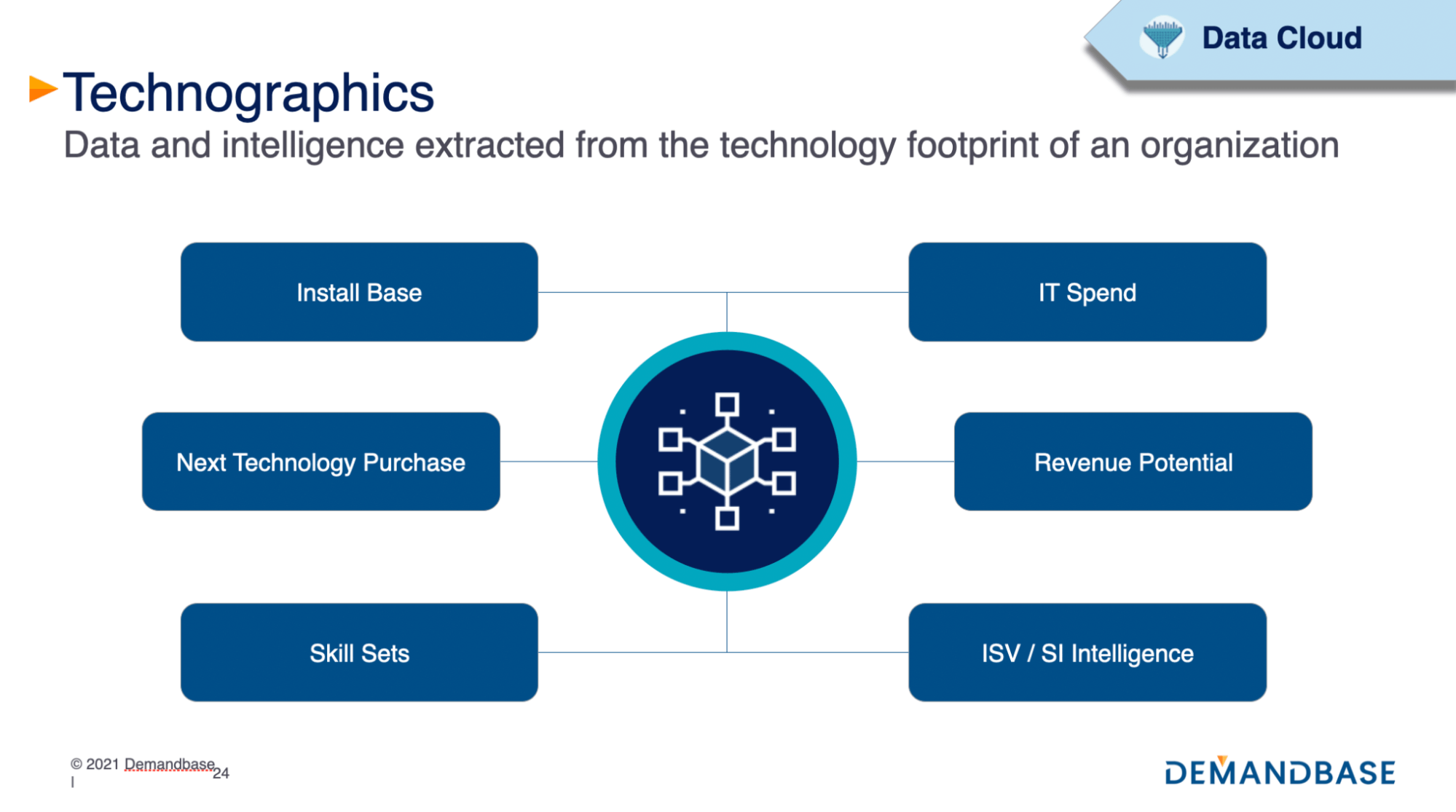
Technographic data reveals insights about a prospect’s tech stack. With this data, Demandbase can identify potential partners, see which competitors’ tools their prospects are using, and understand which prospects prefer best-in-breed tools (like theirs).
“Companies hire partnership leaders and say, ‘Hey, can you go tell me who the top five companies are that we should partner with?' And then the partner leader goes and looks at his rolodex and asks a bunch of people. But there’s a more data driven way of doing it if they use technographic data.”
Demandbase used DemandMatrix’s technographic data internally and then incorporated the data into its platform for customer usage.
In addition to DemandMatrix’s product appealing to Demandbase, the tech industry climate was also right leading up to the acquisition:
The climate
Demandbase and DemandMatrix began talks of a partnership in February 2020, just as the COVID-19 pandemic emerged in the US. While many businesses suffered revenue losses, the data industry became more essential as workers and consumers spent more time online.
In 2020, the first year that Mathew led revenue and operations at DemandMatrix, Mathew and his team doubled the company’s revenue and customers. DemandMatrix was a bootstrap company without any VC funding; yet, its business doubled in one year.
Additionally, in mid-2020, ZoomInfo announced its IPO (the first IPO in the tech industry since the COVID-19 pandemic began), Dun and Bradstreet announced its IPO, and the value of data continued rising.
“The market got extremely hot and the data partners started to look at the different types of data that they could consolidate and bring into their applications,” says Mathew. “And that’s how the transaction started.
November 2020: The official partnership
Just nine months after initiating the discovery phase, Demandbase and DemandMatrix formed an official partnership. This entailed using DemandMatrix’s technographic data in the Demandbase platform to allow customers to learn about their target accounts’ tech stacks. Customers could then use the data to score and segment their target accounts and develop a strategic outreach approach that accounts for the types of tools and skills the prospect has.
Demandbase and DemandMatrix initiated the beginning phases of their co-selling relationship by launching sales enablement sessions for Demandbase’s sales reps. The goal of the enablement sessions was to train the sales reps on how to help customers use DemandMatrix’s technographic data to learn about their prospects’ tech stacks.
The sales reps would use filters in Demandbase to select specific datasets relevant to their prospects. The enablement sessions helped their reps understand how to use the filters and surface technographic data for various use cases in the platform.
Meanwhile, the data market was growing. Qualtrics went public in January (two years after it was acquired by SAP), Matillion announced $100M in Series D funding in February, and DataGrail received $30M in series B funding in March. Mathew says the acquisition happened so fast that they just barely grazed the surface with their co-selling motions before DemandMatrix got acquired.
“Shortly before the acquisition, we knew there was a need in the market for better technographic data and believed it so strongly that we were going to go fundraise. Then we got acquired,” says Mathew. “Having hundreds of customers adopt our data following the acquisition is that same validation of our original hypothesis.”
Mathew attributes the growing tech climate to the speediness of the acquisition.
“All of this happened so fast that the success story is being built right now,” says Mathew. Following the acquisition, hundreds of users adopted DemandMatrix as an individual solution and now as an integrated solution.
Leading up to the day of the acquisition, Mathew and Demandbase’s CEO, Gabriel Rogol, needed to adjust their hats.
“When you’re a small company, you need to divide labor at the executive level. The CEO needs to be focused on getting the acquisition deal done while someone else is running the company."
While Rogol collaborated with the Demandbase team to devise a deal that would be mutually beneficial for each company, Mathew focused on ensuring Demandbase operated smoothly and achieved its business goals.
May 2021: The acquisition
In May 2021, just seven months after launching the official partnership, Demandbase acquired DemandMatrix and InsideView.
In the beginning months of the acquisition, Demandbase decided to keep the three companies and their solutions operating separately for three reasons:
- Keeping each solution separate gives customers the choice to buy each module separately or the whole suite of products in one go.
- Each solution influences stickiness in the market and can draw in unique customer bases without needing to purchase all three solutions at once.
- Each solution has built its own brand reputation that has influence in the market.
However, Demandbase learned that its customers wanted to engage with a single point of contact during the buying process and actually preferred purchasing the whole solution (including Demandbase, DemandMatrix, and InsideView) at once, rather than in pieces.
Three months into the acquisition, Demandbase integrated DemandMatrix and InsideView into its platform. The decision stemmed from one of Demandbase’s core values of customer success.

When Demandbase would acquire DemandMatrix, it would launch its Data Cloud with DemandMatrix’s technographic data. By acquiring InsideView, it would launch its Sales Intelligence Cloud. Additionally, it acquired Engagio, which filled in its ABX Cloud, and Demandbase already had its Advertising Cloud. Demandbase built its GTM suite through acquisitions.
Launching their co-selling motions post-acquisition
Demandbase and DemandMatrix are now leading training sessions to educate their sales reps about using DemandMatrix’s technographic data with Demandbase’s intent data in the new Data Cloud.
To enable sales reps on both sides, Demandbase and DemandMatrix are leading:
- Office Hours for sales reps, or deep dive Q&As where sales reps can ask about specific use cases, learn how to sell the technographic data to customers, and get a better understanding of who typically buys technographic data and how.

- Monthly training for sales reps, to discuss new use cases for technographic data and educate the sales reps on both sides.
- Trainings for the solutions consultants, led by Mathew and/or the data delivery team (think: those who parse data for customers and uncover insights on their behalf), which discussed new types of technographic data, the attributes customers care about, and how to package the data in a way that benefits the customer.
- They also developed their joint target plan, which entailed choosing specific accounts to target together and making a push to book the demo, confirm the sales meetings, and work on closing the deal. To keep their joint target plan on track, Mathew plans on hosting pipeline review calls, deal analysis, and other meetings with each team’s sales reps regularly.
—
Have you led a partner program to an acquisition or IPO?


