


How FullStory Increased Client Retention Using Ecosystem-Led Growth Tactics


Explore how FullStory improved its gross and net dollar retention by helping customers and prospects activate and adopt more integrations. Learn their three-step process for launching Ecosystem-Led Marketing campaigns using Crossbeam and Marketo.


Done correctly, Ecosystem-Led Growth can be a super power for driving retention in your SaaS company.
Just ask the partnerships team at FullStory, a digital experience platform. They’re accelerating go-to-market motions with partners, driving integration adoption, and influencing joint value proposition selling for more than 100 technology partners.
FullStory’s partnerships team is accountable for building net new pipeline and influencing retention metrics:
- New Pipeline – How much pipeline is FullStory generating through co-selling and co-marketing?
- Gross Dollar Retention – How well does FullStory retain customers?
- Net Dollar Retention – How well does FullStory retain and expand customers?
Integration adoption and joint value proposition selling play a key role in influencing retention. The more integrations customers adopt and the faster they realize value, the stickier FullStory and its partners’ technologies become. That’s why FullStory’s partnerships team turned to Crossbeam to power their Ecosystem-Led Marketing (ELM) campaigns.

“When you keep your clients informed of impactful integrations that are catalytic in their technology stacks, that will organically drive adoption and usage of our own technology,” says Jon Mead, Director of Technology Partnerships and Solutions at FullStory
The FullStory team uses Crossbeam data to identify shared customers and/or prospects of partners for integration and joint value proposition promotions. Thanks to these targeted campaigns, FullStory is helping customers and prospects activate and adopt more integrations.
As a result, FullStory is seeing a:
- 4 percentage point increase in gross dollar retention, with half of that impact attributable directly to having a live integration
- 6 percentage point increase in net dollar retention when working with an ecosystem partner (including tech and solution)
- 50% increase in new pipeline from co-seling and co-marketing
- 5X increase in partner attached “Closed Won” deals YoY (inclusive of both sourced and influenced revenue)
“We have a significant focus on ensuring our clients maximize their digital experience investments. We leverage Crossbeam data to identify integration opportunities, drive joint solution opportunities, and confirmation of core value propositions. This has had a direct result in improving client retention and client expansion of our digital experienc intelligence solution,” says Will Schnabel, SVP of Alliances and Partnerships at FullStory.

In this story, learn how FullStory is getting Crossbeam data into its marketing, customer success, and sales teams’ hands to power Ecosystem-Led Marketing motions and boost retention.
Table of Contents:
- Step 1 – Build a Crossbeam-powered "better together” campaign
- Step 2 – Get your customer success and sales teams’ buy-in by running an internal enablement campaign
- Step 3 – Track and measure integration adoption activity
Step 1: Build a Crossbeam-powered "better together” campaign
Integrations are hard. Not just scoping and building the integrations and joint value messaging, but also ensuring the people you built them for actually adopt the integration.
The FullStory team uses Crossbeam to identify the right audience to target for integration announcements and promotions. Mead and his team collaborate with the partner marketing and marketing operations teams to launch highly targeted co-marketing campaigns to mutual customers and prospects of technology partners.


“The Crossbeam data allows us to zero in on the clients and prospects who would find our joint value proposition and integrations valuable and relevant for their use cases,” says Jaclyn Garthwaite, Global Partner Marketing Lead at FullStory.

Here are the steps the FullStory team follows:
- Identify the right partner to run a campaign with:
- Review customer or prospect overlap in Crossbeam and how that aligns to business objectives
- Develop ABM campaign objectives and supporting goals that align with the partners whose joint story or integration has potential to provide the most value to the highest priority customers and prospects. This helps ensure you know what type of partner to start with and what type of data you will need to use in Crossbeam.
- Ensure there is cross-team alignment between the partnership, sales, customer success, and marketing teams to support
Here are some examples of marketing collateral promoting FullStory and Google Cloud:

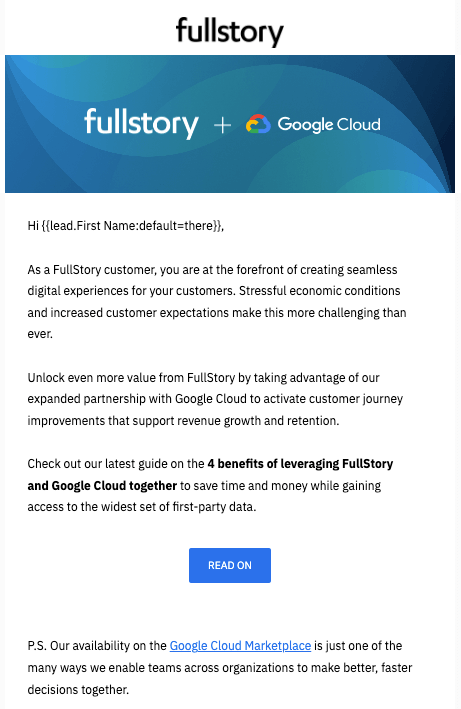


2. Build a report in Crossbeam comparing FullStory’s customers and/or prospects to priority partner’s customers and/or prospects. Export the list out of Crossbeam or use the Crossbeam Marketo Integration. Share the final list with marketing operations with context about the campaign.
3. Marketing operations imports the overlap list into Marketo. Then they create and refine a contact list in Marketo based on the Crossbeam overlaps. 💫 Note: FullStory plans to use the Crossbeam Marketo integration to make this step more automated in the future.
4. Partner marketing and ABM teams create the campaign strategy which can vary based on the business objectives, but usually consists of one or many of the following: emails, display ads, landing pages, webinars, blogs, social posts, etc. The messaging contains integration or joint value proposition benefits that make it easy for the customer or prospect to understand what’s in it for them, so their chances of converting from your campaign are higher.
5. Before launching the campaign, the partner marketing team socializes the campaign internally so the FullStory customer success and sales teams are prepped and enabled on the campaign, the integration, and the joint value proposition. (More on this later).
6. After the campaign is launched, measure the success! Keep track of:
- Integration activation and adoption rates if applicable (More on this later).
- Demo requests, form fills, opportunities created, email stats, webinar/content engagement, landing page metrics, etc.


💡Did you know you can automate your co-marketing campaigns using Crossbeam’s Marketo Engage Integration?
Your marketing team doesn’t have to meddle with Crossbeam exports and Marketo imports. Overlapping accounts from Crossbeam will automatically feed into Marketo so marketers can create highly targeted lists to power:
- Partner events like webinars or fireside chats
- Integration announcements to mutual customers
- ABM campaigns telling “better together” stories
Learn more about Crossbeam’s Marketo Integration here.
“We’re excited to get started with the Crossbeam and Marketo integration. We’re just scratching the surface of what’s possible with our Ecosystem-Led Marketing motions so I’m eager to further automate and scale these “better together” campaigns so we can move faster,” says Garthwaite.
“To help us continue improving our partner campaigns and scaling these motions, we are also working with Ampfactor, a B2B account based marketing and demand gen agency who specializes in partnerships,” she adds.
Step 2: Get your customer success and sales teams’ buy-in by running an internal enablement campaign
Partnerships is a team sport — and that means getting your customer success and sales teams onboard to support your adoption campaigns.
“It’s critical for the customer success and sales teams to know about adoption campaigns ahead of time so we get their buy-in and support to help customers or prospects with integration activation,” says Mead.
Why is this important? Let’s say a customer or prospect sees the ABM campaign and then contacts their CSM or AE to ask how they can get started using a specific integration. You never want your CSM or sales rep to be blindsided by this.
“We have to take that same kind of message that we’re sending to our customers and prospects and distill it so that our teams are up to speed on what the integration is, as well,” says Mead.
Here’s how Mead and his team ensure the CSMs and AEs are enabled on integrations and aware of supporting marketing campaigns:
1. When onboarding a new technology partner, the partnerships team creates integration collateral for the sales, sales engineering, and customer success teams to leverage throughout the partner lifecycle.
2. The partnerships team selects a partner for an adoption campaign when the following criteria are met:
- There’s a healthy overlap count with the tech partner
- A highly valuable integration is released
- The tech partner has completed the onboarding process
3. The partnerships team meets with CSM and sales teams and reviews available partner collateral, which typically includes:
- Partner Sales Kit: This includes the integration value proposition as a one-liner, the use case(s) the integration satisfies, and a case study (or more) if available.
- Integration Article: Every technology partner in FullStory’s directory has a published integration on FullStory’s knowledge base. The partnerships team reviews this document with the customer success team, and if available, walks through a sandbox demo (available to all FullStory teams) of the integration and how it works.



4. Mead and his team host weekly “technology partner office hours” for anyone in the organization to drop in and pose questions. Colleagues can use the office hours as an open forum to ask questions or they can submit their questions ahead of time in a worksheet.
“Before the world of Crossbeam, the hardest part of the account mapping process was getting relevant client overlap data. Now that we have the data, we can tackle the next opportunity of influencing and directing organizational change,” says Mead.
“By working together with the customer success and marketing teams, and providing them with the Crossbeam data they need to be successful in Salesforce and other tools they’re using, we can not only ensure buy-in from the greater organization but also make a better, more collaborative workplace overall,” he adds.
Once the customer success and sales teams are enabled, it’s go-time. The partner marketing team can launch the co-marketing campaign and begin tracking campaign performance.
Step 3: Track and measure integration adoption activity
After putting together the marketing campaign and running the internal campaign, the partnership team’s work isn’t done. They need to ensure they get credit to the extent they positively impact Gross Dollar Retention, Net Dollar Retention, or generate new pipeline.
The partnerships team tracks integration adoption activity using their own internal metrics and by drinking their own champagne — using FullStory to monitor integration adoption.
Mead says FullStory’s adoption metrics are calculated based on a wide variety of variables and are highly dependent on the integration technology.

Some examples:
- The FullStory team will track their integration with Partner A, by creating indicators in the click-through rates of the integration that are reportable in their backend using Looker dashboards.
- They’ll track an integration with Partner B by looking at users who have custom events defined by JavaScript coming through to their FullStory account.
- They’ll track an integration with Partner C by looking at the referrer URL being equal to an internal Partner’s application domain names.
In Salesforce, Mead and his team can also see the number of integrations a customer has activated. The FullStory team uses a report that shows the impact to Gross Dollar Retention, based on the number of integrations a customer has. “There’s a big difference in GDR for a customer that has three integrations activated versus six integrations,” says Mead.
–
“We’ve really woven Crossbeam into the fabric of how we go to market with partners,” says Mead. “We’re now building repeatable processes and technology around our partnership initiatives. Crossbeam plays a key role in how we think about executing our partnership plays,” he adds.


