





How to Launch a Strategic Partner Program (And Not Take Forever to Deliver Value)


Strategic partner programs can be a great long-term investment: they can open up new markets, maximize value for your customers, and even create a pathway to acquisition. However, they require some time as you form and strengthen the partner relationships that eventually yield these results. It’s important to give strategic partner programs time to grow. One way to help do this is through reasonable, attainable short-term KPIs.

Strategic partnerships can be a great long-term investment for companies wanting to increase the impact of their partner program: Over time, strategic partnerships can:
- Maximize value for customers. Partnerships with complementary businesses can help close gaps in product lines and maximize your offering’s value.
- Open up new markets. Partnering with recognizable brands can open up new customer segments that otherwise might be inefficient to reach through other means.
- Optimize your marketing spending. Leveraging existing audiences from larger, more well-known brands through co-marketing and other strategic efforts can help lower customer acquisition costs and improve profitability.
- Create a pathway to eventual acquisition. Since senior executives are often heavily involved in strategic partnerships, strategic alliances can be stepping stones for companies seeking an eventual acquisition.
Tyler Zanini is a Director of Strategic Partnerships at Checkout.com, an international payment processing company that recently closed $1B in Series D funding. In the previous 18 months, his team has grown from two in the U.S. to 16 members globally.

Zanini attributes his team’s growth to the prioritizing of ecosystem growth KPIs instead of revenue KPIs. In other words, he focused on the number of partners instead of initially tracking revenue metrics. This helped Checkout.com expand its partnerships team and gave the team the foundation to start hitting revenue-based KPIs within nine months.
We asked Zanini for his advice for accomplishing this growth in his strategic partner program. His tips:
1. Report to someone who sees the long-term value in partnerships
2. Make ecosystem growth your initial KPI
3. Move to revenue-driven KPIs
1. Report to someone who sees the long-term value in partnerships
It’s difficult to advocate for a long-term KPI strategy unless your leadership understands the value of partnerships.
For Zanini, this is relatively straightforward: the strategic partner team at Checkout.com reports to the Global Head of Partnerships who in turn reports to the CRO. As more companies bring on partnership professionals at a C-suite level, more partnership professional might find themselves in a similar position. According to Zanini, having the support of a higher-up who is bought into the impact of partnerships has let his team focus on growing.
For those who don’t already report to a partnerships-specific person:
- Show them these success stories that highlight the business impact of partnerships in the long-term
- Write out a long-term plan for how your specific strategic partner program will benefit your company and specifically emphasize why initial program growth is important.
- Outline a 30/60/90 day plan for what your initial KPIs will look like, how they are meant to help your program grow, and how you will eventually transition to revenue-driven KPIs.
2. Make ecosystem growth your initial KPI
Most strategic partnership professionals, don’t have months, (let alone years), worth of buy-in before their programs need to start yielding results. As a result, it’s paramount that strategic partner managers ensure they focus on ecosystem KPIs and not revenue KPIs.
Revenue KPIs are those tied to money. As we saw in our State of the Partner Ecosystem Report, the second two most popular KPIs used to measure partner programs are directly related to revenue generation:
- (59% of respondents are measured by “partner-sourced revenue”
- and 52% are measured by “partner influenced revenue”).
Ecosystem Growth KPIs are ones tied to ecosystem growth. 29% of partnership professionals reported being measured by new tech integrations in the same report.
More examples of popular KPIs:
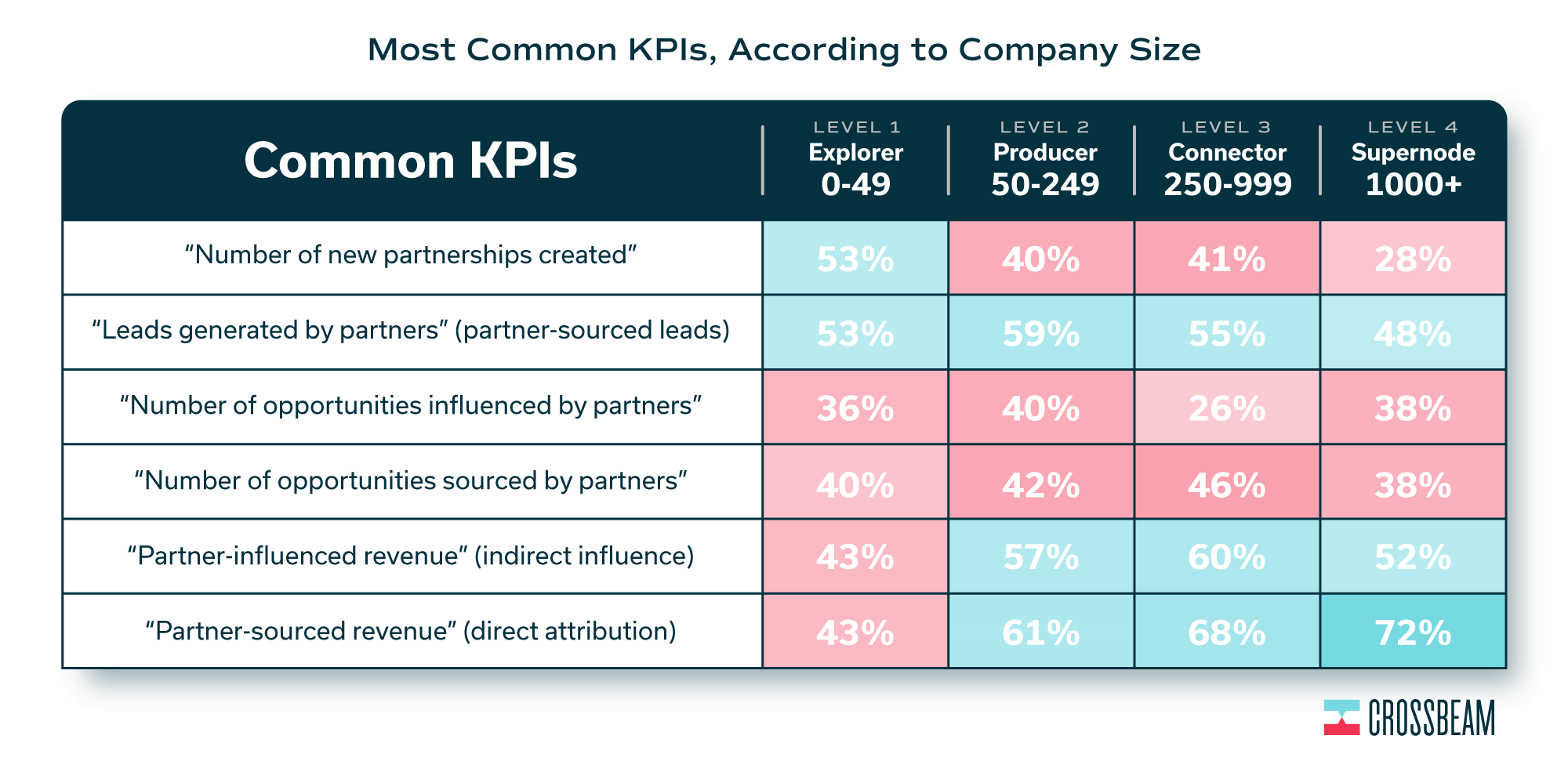
Starting with a revenue-based KPI can kick off a vicious cycle for strategic partner programs: Having a KPI that you can’t quite hit (but will be able to in the future) can put your partner program at risk of being seen as underperforming, thus not getting the resources and headcount to continue building.
“We knew that once we had built up our ecosystem, we could start to think about measuring ourselves on revenue impact,” Zanini told us. “So we started by identifying the low hanging fruit to get some quick wins while continuing to prospect and work towards our bigger strategic partnerships.”
In practice, this looked like going after tech partners with a high return on investment (ROI) and tracking the number of partner agreements signed as the partnership team’s primary KPI. Tech, channel, and strategic partnership verticals weren’t initially adhered to and the team focused solely on building the partner ecosystem as a whole (a move that ultimately gave each partnership vertical momentum as they moved into more specific roles).
Instead of implementing revenue-based KPIs from the start, new and growing strategic partner programs should:
- Set initial ecosystem KPIs that make sense for growing your team. What’s a goal that will expand your ecosystem, build momentum, and work in conjunction with your long-term strategic goals? Focus on that upfront. For example, measure the number of leads generated from your partners (something that 60% of respondents to our State of the Partnership Ecosystem survey do).
- Have a clear timeline for switching your intended KPIs. Give yourself a deadline for switching your KPIs. Then, set milestones along the way to make sure you’re progressing towards your KPI goal in a timely manner.
- Communicate to your internal stakeholders. Communicating your short and long-term goals to your internal stakeholders can help you get continued buy-in.
3. Move to revenue-driven KPIs
After nine months of focusing solely on ecosystem growth, Zanini started getting this message from his higher-ups who indicated that, in order to get more resources for growing the partner team, they needed to start measuring the revenue impact of the partner program.
Because of their work growing their ecosystem meant that Zanini’s team had a strong foundation of partners to optimize revenue from, making the switch easy. Zanini then worked with Checkout.com’s Partnerships, Sales, and eTeam to create new KPIs and switched his team’s focus from just ecosystem growth to revenue.
To make sure your team can hit revenue-based KPIs:
- Prioritize large partners. While expanding your ecosystem means going after partners of all sizes, a new focus on revenue means prioritizing partners with higher potential revenue opportunities.
- Track partner sourced and partner influenced revenue. Establish partner-attribution metrics early on to track all revenue your team is helping bring in. Check out how we set up our partner attribution metrics when we launched our tech ecosystem.
- Make sure your team is getting credit for your work by building attribution tactics into your co-selling and co-marketing workflows.
If you want to learn how to leverage ecosystem intelligence to launch a strategic partner program, book a free ELG strategy call with our team.


