


Learn from Kate Hammit, Emily Wilkes, and Justin Zimmerman everything you need to know about implementing a successful ELG co-marketing event strategy.

You have heard of inbound-led growth or product-led growth, but how familiar are you with event-led growth?
This GTM motion is not about finding venues, or deciding which SWAG looks cute—it’s about leveraging events to build relationships, and then transforming those relationships into revenue.
“Events are about bringing people together. It’s doing something fun and valuable for your customers and prospective customers, and Sales teams making connections. It’s about nurturing our community, strengthening bonds, and helping the Sales team deepen and build relationships.” –Emily Wilkes, Director of Field and Partner Marketing at Gainsight
Events aren’t just lead-generating engines anymore, but a way to go to market. GTM Partners included this motion as part of the 6 GTM motions you need to use to succeed, and it’s shocking how only 41% of companies are leveraging events as a source of trust and revenue.
“Events are the most powerful lever for modern GTM teams. They help you to create authentic connections, engagement, acquisition, and retention.”–Kate Hammit, CMO at Splash
Just look at the stats shared by Kate Hammit:
- 3x pipeline from events
- 45% increase in product usage by attendees
- 78% attendance rate
- 200% increase in total revenue from event programs
- 10% increase in win rate from attendees
Emily Wilkes also shared the results of implementing an event-led GTM motion in Gainsight’s Q1 this year:

In their Q3 they had similar results, plus 50% of their attributed pipeline came from events.
That’s what happens when you leverage events at scale.
So, are you ready for a piece of that cake?
During the Nearbound Summit, many people shared their challenges while building an event-growth strategy in tandem with Ecosystem-Led Growth (ELG). Luckily, Kate Hammit, Emily Wilkes, and Justin Zimmerman, shared their tips and hacks to drive revenue and foster meaningful connections by leveraging ELG.
(Access their Nearbound Summit sessions here.)

What is event-led growth?
“Event-led growth is more than your one-off events, it’s a way to foster real connections with your customers, establish deep trust, and inspire meaningful engagement with your buyers.” –Kate Hammit, CMO at Splash
Event-led growth is a holistic GTM strategy rooted in events. It involves premium event experiences to drive quality connections. They can be either in-person, virtual, or hybrid.
In this GTM motion, you have to match the stage of your prospect in the sales cycle to the type of event you want to do. Only this way you are going to be able to generate event-influenced revenue or event-attached revenue.

As you move down on the funnel, consider making your events more personalized to help close deals faster. Follow Kate’s strategy to allocate events according to your potential buyers’ journey:
- Top of the Funnel (TOFU): These are usually large-scale, third-party events like conferences, tradeshows, and online events that can help you educate your audience on the problem that the market is facing. Keep in mind that 84% of deals are won by the company or seller who reaches the buyer first, so these kinds of events are important to get your foot in the door. But remember, they will only work if you deliver meaningful subject matter expertise and thought leadership.
- Middle of the Funnel (MOFU): These events can be in-person or online events where you deliver use cases or best practices to leverage your product better. Here you have to share frameworks that can help your customer achieve their goals.
- Bottom of the Funnel (BOFU): These are the more curated and targeted in-person events. These gatherings should be a community-oriented experience, and are key to connecting with your prospects, closing the deal, and/or building strong relationships with existing customers.
The importance of ELG co-marketing events in 2024
In the ELG Era—where building trust and relationships first is key to your sales success—events are one of the GTM motions that can help you effectively engage large audiences, create warm leads, and enable you to build relationships based on your customer’s pain points.
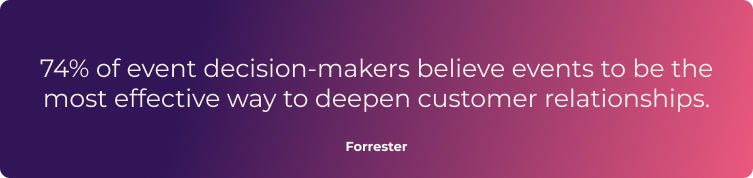
With saturated inboxes and SEO being a difficult game to win, more than ever you need to be and meet your customers where they are. Whether you’re planning a VIP dinner, or sponsoring an event, community meetup, or any other event, make sure you’re meeting your customers right where they are, and nurturing them with the right content—don’t just be another noisy signal.
Events can help you cut through the noise that inbound and outbound are making, especially if combined with an ELG strategy.
Here’s how ELG can help:
- Targeted engagement: ELG events prioritize building relationships and trust with the audience. By focusing on understanding customer pain points, these events provide a more targeted and personalized approach. Attendees feel a genuine connection, reducing the likelihood of them perceiving the event as just another piece of marketing noise.
- Location relevance: The essence of ELG strategies is meeting customers where they are. By leveraging Ecosystem Intelligence like market presence, and hosting events in locations that are convenient and meaningful for the target audience, you position your brand as accessible and attentive.
- Community-centric approach: ELG co-marketing events often involve partnerships with local communities, customers, and partners. This collaborative approach fosters a sense of belonging and community engagement creating meaningful connections.
- Strategic partner integration: Collaborating with partners in events adds another layer of credibility. Partnerships bring diverse perspectives and expertise to the table, enhancing the overall event experience—and can help you enter new markets.
- Intent data utilization: Leverage events as sources of intent data. Understanding attendee behavior, interactions, Ecosystem Intelligence, and interests during events provides valuable insights. This data-driven approach allows for more precise and targeted follow-ups, ensuring that subsequent communications resonate with the specific needs and preferences of your audience.
The perfect example is planning roadshows in different cities and inviting local customers, prospects, and partners. It’s not about getting people drinks once the panel is done, but providing thought leadership content and connecting them with the right people who can help them reach the promised land.
If you create a good ELG co-marketing event strategy, you can fuel the rest of your business, not only with leads, but also with content that you can repurpose (by you, your customers, or your partners) to create video clips, whitepapers, infographics, blog posts, sales enablement material, etc.
The goal is the deliver value to your customer, and to get every drop of value you can for your company. This helps you own a higher percentage of those 28 touchpoints in the buyer journey that Jay McBain talks about.
How to build an ELG co-marketing event strategy
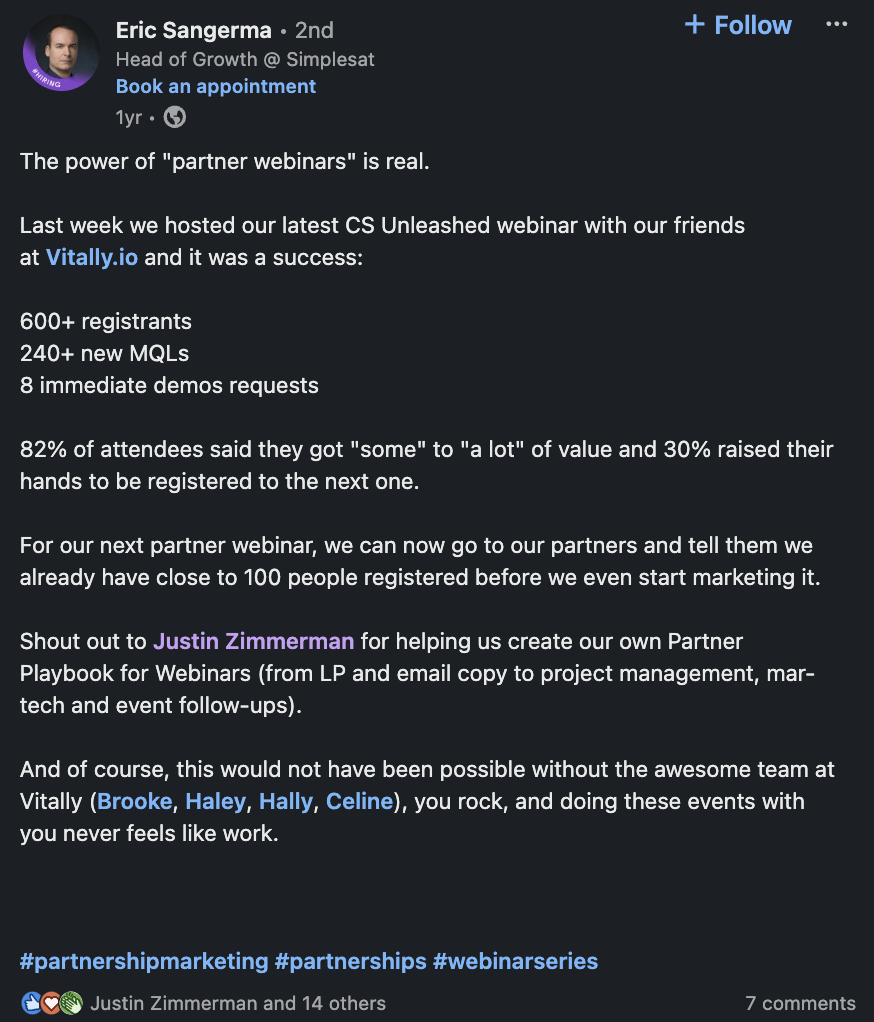
A successful event strategy is not the one with 1k registrants. Yes, numbers matter—but if you aren’t able to connect with any of those registrants, you won’t be able to drive revenue.
Successful events are the ones where you can provide value, connect with the customer, build trust, and leverage the intent data to market and sell better.
To build your 2024 event roadmap, make sure you do the following tips shared by Emily Wilkes, Kate Hammit, and Justin Zimmerman at the Nearbound Summit:
Alignment before planning any event
When implementing an ELG co-marketing event strategy, you need to leave behind the idea that events are only about sponsoring in-person events, having booths at a conference, or getting swag.
Besides doing whatever GTM strategy needs, like setting goals and metrics, you have to keep in mind that the main goal of your event isn’t sales, but making your customer successful.
Then, if you want to get your events right, you have to align your Events, Marketing, and Demand Gen teams.
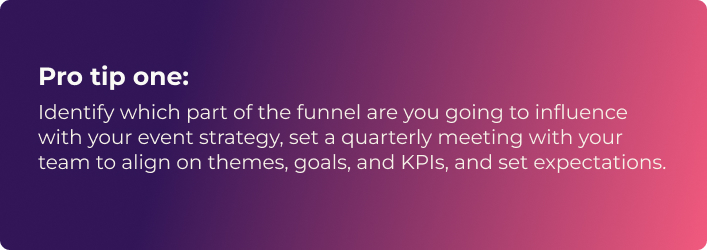
Aligning your teams won’t only give you the best theme and KPIs, but the key to actually achieving them: the perfect guest list. Getting the right people in the room is one of the hardest things you can do while planning an event. By leveraging demographic, technographic, and Ecosystem Intelligence, you can narrow down your guest list to the people who are interested in attending your event–increasing your attendance rate.
Pull lists from a multisource approach: leverage Crossbeam, LinkedIn, and your CRM, and work together with your Sales team and partners so they can nominate candidates to attend your events.
After all, your teams have the intel you need to nail that guest list.
Remember, don’t overlook the potential contributions of your partners in this endeavor. Collaboration with your partners can significantly enhance your reach and access to relevant contacts. Engaging with partners ensures a broader pool of potential attendees, enriching the diversity and quality of your guest list. By combining the strengths of your internal teams with the external network of partners, you maximize your chances of assembling the perfect audience for your event.
Find the right partners who can help you achieve your goals
In this step, you have to leverage that low-hanging fruit—the partners of your partners who share your ICP.
Through account mapping, you can easily spot the best partner to work with and prioritize the ones who have common opportunities. Ask yourself this question: who has the highest overlap of prospects and customers/contacts?
Leveraging your partners at events is:
- Building trust with your audience: Search for those partners that are already engaging with your users and prospects.
- Bridging your knowledge gap: There’s a pool of experts and influencers who are talking about the same subject you want to share with your audience.
- Expanding into new markets: Focus on a partner that can give you entry to a market that’s hard to break into and that can give you credibility.
You can also leverage your partners in these ways:
- When sponsoring an event, connect with your co-sponsors. You can create a follow-up piece of content related to the main event, find your common prospects, start a co-selling program, or even ask for referrals.
- Identify your partners’ content. Sometimes your partners might own newsletters, blogs, or vlogs, and they look to highlight what’s going on in the industry, so, that’s the perfect opportunity to promote your event.
Nail the format of your event
There is not a one-size-fits-all event. There are more event types than fingers on your hands, so you have a lot of options to choose from.
But regardless of the format you choose, there is one question that everybody needs to know how to answer: How can I drive economic value without building my event as a pitch for my product?
“If you focus on more than the big picture of thought leadership, and product demonstration, but you narrow it down to moments in your event that allow you to talk about your product. Announce your product micro ads at strategic moments of your event to capture the interest of those who really want to buy.” –Justin Zimmerman, Partner Webinar Coach.
For example, Justin Zimmmerman’s event formula (at least for online events) is 20 minutes of thought leadership, 3 minutes of product demo, and 2 minutes of CTA and conclusions.
Be intentional first—don’t focus on your product.

If you’re planning any type of event (hybrid, in-person, or online), you have to find a way to embed the product into the talk track enough to catch the attention of your audience, otherwise, it will look like a sales pitch.
For example, one good strategy is deploying hyper-local events. Consider your event funnel stages: awareness, consideration decision, and retention.
Then, identify your segments. Which accounts are in what stage of your sales process, and who can help you influence that stage? Then identify the best way to meet your customers where they are, and bring the content to where they “live” (the type of event). Then measure your results, you can use these metrics: event pipeline attributed and event influenced pipeline.
The after-event: Turning attendees into revenue
Pay attention to who is attending your webinar—your follow-up depends on it.
“By properly leveraging events you can generate true high-qualified and targeted leads for your marketing automation and your sales team to follow up with.” –Justin Zimmerman, Partner Webinar Coach.
There are two types of attendees:
- Active attendees: The ones eager to learn, ask questions, and engage, and
- Passive attendees: Those who have you playing in the background.
By identifying the intent data, you’ll be able to create a follow-up message that is adequate for each audience.
How?
- Create a lead gen form (as usual) and, on the next pages, identify who is in the market for your product and optimize by intent: tech stack usage/integrations, economic value identifier (consumption: seats, licenses, etc, lead score), competitor tools.
- Create a list of all those people who attended and asked questions or engaged during the event, those are the active ones. You have a higher conversion rate if you “target” them.
Categorizing attendees will help you turn registrations into leads.
Once the event is done, you have to send a recap/ follow-up email to your registrants and attendees. Here you have two options: either you follow up to push attendees/registrants to buy your product (DON’T), or you leverage Ecosystem Intelligence to tailor an email….
“Hey [First Name],
I saw you attended our webinar, I hope you enjoyed the event. Here’s the access to the replay/deck/content discussed during the session.
It caught my attention that you’re a [insert job title], I think these gems thrown by our speakers can be useful:
- Highlight 1
- Highlight 2
- Highlight 3
I also saw that you’re currently using [insert tech stack], which integrates with [insert your brand] to solve [insert pain]. Would you like to set up a time to discuss how you can better leverage that integration to achieve [insert goal]?
Regards,
[insert your name]
P.S. I hope to see you at our next event.”
Scaling ELG events to drive revenue
Co-marketing events in 2024 are not just about the numbers but about creating genuine connections, delivering value, and leveraging partnerships to drive revenue and customer success.
“To implement a successful event-led growth strategy, keep it simple, market yourself internally and to your partners, and scale by leveraging partners and platforms.”–Kate Hammit, CMO at Splash
It’s a strategic approach that goes beyond the traditional view of events. It emphasizes the role of events in building trust, fostering relationships, and ultimately contributing to the overall growth of the business.
The potential of ELG co-marketing events is endless—we’ve barely scratched the surface of what is possible. But with Crossbeam, you can build the best events strategy by:
- Leveraging events lists to craft an ELG field strategy
- Identifying, targeting, and converting high-value accounts
- Identifying and developing lists of potential customers within specific market segments
Want to know how to transform attendees into revenue? Book a meeting with the Crossbeam team, and they will share the 3 ELG use cases you’ve never thought of to build your event roadmap.


