


How to Learn Your Customer’s Tech Stack and Increase Integration Adoption by 17%


How RollWorks uses account mapping to drive integration adoption and a faster time to first value for their newest customers.

You’ve grown your tech ecosystem with love. You’ve seen how your integrations help your customers realize greater value from your platform. And the more integrations your customers adopt, the “stickier” your product becomes.
The key to driving integration adoption? Knowing your customers’ tech stacks. This is where real-time account mapping comes in.

Mike Stocker, VP of Strategic Partnerships at RollWorks, knew there was an opportunity to drive integration adoption earlier in the customer life cycle. As an account-based marketing (ABM) platform that helps marketers identify and engage target accounts, RollWorks’s customers realize the most value when leveraging ABM data within RollWorks in tandem with data from the sales and marketing tools in their tech stacks.
In fact, RollWorks’s customers who are using partner integrations renew at a rate approximately 30% higher than customers who don’t.

Stocker has been using Crossbeam for more than a year, and just recently he’s led the adoption of the partner ecosystem platform (PEP) across multiple teams at RollWorks.
Erez Suissa, Senior Manager of Adoption and Onboarding at RollWorks, was 100% aligned with rolling Crossbeam out to his team of onboarding success managers (OSMs).
“To unlock more value for our customers in the early days makes so much sense,” says Suissa. “I’m a firm believer that customers have a life cycle, and the onboarding role is not to do everything under the sun, but it’s for us to basically help the customer realize the immediate value. We need to unlock that as quickly as possible for them.”
Through real-time account mapping, RollWorks’s OSMs have been able to:
- Improve their customers’ time to first value (TTFV). RollWorks has seen a 16% faster TTFV in a two-quarter period.
- Drive adoption: RollWorks has seen a 17% increase in customers integrated with at least one additional partner (on top of each customer’s standard CRM integration) and a 7% increase in integration usage for their customers’ campaigns in just one quarter.
- Gather data faster for developing a “leading indicator” for retention and renewal to inform their team’s future integration strategy (Remember that 30% higher renewal rate for customers who have adopted an integration?).
Here’s how the onboarding team at RollWorks leverages account mapping to drive immediate integration adoption and improve retention.
- Play 1: Identify Which Integrations Would Provide the Most Immediate Value for the Customer
- Play 2: Look to Your Partner to Educate the Customer About Joint Solution Use Cases on Your Behalf
- Play 3: Develop Your Customer’s Integration Adoption Roadmap
Take a look:
Play 1: Identify Which Integrations Would Provide the Most Immediate Value for the Customer
The OSM’s job is to set the customer up for success by helping them to achieve their first business objective. The amount of time it takes the OSM to help the customer achieve this business objective is called the time to first value (TTFV).
Each OSM has an OKR of setting up at least one integration per customer (in addition to the customer’s CRM integration). On top of their individual OKRs, Suissa is responsible for driving partner engagement as part of a company-wide initiative. This responsibility cascades down through his entire team.
RollWorks takes a Crawl-Walk-Run approach in helping their customers achieve success through their ABM platform throughout the customer life cycle. Typically, the customer achieves their first business objective between the “crawl” and “run” phases. The “crawl-walk-run” phases:
- Crawl: Achieve the customer’s primary business objective (For example, perhaps you’re helping the customer qualify a number of opportunities through your platform).
- Walk: Extend the primary use case further (Now, you help the customer multiple the amount of opportunities they’re qualifying through your platform with the help of an integration that provides greater insights into the corresponding accounts).
- Run: Expand the customer’s use cases through more advanced tactics (Now, you help the customer scale the opportunity qualification process by helping them adopt more integrations that can build on the customer’s expertise in your platform). This is typically when a RollWorks customer transitions from an OSM to a long-term customer success manager (CSM).
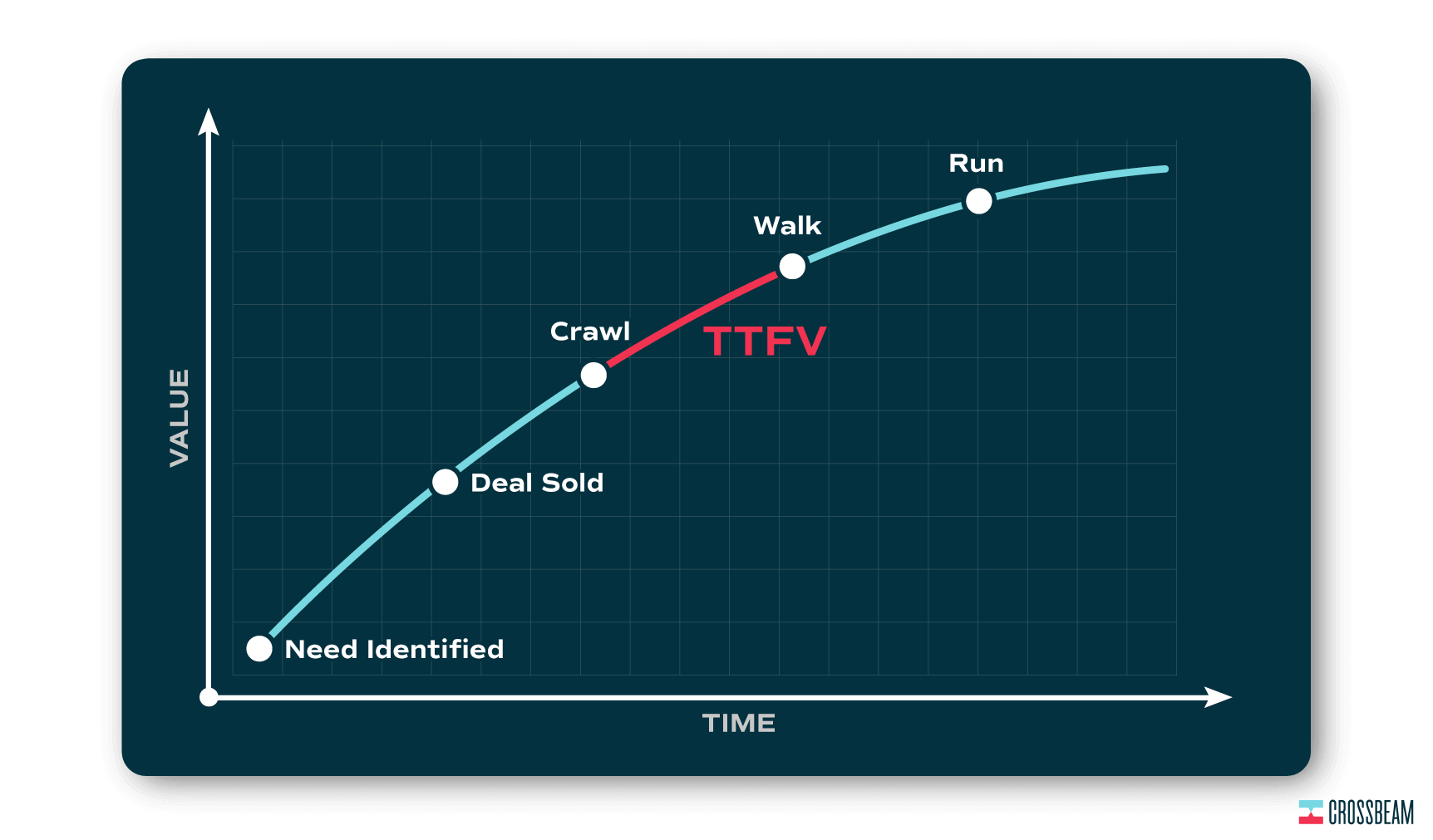
The OSMs help the customer power their ABM strategy with data from additional tools in their tech stacks. This is where integration adoption comes into play.
How to Know Your New Customers’ Tech Stacks
Let’s say the new customer’s goal is to increase opportunities within their company’s enterprise segment. The primary reason the customer purchased RollWorks was because they want to discover and engage more accounts that fit into this segment. The customer’s team is responsible for closing an additional five deals within their enterprise segment during the next quarter. To do so, the customer needs to know which companies to target and how to engage those companies most effectively with ABM.
With the customer’s business objective in mind, the OSMs now need to identify which integrations would help the customer reach their goal the fastest.
For example, if RollWorks’s integration with Opensense, an email signature management software, would help the customer engage their target enterprise accounts faster, the OSM may recommend the customer adopt the integration (if the customer is already using Opensense — we’ll get to that in a bit!). For context, the Opensense-RollWorks integration helps marketers unify their ABM messaging to specific target accounts across their email, social, and display ad channels and measure the engagement across both platforms.
By mapping accounts in Crossbeam, RollWorks’s OSMs can identify which “new customers” exist as a “prospect” or “customer” of their partners. With this partner data in hand, the OSMs can then decide how to navigate the conversation.
“We saw Crossbeam as an invaluable tool where we don’t have to do deep discovery — it becomes more of a natural conversation,” says Suissa.
The OSM can run reports in Crossbeam with their partner Opensense to service one of three possible scenarios:
- The customer is a prospect or opportunity of Opensense. In this case, the OSM will ask the customer if they’ve considered tracking email engagement through Opensense in tandem with RollWorks’s ABM data. The OSM will then explain which integration use cases could help the customer achieve their business objective. If the customer is interested, the OSM can offer an introduction between the partner and the customer to accelerate a deal for the partner (and potentially drive another integration adoption).
- The customer is a customer of Opensense. In this case, the OSM will present a strategic plan to the customer for adopting the integration to help them achieve their business objective.
- If the customer is a prospect, opportunity, or customer of Opensense, but the integration doesn’t solve the customer’s primary use case, the OSM keeps the information for Play 2 or Play 3.

In the example above, you’ve identified 170 overlaps between your customers and your partner’s open opportunities through account mapping in Crossbeam.
Tip: Your onboarding team should uncover each new customer’s company-wide and department-specific business objectives. Your customer’s company-wide goal might be to increase pipeline through your company’s marketing platform, for example, and your customer’s marketing department has a goal of increasing leads through display ads.
Your onboarding team should consider each of these goals while determining the best first integration for the customer (and in mapping the customer’s integration adoption roadmap). They can uncover your new customers’ business objectives directly through conversations with the customer and/or through intel they receive from the sales rep that closed the deal.
Then, have your onboarding team map the “new customer” accounts with your partners. When they identify an overlap between the “new customers” list and your partners’ “customer” lists, they’ll know exactly which of your partners exist in your new customers’ tech stacks. These are the integrations that your onboarding team can choose from for driving early integration adoption. Of those integrations, they should consider which ones will help the customer achieve their first business objective the fastest.
Don’t worry, the rest of your new customers’ tech stacks will come in handy in a bit!
Play 2: Look to Your Partner to Educate the Customer About Joint Solution Use Cases on Your Behalf
If an integration isn’t the best fit for the customer’s primary business objective (at first) but that customer is also a customer of your partner, your partner can still help improve your customer’s onboarding experience.
Your partner can serve as an additional subject matter expert with a fresh perspective to help improve the customer’s “time to first value” in respect to your platform.
In RollWorks’s case, if the customer has a limited view of ABM and that customer is also a customer of sending platform Sendoso, Suissa’s team might ask Sendoso to start a conversation with the customer about some of the most effective use cases in combining ABM with direct mail.

Tip: If your partner’s value proposition overlaps in some way with yours (think: the goal of your products is similar and they work best together), ask your partner to provide context around specific use cases that could benefit your new customers. After all, your partner has already established a relationship with the customer.
To identify which of your new customers exist in your partners’ tech stacks, map accounts with your partner in Crossbeam. Share your list of “new customers” (according to a specified date range), and have your partner share their list of “customers.” For each of your “new customers” that overlaps with your partner’s “customers” list: determine if your customers could uncover even more value from understanding some of the use cases your partner has seen for their customers who are using your platform. This engagement between the partner and your customer can grow your customer’s expertise in your product and prime the conversation for integration adoption with your partner’s product further along in the customer journey.
Once your onboarding team maps accounts with a partner once, they’ll automatically receive updates whenever a new overlap is found. So, if your new customer becomes a customer of your partner shortly thereafter, your onboarding team will be able to act on the data instantly.
Play 3: Develop Your Customer’s Integration Adoption Roadmap
Once the OSMs at RollWorks help a new customer adopt their first integration and achieve their first business objective, they then create an integration adoption roadmap for the customer and pass the roadmap along to the CSM who will manage the account as it matures. The integration adoption roadmap includes a plan for building on the customer’s current ABM strategy and adopting the integrations and tactics that could help them achieve more of their long-term business objectives.
For example, in the integration adoption roadmap below, RollWorks recommends that the customer adopt the integration with HubSpot (as the customer’s standard CRM integration), LinkedIn, and Opensense as part of their onboarding. As the customer advances, they should adopt the RollWorks-Sendoso integration to use direct mail and gifting in tandem with digital ABM.

Tip: All integrations are not created equal. Identify which integrations would provide the most value right now for the customer with the least amount of effort from your onboarding team — Start them off with the first integration to build momentum in realizing value early on. Then, determine if and how they should adopt more integrations as they become a more advanced user of your platform.
—
By account mapping earlier, RollWorks’s team is able to uncover which integrations would provide the most value to the customer at various stages of their customer life cycle — thus making their product “stickier” and leveraging integration adoption as a growth strategy.
“Why don’t we start getting the right accounts to the customer’s website right now,” says Suissa. “It helps us drive the engagement to get the customer to do what’s good for them. Having that information up front empowers the onboarding team during those conversations.”


