


Leveraging AI, automation, and ELG for better sales performance


Learn how AI, automation, and Ecosystem-Led Growth (ELG) boost sales performance with partner data, smarter signals, and actionable RevOps workflows.
Sellers who embed AI and automation into their workflows — not just as shiny tools but as part of their daily rhythm — are pulling ahead.
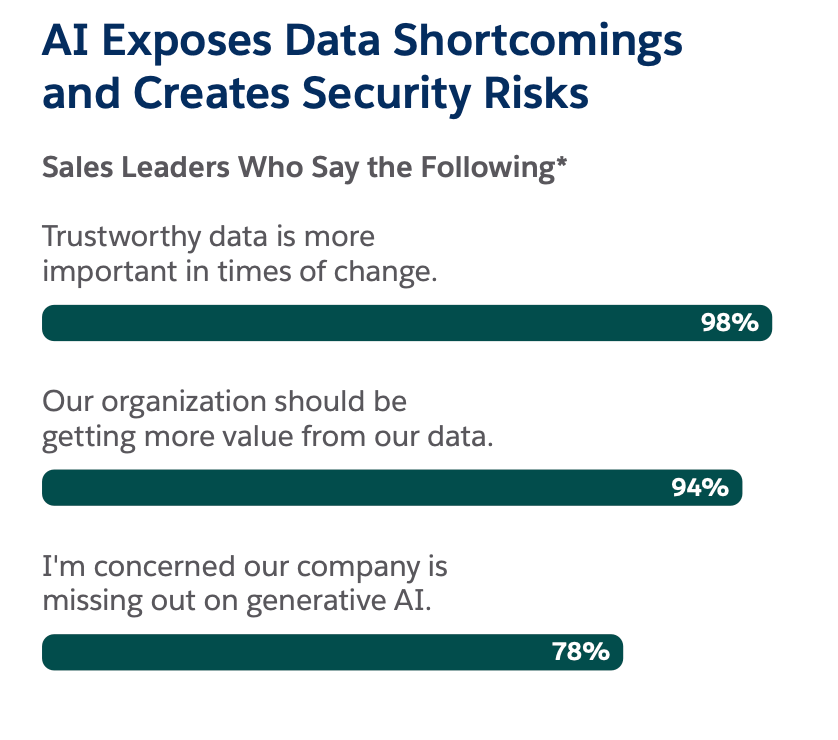
The 2024 Salesforce State of Sales report highlights this shift: four in five sales teams are experimenting with or have fully implemented AI. The payoff is real. The top improvements include:
- Sales data quality and accuracy: Syncing customer interaction data across systems to keep records correct and up to date.
- Understanding of customer needs: Surfacing signals that reveal intent and fit.
- Personalization at scale: Generating emails grounded in contextual customer data.
- More accurate forecasting: Sharpening pipeline predictions with AI-enhanced insights.
- Stronger customer communications: Helping sellers tailor their outreach and messaging.
It’s no surprise then that 83% of sales teams using AI saw revenue growth in the past year — compared to just 66% of teams without AI.
But here’s the catch: AI is only as good as the data you feed it. Adoption is surging, yet too many organizations struggle because their AI is starved of trustworthy, actionable context.
To learn more about how to leverage AI, automation, and Ecosystem-Led Growth (ELG) for better sales performance, Will Taylor, CPO of AudienceLed, shared with us common pitfalls when introducing partner-data workflows, actionable recommendations for sellers and their teams, and how to solve performance issues.
Let’s begin.
First things first…
As Bob Moore, CEO and Co-Founder of Crossbeam, puts it in his latest article:
“AI is still reshaping the way countless types of information work are done around the globe. How can it be so good at everything else and so bad at helping B2B companies sell? The limiter isn’t model quality, it’s context.”
In other words: your AI workflows won’t work without the right data.
First-party sources like CRM records and product usage are a starting point, but they only tell your side of the story. Third-party data is publicly available information like job titles and firmographics, but it’s not unique.
The real force multiplier is second-party partner data (a.k.a. Ecosystem Intelligence), insights shared from trusted partners about the very same accounts you’re targeting.
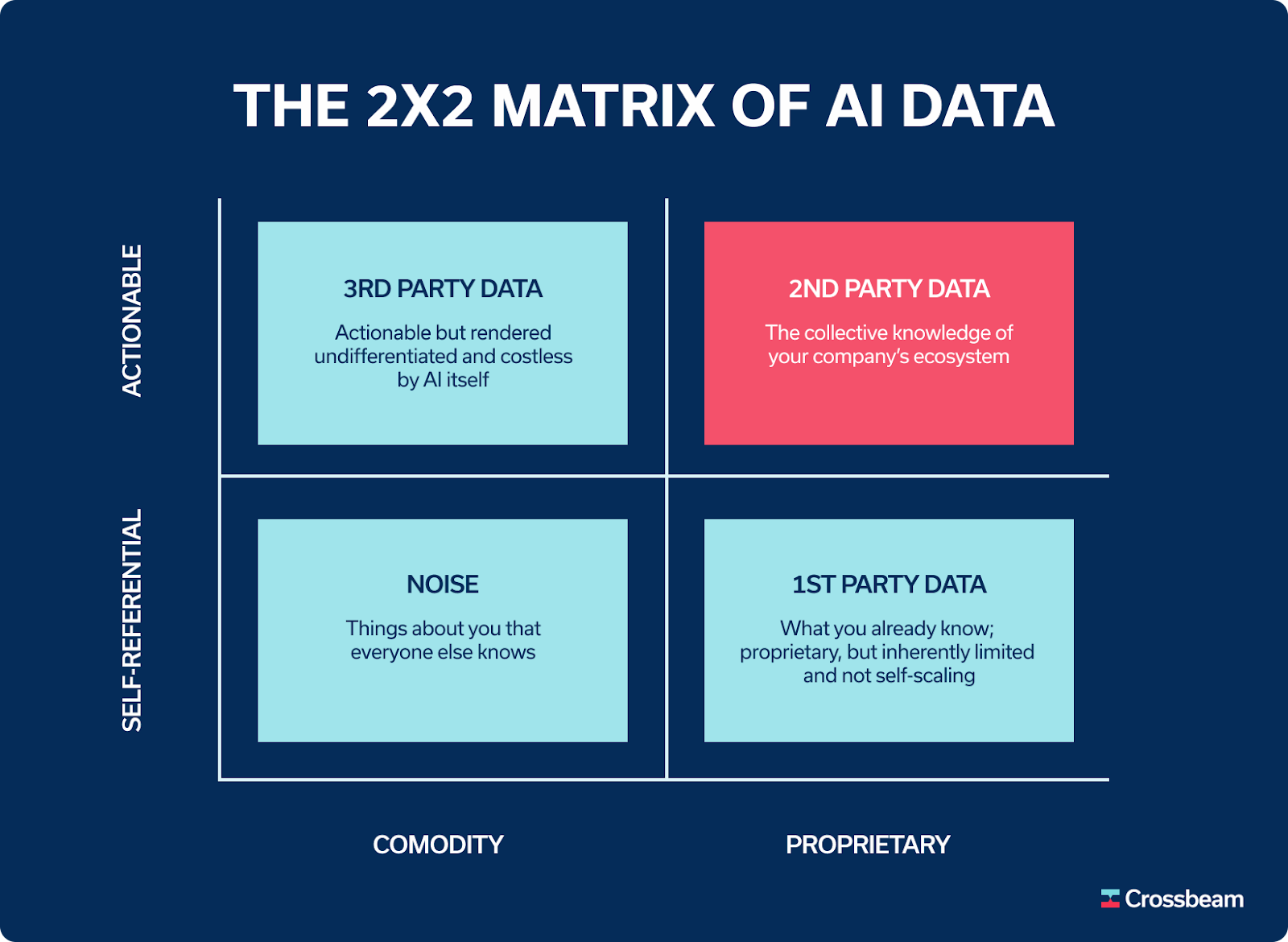
Based on Moore’s 2×2 Matrix of AI Data, here’s what that means for your sales process:
- Smarter prioritization. Second-party data shows you which accounts already buy from your key integration partners, where adjacent deals are moving, or where a partner footprint aligns with your ICP. AI can re-rank sequences, territories, and call plans around real opportunity, not just guesswork.
- Contextual outreach. When AI sees a funding event + partner overlap + product usage fit, it can generate talk tracks that reference the ecosystem context directly. Sellers stop spelunking in CRMs and start running activities with confidence.
- Explainable signals. Alerts should always come with evidence (“which partner event fired”), reasoning (“deals with this partner close faster”), and a clear next action. That’s how you turn Slack noise into revenue moves.
“Sellers don’t think in the way of partners; they think in activities,” said Will. “The data has to meet them where they already work.”
Only with this context does AI stop being an email-drafting assistant and start acting like a real GTM engine.
Common pitfalls when introducing partner-data workflows
Even with the right data foundation, many teams stumble when trying to operationalize partner context with AI and automation. As Will noted, the problem isn’t whether you have the data — it’s how you introduce it into your sellers’ day-to-day.
“If there’s any new motion that sales teams need to adopt that’s not close to the norm, they won’t adopt it easily,” Will said. “The key is to integrate partner data into the existing workflows that sales already uses.”
Without careful alignment, what should feel like an accelerator often turns into friction.
Here are 6 common pitfalls Will warns against:
- Breaking the sales rhythm: The #1 stumble is asking sellers to adopt a new motion or data process that lives outside their normal cadence. If Ecosystem Intelligence sits in a parallel workflow (or separate tool), adoption plummets.
- Treating Ecosystem Intelligence as “static CRM facts”: Dropping a field like “Overlapping Partner: HubSpot” into the CRM doesn’t change behavior. Sellers don’t want to hunt for context; they want actions ready to run.
- Surfacing signals too late: If partner context arrives after an opportunity is already in motion, it feels like a speed bump. To help, not hinder, signals must appear before outreach and at key deal moments.
- Misaligned incentives: KPIs and comp plans often ignore partner motions. If using Ecosystem Intelligence isn’t tied to how sellers win, they’ll default to the old way.
- Notification theater: Slack pings and generic alerts create awareness, but rarely action. Without clear owners, SLAs, and next steps, alerts die in the channel.
- Skipping RevOps: RevOps is the glue between marketing, data, and sales execution. Without them, partner context never makes it into targeting lists, sequences, or dashboards that your sellers actually use.
How AI and automation solve performance issues
Here’s the irony: to make AI and automation effective, you need the right data. But to surface and contextualize the right data, you also need AI and automation.
“Automation is great for awareness, it moves data from point A to point B,” Will said. “But AI gives you the context. It connects the dots and helps the seller know why it matters.”
Here’s how it works: your ecosystem (second-party data), your CRM (first-party data), and public databases (third-party data) give you the insights you need to know a bit more about your prospect. Automation ensures signals are visible across the stack, while AI transforms those signals into context, reasoning, and ready-to-send actions.
Together, they shift Ecosystem Intelligence from “extra work” to “invisible advantage.” Will gave us two fundamental truths:
1) Automation builds awareness: Tools like Zapier or n8n move data from A to B and push reminders into where sellers already work (Slack, CRM, sequencers). Great for visibility and coverage.
2) AI adds context. AI reasons over multiple signals (for example: funding + partner overlap + ICP fit), summarizes why it matters, and drafts the next move, so sellers spend time acting, not deciphering.
From static to active data.
- Static: a lone CRM field that requires manual interpretation.
- Active: partner context embedded into list building, lead assignment, sequence selection, and message generation, all prepped by RevOps and AI.
Will explained it best:
“If the data just sits in a CRM field, that’s static. Active use is when it’s already being used in workflows: in the lists, in the sequencer, or in the message generation. That’s what sellers care about because that’s what helps them hit their metrics.”
Right info, right time. AI/automation should meet sellers where they work (sequencer, CRM task queue, Slack) and when they need it (pre-prospecting, stage changes, stall points), with explainable reasoning so managers and reps trust the move.
Imagine this: your target account just announced a fresh round of Series B funding. That’s the general signal: there’s budget and appetite for new tools. At the same time, your Crossbeam data shows they’re already a customer of your most trusted integration partner: a second-party signal that proves fit and lowers risk.
Instead of a rep digging through the CRM to stitch those dots together, AI does it instantly. It pulls the funding event and the partner overlap, weaves that intel into a crisp first-touch message, and drops it directly into the sales sequencer as a merge field.
“That’s what sellers need,” Will explained. “They shouldn’t be spending time thinking about how to make sense of the data. AI can put that context together for them so they just focus on the activity, the send, the connect, the conversation.”
Will urges everyone to keep this North Star:
“The seller stays in rhythm. The prospect gets a relevant, partner-backed opener. And what could have been hours of manual research turns into a single high-impact email delivered at the perfect moment.”
Here are the tools Will recommends:
- Common Room for right-time & real-time contextualization and message generation.
- Clay for filling in data gaps, as well as complex use-cases.
- n8n for savvy workflow building and orchestration.
- Lavender Aura (where applicable) to turn context into higher-quality emails.
- Use CRM as middleware alongside Crossbeam so downstream tools inherit partner context without point-to-point integrations.
Actionable recommendations for sellers and their teams
So, how do you put this into practice without overwhelming sellers or RevOps?
Will’s advice: “Start small, stay aligned with the buyer journey, and let RevOps handle the heavy lifting.”
He provided the below practical checklist to get early wins, but also scale:
1) Map the buyer journey and your internal workflows. Start by documenting awareness, followed by educating your prospects about your product, closing the deal (sales), and then customer success (post-sale). Note the tools, data, and KPIs used at each stage.
“Understand what steps buyers take, from marketing through the point of sale, and what workflows your team uses at each stage,” Will said. This reveals where partner signals and AI can have the biggest lift.
2) Promote partner context from “field” to “flow.” Work with RevOps to:
- Add partner overlap and change signals into targeting lists and lead routing.
- Feed those lists directly into sequencers so sellers start with partner-aware queues.
“Sales doesn’t care where the lead comes from; they just want confidence it’s worth calling,” Will explained.
3) Make signals explainable and actionable. Every alert should include:
- Evidence: What partner event fired and when
- Reasoning: Expected lift (for example “deals w/ this partner close faster”)
- Next best action: Intro, add partner to opp team, launch co-sell step (including pre-written messaging!)
- Owner + SLA: So nothing dies in Slack
4) Align incentives to behavior. Tie partner-assisted steps to KPIs/compensation (for example, credit for ecosystem-qualified leads, partner-assisted stage progression, or win-rate lift). Reflect these in dashboards your reps and managers actually check.
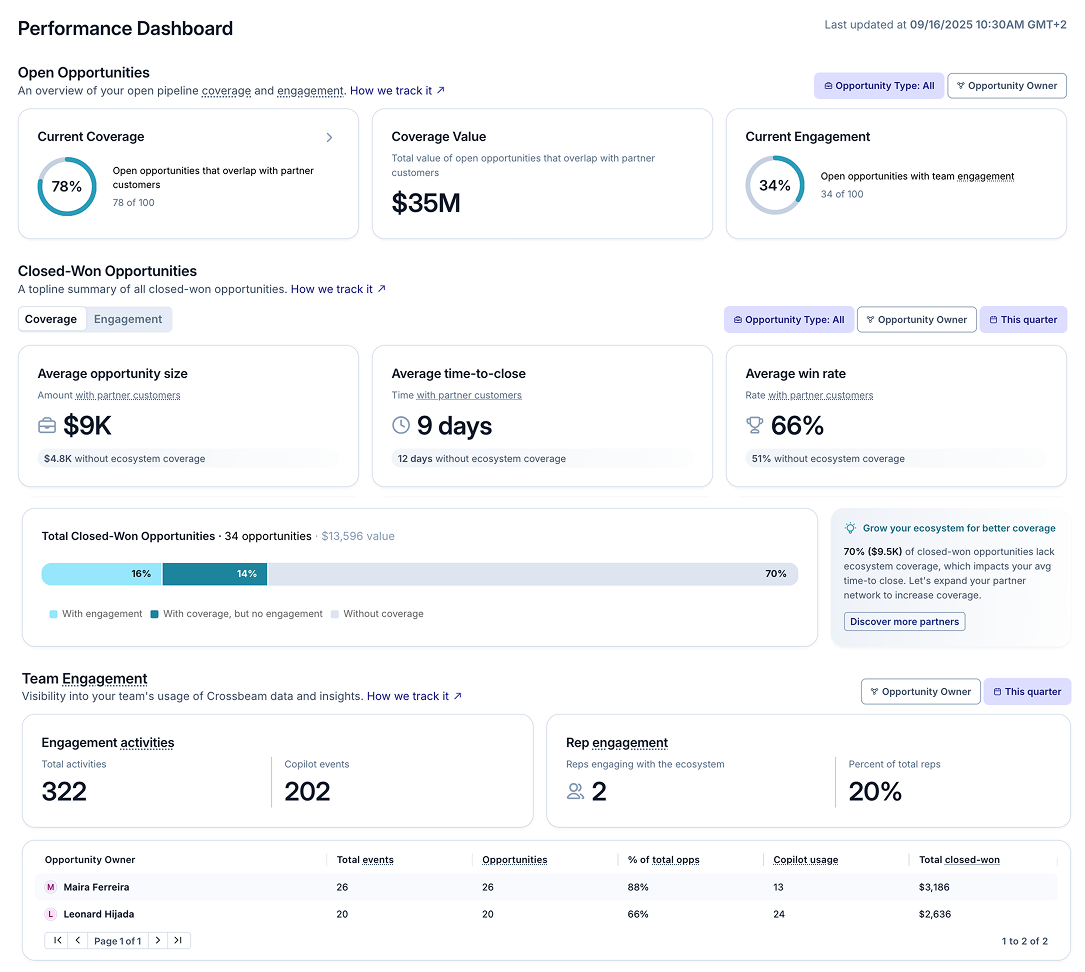
5) Operationalize with RevOps first. Let RevOps own list-building, routing, and sequence selection rules that embed partner data. Sellers shouldn’t be asked to “figure out” context in the CRM.
6) Start with one or two high-impact patterns. Pilot concrete plays like:
- Pipeline gen: partner-customer overlap + funding = prioritized outreach with partner mention.
- Deal acceleration: stalled opp + partner just closed adjacent deal = re-score opportunity, propose multi-threading path, and generate talk track.
Top tip: Measure conversion, speed to first meeting, and win-rate deltas, then scale.
7) Choose a minimal, interoperable stack. Start with Crossbeam (second-party signals), CRM fields/objects (middleware), and sequencer/copilot (delivery). Add Common Room/Clay for enrichment/drafting. Keep it simple and auditable, maintaining execution in tools already used by sales.
8) Close the loop. Attribute ecosystem-qualified leads (EQLs) and partner-assisted stages through to Closed Won. Report lift on cycle time and win rate versus baseline, and prune noisy signals.
A last word
AI and automation aren’t just “nice to have” add-ons.
When Ecosystem Intelligence workflows are built into sellers’ existing rhythm, and when the tools surface the right signals at the right time, the impact can be transformational: faster cycles, higher win rates, better pipeline, lower churn.
Sellers who still treat Ecosystem Intelligence as an optional field in CRM, or who force their teams to do manual stitching of signals, are leaving performance on the table.
As Will summed up, “Sellers don’t need more tools, they need smarter context. When AI gives them that at the right time, everything moves faster.”
If you're a sales or RevOps leader, make the case for expanding the automation + AI parts of your stack.
Ready to learn how to better leverage AI, automation, and Ecosystem Intelligence?
Book an ELG Strategy call and experience how Crossbeam’s ecosystem-powered AI delivers smarter signals, faster cycles, and bigger wins.
Don’t just take our word for it, Will has helped over 10 companies (and counting) make sense of partner data within their sales and marketing. Connect with him here.


.png)


