


Sharing Partner Data Used To Be Scary. These New Best Practices Can Help


The old days of mapping accounts using spreadsheets is over. Now, you can map accounts securely and efficiently — and allocate more of your time to driving revenue and showing the impact of your Ecosystem.

With the death of the cookie and decline of accessible third party data, data sharing with partners is more important than ever. In its 2022 “State of Inbound Marketing Trends” report, HubSpot tells marketers to “future-proof [their] marketing” by “connecting [into] a robust first-party data collection structure.”
Partnerships offer a unique opportunity to incorporate your partner’s data via account mapping, gaining valuable insight and access to prospective customers. Opting out of account mapping is incredibly limiting and invites the risk of missing out on business opportunities.
With the right etiquette, rules, and tools in place, data sharing via account mapping can be automated, fluid, and secure.
In this post, we are covering the steps to take to be in line with best practices (and help show your company leaders that the benefits of accessing your partner’s data greatly outweigh the risks).
A brief history of data sharing
In the years B.C. (before Crossbeam, obvs), the methods for sharing data were predominately make-shift. Partnerships, especially in SaaS, were relatively undefined and underinvested in as a field. As a result, the tools available were not built with the security and efficiency of data sharing in mind.
The primary method of data sharing happened via spreadsheets. This was not ideal because
Spreadsheets are not secure. Once that file leaves your inbox you have no control over who sees it, whether it’s copied, and whether it’s re-shared elsewhere.
Spreadsheets are inaccurate. Spreadsheets are not standardized across populations. From the use of different nomenclature to the labeling of subsidiaries, there are an infinite number of ways you and your partner can differentiate from one another in your record keeping.
Spreadsheets are tedious. Between tracking the human errors in a spreadsheet and having to update your data constantly manually, spreadsheets are time-consuming. The manual, non-secure process slows down the growth of the partnerships job function and wastes time that could otherwise be used building new partnerships.
Spreadsheets are instantly outdated. Once you export your data spreadsheet, it is frozen. Any time you or your partner needs updated data, the process has to start over again.
Relying on spreadsheets to share data with your partners was a risky option for security and quality. This naturally made any leader nervous when they heard the phrase “account mapping” or “sharing data with partners”. A data breach could happen with something as innocuous as someone forwarding the wrong attachment, with serious consequences for both the company and the career of the partnerships professional responsible.
While that apprehension was valid, the standardization of partner etiquette and advancements in partnerships technology have mitigated that risk. It’s similar to how technological advancements in financial services have made online banking far less risky and more accessible.
Data security through partner etiquette
Partnerships are all about relationships. And like any other healthy relationship, it’s important to establish early on how you expect to be treated: with respect and a foundation of teamwork and without competition.
Establish trust with your partner via a discovery period
Any potential partnership should be established on a foundation of mutual trust and should pass a “worst-case scenario” gut check. Do you believe there’s a chance this potential partner would act maliciously?
If the answer falls anywhere between“ I don’t think so?” and “yes,” you should probably take a pause and re-evaluate before continuing the process of partnering with this company.
If you feel confident that your potential partner will act in good faith, we recommend you undergo a discovery period to better gauge their goals.
Use this simple formula to learn the necessary information about your potential partner:

Draft a partner agreement that includes an NDA
If a partner has access to your data in any form, we recommend that you require them to sign a mutual non-disclosure agreement (MNDA) as a part of your partner agreement. A mutual NDA can be a great way to establish clear guidelines (and consequences) for what misuse of that data looks like. It also gives you legal recourse if the agreement is broken.
If you don’t already have an NDA in place, we recommend checking out these free, open source, mutual NDAs:
Try drafting a standard contract that can be modified according your individual partnerships. Like an NDA, you should have a lawyer approve your partner agreement language prior to signing. Check out these public partner agreements for inspiration:
Try a slow rollout
You wouldn’t bring on a new hire and give them access to internal company data without some kind of interview and then onboarding process. The same goes for partners. We recommend protecting your data by implementing a slow-rollout approach for partnerships.
Test your workflows with a good faith partner. If you are nervous about a new data-sharing workflow, test it out with a partner whom you already know and trust. Then, use that to identify any weaknesses in your process that you need to address.
Share minimal data and build from there. With Crossbeam’s sharing settings, you control what you share. Take advantage of this and start by sharing minimal data with new partners. This way, you can monitor how things are going and share more as you are comfortable.
Data security through partnerships tools
In 2019, Crossbeam became the world’s first Partner Ecosystem Platform (PEP), PEPs like Crossbeam are used to vet new partners, identify overlaps in customers and leads between existing partners, and execute co-selling and co-marketing efforts. In addition to features such as the ability to attribute revenue to your partners and track EQLs, Crossbeam prioritizes trust and security as core business values by:
Implementing quarterly penetration tests. These tests include automated scans and manual testing by security experts seeking to uncover and resolve vulnerabilities in Crossbeam’s security. Copies of our most recent penetration tests are made available to Crossbeam customers upon request, subject to the appropriate non-disclosure agreements. For more information, read our usage standards.
Committing to security audits yearly. This includes SOC 2 Type II audit that ensures Crossbeam’s security controls, policies, and practices are validated by AICPA’s SOC for Service Organizations Trust Services Criteria.
Following international data protection protocol. Crossbeam is compliant with stringent data-sharing laws such as the European Union’s General Data Protection Regulation (GDPR) and the California Consumer Privacy Act (CCPA). EU-US Privacy Shield Framework
Check out the Crossbeam security portal here.
Crossbeam gives you control over who has access to your data
If you don’t connect with an organization on Crossbeam, they will not see your data.
And even when you do connect with a partner, you have full control over how much of your data they see. Unlike a spreadsheet where, after you hit send, your partner can both see and re-share your data permanently, Crossbeam lets you start or stop sharing data at any point.
Customize who sees what with:
Sharing defaults
Users who want to set broad sharing settings across their user populations can do that with sharing defaults. You can set each population to default to the status
Hidden. This population is hidden from all of your partners on Crossbeam.
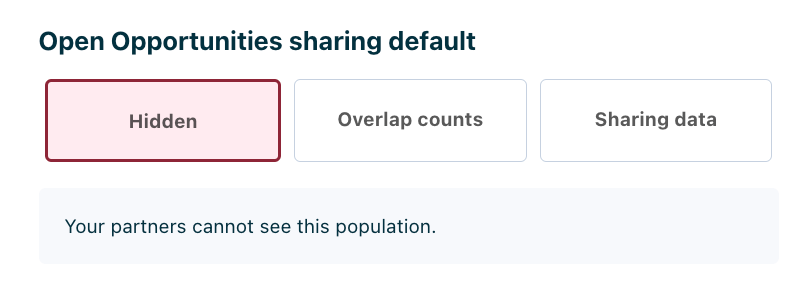
Overlap counts. Share the number of overlaps you have with a partner without revealing any more information about those accounts.

Sharing data. You select which data on overlapping accounts you want to share with your partners. This can be adjusted whenever you want.

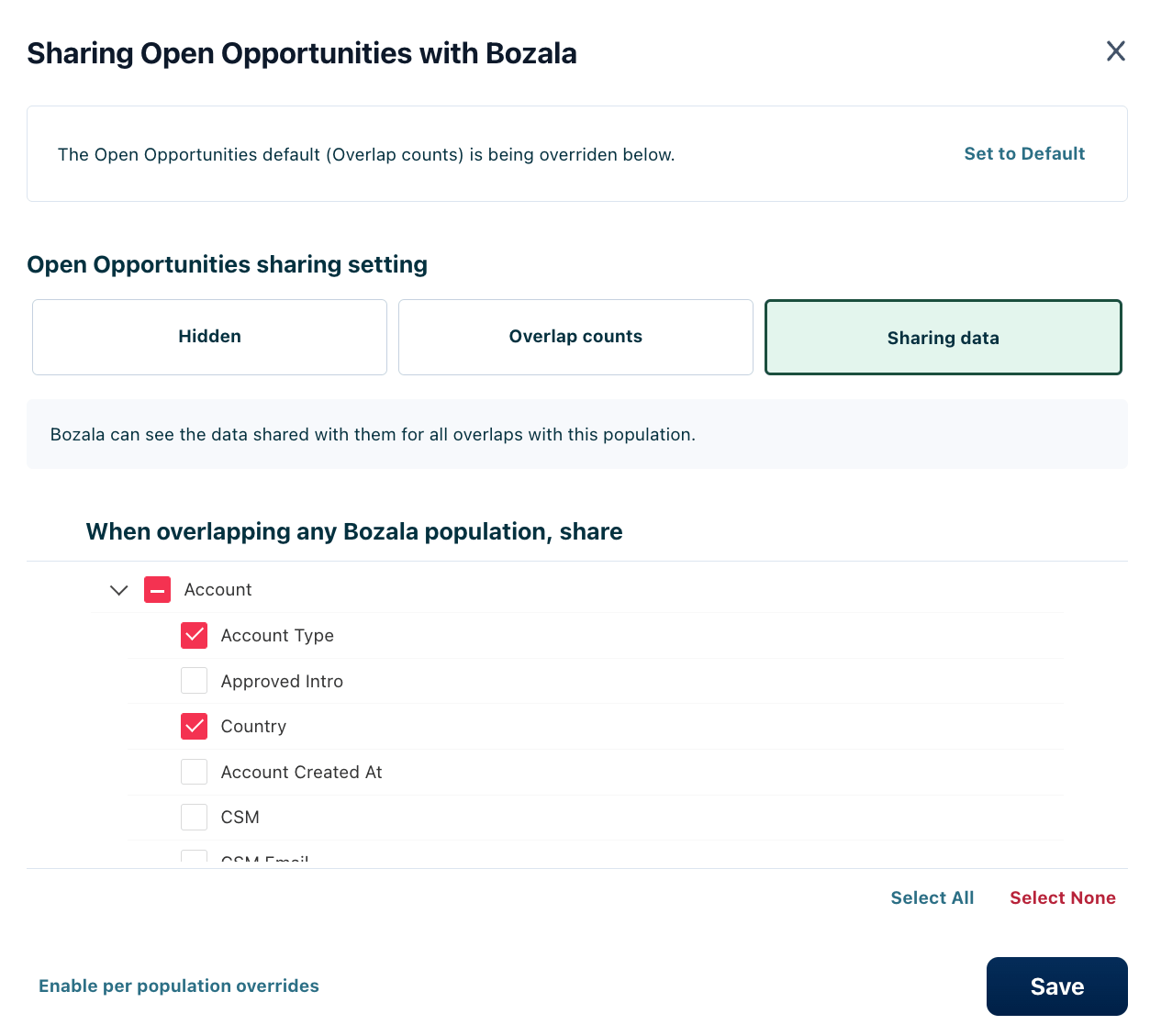
Sharing settings by Partner
Users who want to customize partner-specific collaboration can decide which populations they want to be hidden for individual partners.


Your data is up-to-date and accurate
Because Crossbeam integrates with leading CRMs, data warehouses, Google Sheets, and CSVs, your Crossbeam data is accurate.

And no matter the source, you have total control over what data enters Crossbeam.
Watch the Inside Track: Crossbeam Security 101 with Chris Castaldo for a more in-depth look at Crossbeam’s security features:
The Right Tools + Right Etiquette = Ecosytem-Led Companies
Partnerships are a proven and growing revenue lever for companies. Partnerships can’t exist without data sharing and you can’t share data with your partners if your data sharing methods don’t align.
Plus, by not using Crossbeam you miss out on results like these:
In just two months of using Crossbeam, Ryan Klekas, Director of Channel Partnerships at Bombora, a B2B intent data company, discovered hidden pipeline and closed $100,000 worth of new business.
Crossbeam helped influence 30% of Gorgias’ revenue growth from tech partnerships in just eight months. Now, partnerships account for nearly 50% of Gorgias’ revenue.
Vidyard used Crossbeam to 14x its partner-sourced revenue, going from $25K in 2019 to $350K in 2020.
Okta ventures used Crossbeam to surface 60 ecosystem-qualified leads for its portfolio companies in just two weeks.
Sendoso used Crossbeam to double the number of partner-influenced deals between Q4 2020 and Q2 2021.
By using Crossbeam to source, evaluate, and collaborate with tech partners, the four-person partner team at Dialpad launched 40+ integrations in 2021 — more than a 120% increase from the previous year.
The team at Census used sales intel from Crossbeam to boost their confidence in negotiations and pricing discussions with clients. As a result, the census team saw a 34% increase in higher annual contract values (ACV) on partner-influenced deals vs non-influenced deals.
Since adopting Crossbeam into its partnerships processes, 35% of opportunities for Friendbuy are either partner-influenced or partner-sourced.
The Everflow team uses Crossbeam to execute co-marketing and co-selling campaigns with partners. This has shortened sales enterprise cycles for Everflow by 44%.


