Partnerships 101: ISVs, VARs, SIs, MSPs, and the Glue that Holds them Together
Partnerships 101: What is Cross-Selling?
Partnerships 101: Strategic Alliances Explained (Finally!) Plus Examples
Don’t Fall Behind: Get Your Partner Data in Your Data Warehouse (Part 1 of 2)
What Partner Ecosystem Maturity is and Why it Matters
The nearbound.com manifesto: Trust is the new data
How RingCentral Built an Internal Culture of Partnerships
It’s Happening! Crossbeam and Reveal are Joining Forces to Disrupt Go-to-Market Strategy as We Know It.
Just Because It’s Partnership Tech Doesn’t Mean It’s a PRM
The Beginner’s Guide to SaaS Tech Partnerships
Everything You Ever Wanted to Know About Channel Partnerships
Nearbound Podcast #051: Day Zero Mentality - How Rob Brewster Went from Partner Chief to Company Chief
Navigating Partnership Ecosystems: Channel, Tech, and Strategic
Partnerships 101: What Is a System Integrator (SI), and Should You Partner With One?
How to Build Your Agency Partner’s Reputation While Protecting Your Own
2022 State of the Partner Ecosystem Report
Nearbound Podcast #048: The Fear & Greed Index - Right Now Every Partner Pro Needs to Stand Tall
25 Articles Showing the Business Impact of Partnerships (Bring These to Your CEO)
The Case for a Co-Marketing-First Approach
Growing Your Partnerships Team? Here are 3 Skills You Should Look for in Your New Hires
Does Partnerships Have a Boredom Problem?
A 5-Step Guide for Scoping and Qualifying Your First Tech Partners
Secrets to Building a High-Impact Partner Program
How to Ensure Accurate Ecosystem Data
A recommended ecosystem AI strategy: Take an integrated rather than a top-down approach
A Primer: 3 Things to Lookout for as a Partnership Leader
Your Guide to Preparing for Your Next Partner Pitch Meeting
How to Launch a Strategic Partner Program (And Not Take Forever to Deliver Value)
How to Guide: Partnership Alignment with Internal Stakeholders
How to measure and attribute nearbound impact
Balancing AI, automation, and the human touch in partner management in 2024
Tech Ecosystem Maturity: Scaling Your Integration Program Via Your API
The Inside Track: How to Accelerate Crossbeam Onboarding for Your Partners
Tech Ecosystem Maturity: 4 Ways Most Partner Programs Fall Short
You Have Dormant Partners. Here’s How to Get Their Interest
How to nail co-marketing events in 2024 with nearbound
How to Gain Internal Buy-in to Build New Integrations | Connector Summit 2022
Track Churn and You’re 3.6x More Likely to Have Dedicated Budget for Integrations
The State of the Partner Ecosystem 2022 Webinar
Crossbeam Explains: What are System Integrators?
The Awkward Dance: Should You or Your Partner Build the Integration?
Building the Flywheel Starts with Your Partners
Remote, In-Office, or Hybrid? Where Partnership Professionals Worked in 2021
Four Signs it’s Time to Expand Your API Docs
7 Tips for Co-Selling Like a Supernode
Nearbound Podcast #039: Dancing with Elephants — The Art of Strategic Partnering
Tech Ecosystem Maturity: How to Level Up Your Co-Marketing Motions
20+ Interview Questions for Hiring Your First Tech Partner Manager
3 Reasons to Get Certified in Your Partners’ Tech and Become Indispensable to Your Team
Tech Ecosystem Maturity: How to Level Up Your “Better Together” Messaging
Partner Ecosystems 101
Dave Goldstein: Ecosystem-Led Sales for the Enterprise: How Braze Leveraged Alliances to Fuel Robust Growth | Supernode 2023
8 Times a Partnership Impacted an “Exit Event” (And Why Acquisitions are on The Rise)
5 Signs Your Tech Partner's About to Get Acquired (And How to Prepare for Change)
Tech Ecosystem Maturity: How to Level Up Your Integrations Team
The Inside Track: Crossbeam Security 101 with CISO Chris Castaldo
Six Tips for Expanding Internationally Using Channel Partners
10 steps to develop a co-marketing strategy
How Typeform Went from 30 Integrations to 100+ in Just One Year
How Typeform Improved Their Revenue by 40% with ELG and PLG
Partnerships 101: What Is Co-Selling?
Partnerships 101: Inbound vs Outbound Integrations and Why They Matter for Your Partnerships
How to Communicate Effectively With Your Entire GTM Team and The C-Suite
Partnerships 101: What Is an Ecosystem and How Is It Redefining Partnerships?
The Inside Track: Get to know the Crossbeam Salesforce App
The 7 Metrics That Prove the Business Impact of Your Tech Integrations
8 Times Sales Reps Won the Deal by Co-Selling With Partners
6 Ways Sales Professionals Can Use Partnerships to Advance Their Careers (and Get Promoted)
How Co-Selling & Co-Marketing Build Revenue
How Demandbase Acquired DemandMatrix in Seven Months After Launching a Partnership
The Intersection of Partnerships and Product Development with Pandium’s Cristina Flaschen
The 4 Levels of Tech Ecosystem Maturity
8 Tips for Surfacing the Business Impact of Partnerships and Driving Partner-Sourced Revenue Earlier
Tech Ecosystem Maturity: How to Level Up Your Co-selling Workflows
Despite The Economy, Gartner Projects Double-Digit Growth As Companies Find Ways to Do More with Less
The 5 Things to Do in Your First 90 Days as a Partnership Leader
Ecosystem is Everything: How to Embrace Second Party Data with Crossbeam
Vetting 100s of Channel Partners? Use This Four-Criteria Checklist to Speed Up the Process
8 Ways to Treat Your Co-Selling Partners With R-E-S-P-E-C-T
Nearbound Podcast #026: Building Trust in Channel Partnerships
Partnership KPIs For Marketing, Sales, Customer Success + More
No More Silos: 4 New Ways to Use Partner Data
Account mapping. How to (finally) do it without giant, cumbersome spreadsheets
15+ Questions to Help Your Sales Reps Master Their Co-Selling Motions
How We Foster Collaboration Remotely at Crossbeam
21 Partnerships People You Should Follow on LinkedIn
A Fill-in-the-Blanks Exercise for Evaluating Your Partner Program
How to Use CRM Data & Automation to Nurture Your Co-Selling Relationships
How to Use Partner Data In Your Sales and Marketing Dashboards (Part 2 of 2)
How CallRail Increased Integration Adoption by 167% Through Strategic Partnership with HubSpot and Reveal
3-step strategy for partnership managers
How to Execute an Effective Nearbound Channel Strategy
Don't Try To Fit Ecosystem Partners into a Channel Hole
Nearbound Podcast #022: Build, Buy, or Partner
You Should be Account Mapping at Every Stage of the Customer Lifecycle
5 Ways to Incentivize Your Sales Team to Live, Eat, and Breathe Partnerships
How to Learn the Partnerships Love Languages
How to Learn Your Customer’s Tech Stack and Increase Integration Adoption by 17%
The 9-Step Partner Impact Score Methodology for Strategic Co-Selling With Partners
Catherine Brodigan: Effective Co-Selling* (*because you have no other choice) | Supernode 2023
ELG AI

The 2x2 Matrix of AI Data
by
Bob Moore
SHARE THIS

Discover how AI can transform your B2B sales strategy with second-party data. Learn from Bob Moore about the 2x2 matrix of AI data and why feeding AI the right information is key to unlocking its true potential.

by
Bob Moore
SHARE THIS

In this article

Join the movement

Subscribe to ELG Insider to get the latest content delivered to your inbox weekly.

If you’re building AI agents to power your team’s work, you need to stop thinking about AI like a productivity hack and start thinking of it as a partner strategist. And like any good strategist, its impact is only as strong as the intelligence it’s fed.

If you read my book, you know that I’m a sucker for a good 2x2 matrix. The realm of AI is no exception. In fact, the single most important framework I’ve used this year to explain what’s going on in the AI landscape and across the B2B industry is the 2x2 matrix of AI data. It is my most requested slide of 2025.

This simple matrix helps teams (and Crossbeamers) understand exactly why their AI tools and agents are hitting ceilings, and where the leverage lies to break through.

The 2x2 matrix: Commodity vs. proprietary, actionable vs. self-referential
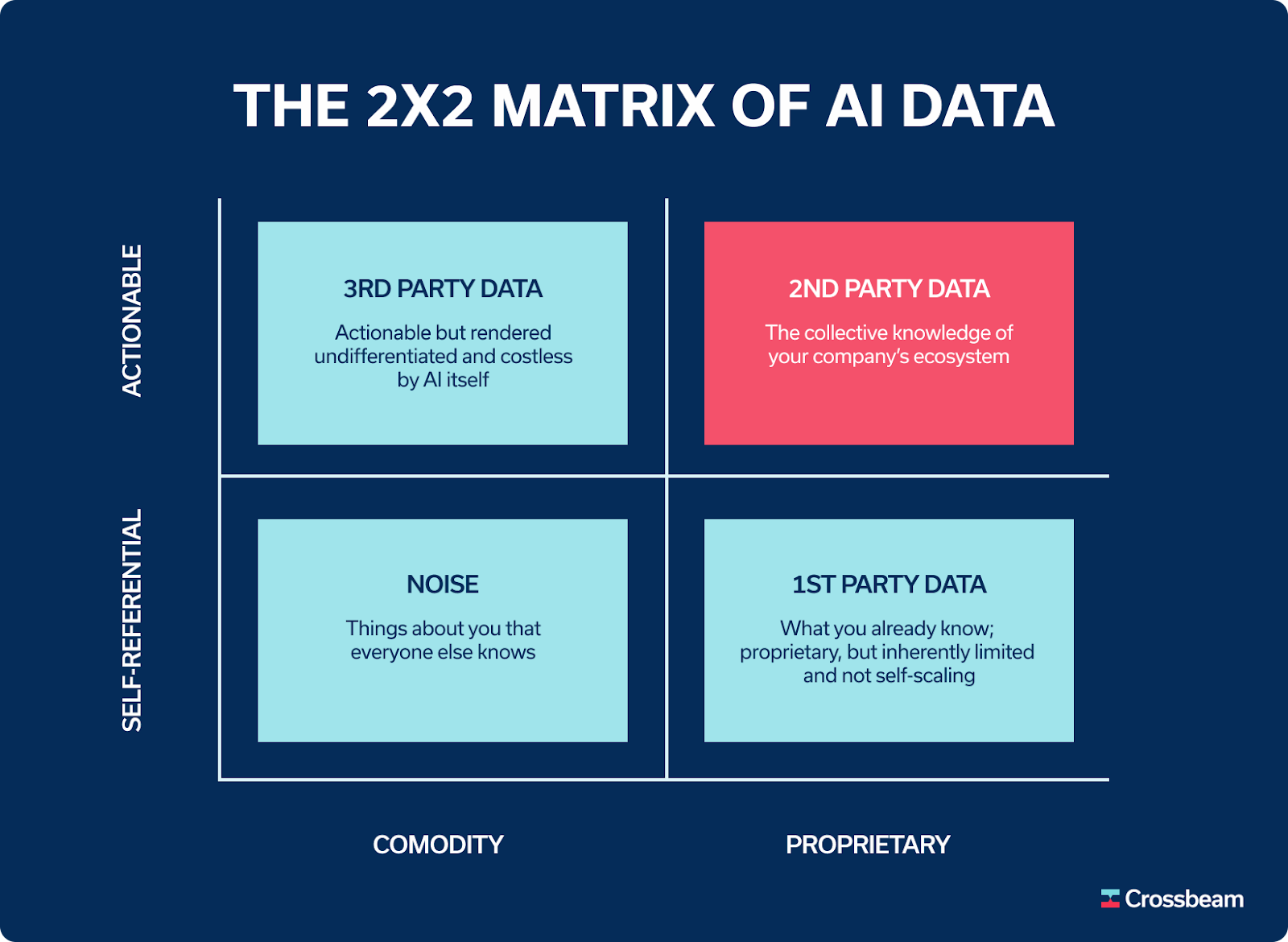
All the data you feed into your AI agents can be plotted along two axes:

  • Commodity vs. proprietary: Can anyone get this data if they’re willing to pay for it or scrape the web? Or is it locked behind your walls, unique to you?
  • Actionable vs. self-referential: Does this data uncover new opportunities and expand your market? Or is it just processing and resurfacing things you already know?

Put those on a grid, and here’s what you get:

  1. Bottom left (commodity + self-referential): It’s basically noise. Think: stale leads in your CRM or IP addresses of anonymous web traffic. Everyone has it and not everybody needs it.
  2. Top left (commodity + actionable): Better known as third-party data. It’s publicly available lists with information like job titles and firmographics, the kind of stuff you buy from a broker. It’s actionable, sure, but it’s not unique since people can “easily” access it.
  3. Bottom right (proprietary + self-referential): This is first-party data like your own product usage stats, website forms, active CRM records. This type of data is only yours, but it’s only telling you what you already know.
  4. Top right (proprietary + actionable): The crown jewel, second-party data. It includes shared partner data that reveals new opportunities you wouldn’t know otherwise. It’s unique to your ecosystem, dynamic, and it changes the game and now it comes through account mapping with AI.

Enter second-party data: The AI superpower

Second-party data is both proprietary and actionable. That’s what makes it so powerful. It’s the rare kind of intelligence that’s not publicly available, yet instantly useful. This is the data AI agents crave — not scraped, sold, or generic, but shared directly from trusted partners. It tells you what’s happening inside accounts you don’t yet own, but absolutely should.

The good news is that obtaining data like this doesn’t require you to build or overhaul your current systems. This is account mapping. This is Ecosystem-Led Growth (ELG). And this is where your sales and ecosystem AI strategy either flies or falls.

At Crossbeam, we’ve spent years helping companies build this data layer and now we’re feeding it into AI. When you combine partner overlap data with first-party CRM insights, you unlock capabilities that are genuinely new, like our new feature (now in Beta), Deal Alerts.
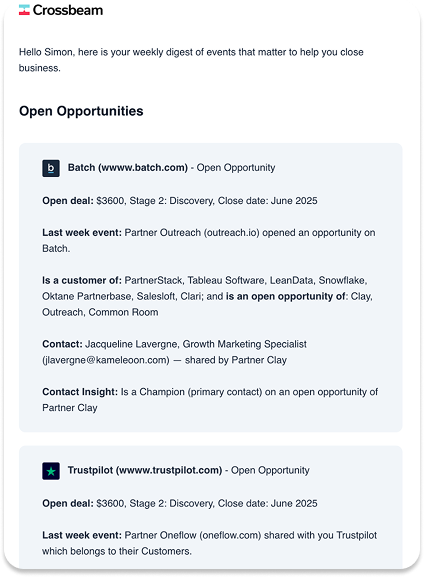
These are AI-powered signals that surface high-impact opportunities by analyzing things like:

  • Overlaps with partners in your ecosystem
  • Status of shared accounts (customer, open opp, churned, etc.)
  • Movement in your CRM (new contacts, stalled deals)

Instead of your reps endlessly digging through dashboards or running reports, Deal Alerts show up directly in your inbox, flagged and explained by AI. They don’t just say what’s happening, they tell you why it matters now. 

Think: “This opp stalled 30 days ago, but your partner just closed a deal with the same account. Here’s the contact.”

As Matt Nicosia, our Head of AI Operations, wrote in his breakdown of AI at Crossbeam, “We're building AI features that sit inside our products, see your ecosystem data, and suggest what to do next.” That’s exactly what Deal Alerts do, they take the guesswork out of go-to-market by letting your ecosystem do the talking.

Because, in the age of AI, your advantage isn’t the model, it’s the data — and second-party data is the one edge no one else can copy.

Why this matters now

We’re at a point where Large Language Models’ (LLMs) functionality is a commodity. The model doesn’t matter as much as the data you’re feeding it. And if you’re only giving it what’s already in your CRM, you’re going to hit a wall.

OpenAI and others are making it easier than ever to plug your AI into every data source you’ve got. But what you feed it matters more than how much, and most companies are missing the one quadrant that truly unlocks scale: partner ecosystem data.

As AI in B2B sales becomes table stakes, ecosystem data becomes your differentiator.

The ecosystem advantage

AI is no longer just a tool. It’s a channel — an agentic ecosystem, capable of scaling strategy, not just execution. And when you feed that ecosystem second-party data and Crossbeam AI data, you’re not just building smarter dashboards or tighter workflows. You’re creating connected intelligence across organizations.

“Integrated ecosystems with connected organizations, that’s the future,” as James Hodgkinson, SVP of Ecosystems at 360Insights, put it in our recent webinar.

I couldn’t agree more.

Curious how we’re using AI at Crossbeam to power smarter go-to-market strategies?

Book a meeting with our team to learn how we’re leveraging AI internally and how features like Deal Alerts turn ecosystem data into real revenue.

You’ll also be interested in these

AI at Crossbeam
Ecosystem Intelligence: The Shortcut to Sales That Actually Close
Build a Smarter Sales Playbook: Powered by Ecosystem Data