What a Genuinely Personalized AI Cold Email Actually Looks Like — With Examples


Signal-based outbound delivers 18% reply rates vs. 3.4% for generic outreach. Here's what the prompts behind high-performing AI cold emails actually look like — with real examples.

Last updated: May 2026
Most sales leaders deploying AI outbound discover the same thing at around month three: the reply rates didn't move. Volume went up. Noise in the inbox went up. But the percentage of emails that got a response stayed roughly flat.
The instinct is to blame the AI. Or the tool. Or the prompt wording. It's rarely any of those.
Jason Lemkin, CEO and Founder of SaaStr, puts it well: it takes 47 iterations to stop one AI SDR from being too aggressive on pricing. The companies failing with AI agents expected two iterations. The ones winning expected 50.
Most of those iterations should be happening on the data, not the prompt wording. What you give the AI to work with determines the ceiling on what it can produce. This article shows what that difference actually looks like, with three real prompts and the emails they generate.
Where AI SDRs actually work — and where they break
Before getting into the prompts, it's worth being honest about what AI is good at in the outbound workflow and what it isn't. According to Instantly’s 2026 Cold Email Benchmark Report, signal-based selling — where you're leveraging specific, exclusive data about each prospect — is the stage where AI delivers 18% reply rates vs. 3.4% for generic outbound.
But AI is brittle at the later stages: handling actual conversation, qualifying intent, building the trust that closes.
The reps winning right now aren't choosing between AI and human judgment; they use AI to fill the pipeline with well-researched, data-rich outbound, then show up to the conversation as the expert the AI can't replicate.
The prompt quality determines how well the AI does its job in the first part. Here's what separates the prompts that produce generic output from the ones that produce emails worth responding to.
What do the three data layers unlock?
Every AI outbound email draws from some combination of three data types. The ceiling on what the email can say is set by the data types in the prompt. We cover this in more depth in this article, but here's a quick recap:
- First-party data is what's in your own systems: engagement history, prior conversations, and content downloads.
- Third-party data is what you license from enrichment and intent vendors: better reach for cold outbound.
- Second-party data is information that exists in the relationship between your company and your partner ecosystem: for example, which accounts already use tools that integrate with yours.
Three prompts and what each produces
The following examples use a fictional company called Vantage, which sells revenue analytics software. Their SDR, Morgan Lee, is reaching out to Pat Sullivan, VP Revenue Operations at Cascade Technologies. Three prompts, three very different emails.
Prompt 1: first-party data only
What Morgan gives the AI:
Prompt:
"Write a cold email to Pat Sullivan, VP Revenue Operations at Cascade Technologies.
Context: Pat downloaded our guide on improving forecasting accuracy last month.
Tone: conversational, under 100 words. CTA: 20-minute call."
What comes back:

This email can only go to Pat because Pat has already interacted with Vantage. For the rest of Cascade's RevOps team — anyone Morgan might want to reach to multi-thread the deal — the prompt has nothing. Even for Pat, it gives no reason why the conversation would be worth their time specifically.
Prompt 2: first-party and third-party data
The key difference: now we're adding enrichment signals.
Prompt:
"Write a cold email to Pat Sullivan, VP Revenue Operations at Cascade Technologies.
Context: Pat downloaded our forecasting accuracy guide last month. Cascade has scaled fast — 12 new AE hires in the last 90 days, new VP of Sales just joined. Teams at this growth stage typically hit friction around forecast accuracy.
Tone: direct, under 120 words. CTA: 20-minute call."
What comes back:
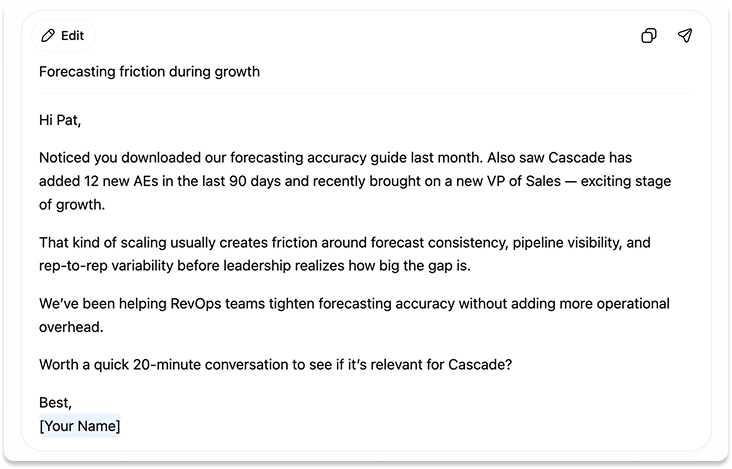
Better. The email reflects something real about Cascade's situation. But the hiring data came from enrichment vendors that every one of your competitors also subscribes to.
After enough emails in this format land in the same inbox, the pattern becomes recognizable. Pat is receiving structurally similar messages from other vendors this week. This is what Jason meant by "reviewing the first 1,000 emails"; this process usually reveals that the AI learned to write well-formatted emails that all follow the same structure.
Prompt 3: first-party, third-party, and second-party data
Add ecosystem data:
Prompt:
"<task> Write a cold email to Pat Sullivan, VP Revenue Operations at Cascade Technologies. </task>
<context> Pat downloaded our forecasting accuracy guide last month. Cascade has been scaling quickly — 12 new AE hires, a new VP of Sales. Cascade already runs Salesforce, Gong, and Clay — all three integrate directly with our platform. We have over 70 customers running Vantage on that exact stack; they've told us specifically that it closes the gap between having revenue data and actually trusting it. CTA: 20-minute call to show Pat what this looks like for Cascade specifically. </context>
<format> Direct, peer-to-peer, no superlatives, under 150 words. </format>"
What comes back:
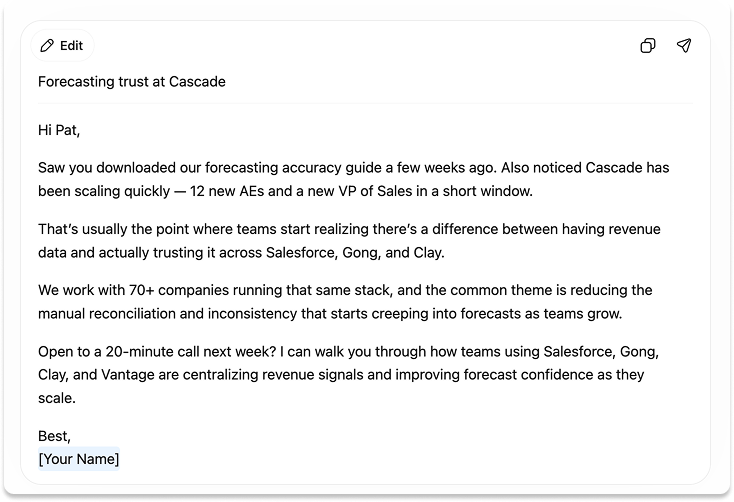
No competitor targeting Pat this week can send that email. The Salesforce, Gong, Clay piece, and the 70 customers on that stack come from Vantage's partner ecosystem data.
The XML tag structure (<task>, <context>, <format>) keeps the model focused when the prompt is this detailed. The email it produces is different in kind — not a better version of Email 2, but a structurally different argument built on data only Vantage has.
"The companies failing with AI agents are the ones who expected 2 iterations. The ones winning expected 50." — Jason Lemkin, SaaStr. Most of those 50 iterations should be spent on the data going into the context, not the wording of the prompt itself."
One example is BEMO, a managed IT service provider focused on security and compliance, which used this signal-aware outreach approach to improve outbound performance.
By layering Crossbeam partner overlap data into their existing stack — ZoomInfo, Clay, 6sense, and HubSpot — they went from booking 10 meetings in 10 months to 5–10 meetings per month, a 900% improvement. They also achieved a 10% reply rate on opened outbound emails and generated $1.8M in pipeline in 6 months.
Their process didn’t change; the signal layer underneath it did. Learn their step-by-step process here.
What is signal-aware outreach?
Signal-aware outreach is a cold email built on relationship-context data — specifically, data about how a prospect's company relates to your existing network of customers and partners — rather than firmographic or intent signals alone. Signal-aware outreach requires three things: a data source that surfaces second-party data (Crossbeam), an AI agent that can turn that context into a personalized message, and a sequencing platform that delivers it at scale. The prompt connecting those three is where the quality lives.
What ecosystem signals should an AI SDR use to personalize a cold email?
Crossbeam surfaces several distinct categories of second-party signal, each of which enables a different kind of exclusive email premise. Here are the four most actionable, with an example of how your AE might use each one.
Signal 1: Crossbeam Copilot (reach the actual decision-maker)
What Crossbeam surfaces: Crossbeam Copilot identifies the true decision-maker and economic buyer at a prospect account, enriched and validated through your partner network. Rather than guessing from a job title, you get partner-vetted contacts — the specific people your partners have confirmed own purchasing decisions for your product category.
How to use it in a prompt: reference the partner validation in the opening. The premise is that you're not reaching out because of a title match — you're reaching out because a trusted partner confirmed this is the right person.
Email example:
Subject: Quick question about forecasting at Cascade
Hi Pat,
I came across Cascade while working with the Salesforce ecosystem team and thought the timing might make sense to reach out.
We work with several RevOps teams using Salesforce alongside Vantage, and a common theme is improving confidence in forecast conversations as teams scale.
Given your role, I figured this might be relevant to what you’re thinking about internally.
Open to a quick conversation next week to compare notes?
— Morgan, Vantage
Why only you can send this: the partner validation that Pat is the economic buyer — not just someone with "VP" in their title — comes from Crossbeam Copilot's partner-enriched contact data. Your competitors are guessing who to email at Cascade. You're not.
Signal 2: Partner has an open opportunity (co-sell moment)
What Crossbeam surfaces: one of your integration partners has an active opportunity with an account in your pipeline. This creates a co-sell window; both companies have a reason to show up for the same conversation.
How to use it in a prompt: reference the partner context and the shared timing. The most natural angle is to offer support for what the partner is already building with the prospect.
Email example:
Subject: Gong + Vantage at Cascade
Hi Pat,
I know a lot of teams using Gong eventually run into the challenge of connecting conversation data back to forecast confidence and pipeline quality in a practical way.
That’s usually where Vantage comes into the picture. Several of our customers use the two together to give RevOps and sales leadership a more reliable view of what’s actually happening in deals.
Thought this might be relevant given the tools Cascade might be evaluating.
Worth a 20-minute conversation?
— Morgan, Vantage
Why only you can send this: the partner opportunity data is visible to you through Crossbeam because your partner agreed to share it. Your competitors don't know Gong is already in that account. You do.
Signal 3: Account is a customer of a partner (integration relevance is immediate)
What Crossbeam surfaces: an account in your pipeline is already a paying customer of one of your integration partners. This is the strongest integration argument — they've already committed to the adjacent product, and the integration works for their exact use case.
How to use it in a prompt: lead with the native integration and what it enables specifically for an account already running the partner product.
Email example:
Subject: The Cascade, Holver, and Vantage workflow
Hi Pat,
A lot of RevOps teams running Holver reach a point where forecasting becomes harder to trust as the sales org grows — especially once more reps, managers, and pipeline sources get added into the mix.
Vantage plugs directly into Holver, so teams can centralize pipeline and revenue signals without relying on manual reconciliation across systems.
Thought this could be relevant for Cascade, given your current stack and growth stage.
Open to a quick 20-minute conversation next week?
— Morgan, Vantage
Why only you can send this: you know Cascade is a HubSpot customer through partner-shared data in Crossbeam. The email premise — immediate native integration for a product they're already running — is only relevant because of that specific signal.
If you want to turn a cold outreach into a warm introduction, use Ecosystem Intelligence to identify which partner already has credibility and context with the account.
For example, Crossbeam's Partner Score gives your sales and partnerships teams a clear signal for which partners are most likely to help move a deal forward. It combines account overlap coverage with historical partner impact — including win rate, deal size, and time to close on shared accounts — into a simple rating: High, Medium, Low, None, or Unknown.
Sellers get a data-backed recommendation directly inside the tools and workflows they already use, making co-selling decisions faster, more consistent, and easier to operationalize across the GTM team.
How to add second-party data to your prompts
The second-party data comes from your partner ecosystem — specifically, the accounts in your pipeline that already run tools compatible with yours. For most teams, this data exists, but it just isn't connected to the outbound motion. It lives in a partner portal or a spreadsheet that the sales team has never seen.
Crossbeam maps your partner ecosystem and surfaces which accounts in your pipeline already have that overlap. The segmentation is the move; knowing which accounts you can write the ecosystem email for is actionable before you touch a single prompt.
One practical note from the operators: don't deploy the ecosystem prompt at scale until you've manually reviewed the first batch. The principle from Lemkin applies here too — review enough outputs to understand what the model is doing with the ecosystem context before you let it run unsupervised.
See which accounts in your pipeline qualify for an AI outbound prompt
Most teams find overlap they didn't know was there. Crossbeam surfaces which accounts in your pipeline are already connected to your partner network — the accounts where the ecosystem prompt is possible.
Join Crossbeam for free and see which of your pipeline accounts already overlap with your partner network — before your next AI outbound campaign.
FAQ
What data should I put in an AI outbound prompt to get better emails?
Lead with second-party data — which tools the prospect already uses that integrate with yours, and what your existing customers on that same stack have experienced. Add first-party context (prior engagement if it exists) and third-party enrichment (growth signals, timing triggers) as supporting context. Use XML tags (<task>, <context>, <format>) to keep the model focused when the prompt is detailed. For accounts with second-party data available, this combination produces emails no competitor can replicate.
How many iterations does it take to get AI outbound right?
More than most teams expect. Jason Lemkin noted it took 47 iterations to stop one AI SDR from being too aggressive on pricing. Most of those iterations should be on the data strategy — which signals are going into the prompt — not just the wording. Teams that expect to improve AI outbound in two to three adjustments consistently underperform the ones that build iteration into the process from the start.
What is the difference between AI outbound that works and AI outbound that doesn't?
Signal quality. Research shows signal-based selling produces 18% reply rates vs. 3.4% for generic outbound. The AI itself is not the differentiator — the data in the prompt is. Generic prompts built on enrichment data, every competitor also has to produce generic emails. Prompts built on second-party ecosystem data produce emails only you can send. The model is the same. The ceiling is set by the inputs.
Where do AI SDRs work well, vs. where do they break?
AI excels at the early stages of the SDR workflow: list building, personalization, and outbound execution. It is brittle at the later stages: handling actual conversation and qualifying intent. The winning model in 2026 is not AI replacing the SDR — it's AI filling the top of the funnel with well-researched, data-rich outbound so the human SDR can focus on the conversations that actually close. The prompt quality determines how well the AI does its part.
What is signal-aware outreach?
Signal-aware outreach is a cold email built on relationship-context data — how a prospect's company relates to your existing network of customers and partners — rather than firmographic or intent signals alone. It produces emails where the argument is exclusive to the sender: not "you fit our ICP" but "you're already operating in a network where our product is trusted." The exclusivity comes from second-party data (ecosystem overlap, partner opportunity status, tech stack adjacency) that no enrichment vendor sells.
What signals should an AI SDR use to personalize a cold email?
Prioritize signals in this order: second-party ecosystem signals first (tech stack match, partner has an open opportunity, account is a partner's customer, mutual customer overlap), then first-party context (prior engagement), then third-party enrichment (growth signals, timing triggers) as supporting context. The second-party signals are the ones that produce emails no competitor can send. The first and third-party signals add warmth and timing relevance but don't change the competitive dynamics on their own.
How do I get second-party data into my AI outbound prompts?
Connect your CRM to Crossbeam and invite your integration partners to do the same. Crossbeam surfaces which accounts in your pipeline already have ecosystem overlap with your partner network. Those accounts get the ecosystem prompt. The rest get your standard enrichment-based prompt. The segmentation is valuable on its own — knowing which accounts you can write the third email for tells you which pipeline accounts are already pre-qualified through your ecosystem.