



Why AI Outbound Feels Generic and What's Actually Missing


AI outbound feels generic because everyone uses the same data. Here's why and how second-party signals create emails no competitor can replicate.

Last updated: April 2026
The most common response to underperforming AI outbound is switching tools. However, the issue is upstream from the tool, in the data the tool is working with. To get your AI outbound motion up and running, all you have to do is fix the data, and trust us, your emails will get better.
Add a better model on top of the same data, and you get the same emails slightly faster.
This article explains why AI-generated outreach feels generic even when it's technically personalized, introduces the three categories of data that determine email quality, and shows — through concrete examples — how layering second-party data into your brief produces emails no competitor can replicate.
Why does AI-generated outreach feel generic?
Every AI outbound tool on the market draws from the same three data pools.
First-party data: What you've collected directly, for example: CRM records, engagement history, and prior conversations.
Second-party data: What exists in the relationship between your company and your partners — ecosystem overlap, integration network adjacency, and shared accounts.
Third-party data: What you buy from enrichment and intent vendors, for example: firmographics, content consumption signals, job changes, and tech stack information.
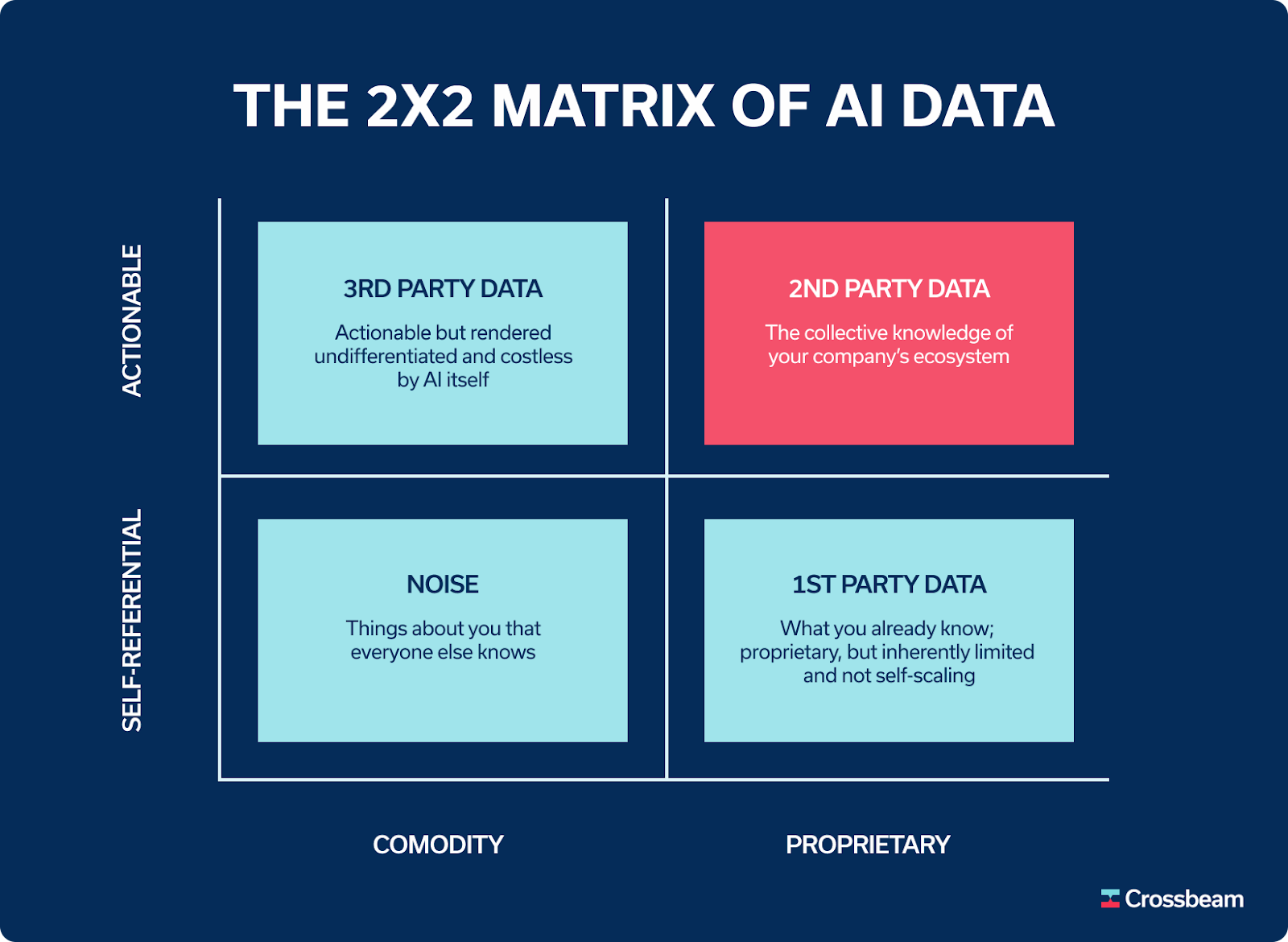
Most AI outbound stacks run almost entirely on first-party and third-party data. The first-party layer is limited to accounts already in your funnel. The third-party layer is useful, but it's available to every company with the same vendor subscriptions. When the input data is identical across every competing vendor, the personalization outputs are structurally identical.
Two companies, same prospect, same data pool, same email premise. What will happen is that your prospect will receive both emails and tell you that neither is specific to them.
AI outbound volume has grown substantially over the past two years. Reply rates have gone the other direction. More emails, fewer responses per email. This is what happens when personalization scales without the signal layer underneath it changing.
What is the difference between AI personalization and mail merge?
Mail merge personalized the greeting and the company name. AI outbound personalizes the opening line, the subject, and sometimes the value proposition framing. When both draw from commodity data, the structural difference is cosmetic — the surface changes, the premise doesn't.
Genuine personalization means the argument itself is different, not just the references. The clearest way to see this is by example:
Consider a fictional SDR, Taylor Reyes, at Sentinel Software — a fictional cybersecurity vendor — reaching out to Chris Nakamura, Head of Information Security at Quantum Dynamics.
Email one: First-party data
Subject: Your recent guide download
Hi Chris,
You downloaded our guide on threat detection best practices last month. We work with information security teams at companies of your size, and thought it might be worth a conversation about what we're seeing in similar environments.
20 minutes this week?
— Taylor Reyes, Sentinel Software
This email can only go to Chris because he engaged with Sentinel's content. For the other 95% of security leaders at Quantum's scale who haven't, the first-party data cupboard is empty.
Email two: First-party and third-party data
Subject: Quantum's expansion and what that means for your attack surface
Hi Chris,
You downloaded our guide on threat detection last month. I can also see that Quantum Dynamics has been growing quickly — three new regional offices this year, significant headcount expansion.
That kind of growth typically means a meaningfully larger attack surface and more endpoints to protect than the existing stack was sized for.
Teams at this stage often find coverage gaps they didn't know were there. We've helped a few companies work through this faster than expected.
Worth 20 minutes?
— Taylor Reyes, Sentinel Software
Taylor is demonstrating awareness of Quantum's actual situation. But the growth signals and office expansion data came from third-party sources that every enrichment vendor sells. Three of Sentinel's direct competitors sent Chris a structurally similar email this week, built from the same data.
Email three: First-party, third-party, and second-party data
Subject: Quantum's growth and something in your security stack
Hi Chris,
You downloaded our guide on threat detection last month — and from what I can see, Quantum has been expanding quickly.
Here's what actually prompted me to reach out: Quantum is already running [Security Tool A], [Security Tool B], and [Security Tool C].
All three integrate directly with our platform. When those tools are mapped together, it often reveals coverage gaps and redundancies across your endpoint environment that aren't visible from inside any single tool.
We can show you what that looks like for Quantum's stack specifically. 20 minutes?
— Taylor Reyes, Sentinel Software
Every company targeting Chris this week has access to the first-party signal (if he engaged with their content) and the same third-party growth data. Nobody else has what's in the email three.
The specific knowledge of which security tools Quantum already runs — and how they map to Sentinel's integration ecosystem — is information only Sentinel has because of the specific partnerships they've built.
"What is signal-aware outreach? Signal-aware outreach is a cold email built on the three layers of data: relationship-context data — partner overlap, ecosystem adjacency, integration network connections — rather than firmographic or intent signals alone. It produces emails where the argument is structurally different, not just the surface references."
Why is AI outbound personalization stuck at the surface level?
The enrichment industry has successfully convinced us that more data means better personalization. It doesn't. More first-party and third-party data produces more sophisticated surface-level personalization. The ceiling is determined by the category of data, not the volume of it.
Second-party data is the missing layer. This data isn't available from any enrichment vendor, because it only exists in the specific overlap between your CRM and your partners' CRMs.
How to make AI outbound more relevant and less spammy?
Start with an audit of what data you're actually passing to your AI agent. Pull up your current brief and list every field.
For each one, ask: Is this data available to my competitors from the same sources? If the honest answer is yes across the board, every competitor targeting the same accounts is building from the same inputs.
So, here’s what we recommend you do:
- Connect your CRM to Crossbeam to surface which accounts in your pipeline already have second-party data available. Crossbeam maps ecosystem overlap across your partner network automatically. It gives you the list of accounts where a structurally different brief is possible, without requiring manual research on every prospect.
- Identify which of those accounts use integration tools connected to your partner network. These are the accounts where no competitor can send the same email you can — because the premise is built on your specific relationships, not shared enrichment data.
- Build a separate brief for those accounts that leads with the integration connection and what it implies about overlap.
- Run both briefs in parallel for two weeks and compare reply rates. The gap is the business case for investing further in second-party signal acquisition.
The teams seeing genuinely different results from AI outbound are not running better models. They're running the same models on data their competitors can't access.
See what second-party data exists in your pipeline
Crossbeam surfaces the ecosystem overlap between your accounts and your partner network — the second-party signals that make email three possible. Most teams find accounts in their pipeline that they didn't know were already connected to their ecosystem.
Join Crossbeam for free and see which accounts in your pipeline already overlap with your partner network, before your next outbound campaign goes out.
FAQ
Why does AI-generated outreach feel generic?
Because every team is building outreach from the same two data categories: first-party data from their own CRM and marketing systems, and third-party data from enrichment vendors. When the inputs are identical across the market, the outputs are structurally identical. The fix is adding second-party data — information that exists in your partner ecosystem and isn't available to any competitor from any vendor.
What is the difference between AI personalization and mail merge?
Mail merge changes the name and greeting. AI personalization changes the surface references — opening line, subject, framing, etc. When both draw from commodity data, the structural difference is cosmetic. Genuine personalization means the core argument is built on information no competitor has access to — which requires second-party data, not just better prompts.
Why do AI SDRs underperform human reps at personalization?
Human reps incorporate relationship context that AI agents don't have access to: a conversation at a conference, a mutual contact's recommendation, and intuitive knowledge of how a prospect's business relates to the rep's network. AI agents can reach the same quality of personalization when given the same class of context — specifically, second-party ecosystem data that reflects relationship proximity rather than firmographic similarity.
What is signal-aware outreach?
Signal-aware outreach is a cold email built on relationship-context data — partner overlap, ecosystem adjacency, integration network connections, plus firmographic and intent signals. It produces emails where the argument is structurally different because it's built on information no competitor can access from a vendor.
Why is AI outbound getting lower reply rates than manual outreach?
AI outbound at scale pushes every team onto the same commodity data inputs. The market has scaled volume substantially while the underlying signal quality has stayed flat — the result is more emails producing fewer responses. Teams that layer second-party data into their first and third-party data outbound motion consistently outperform this pattern, because they're building from signals their competitors don't have.