Why AI + Partnerships Is the New GTM Power Combo: Insights From the ELG Summit


Discover why AI + partnerships are redefining modern GTM. Learn how Anthropic uses MCP, Claude, and ecosystem data to power a lean, high-impact revenue engine.
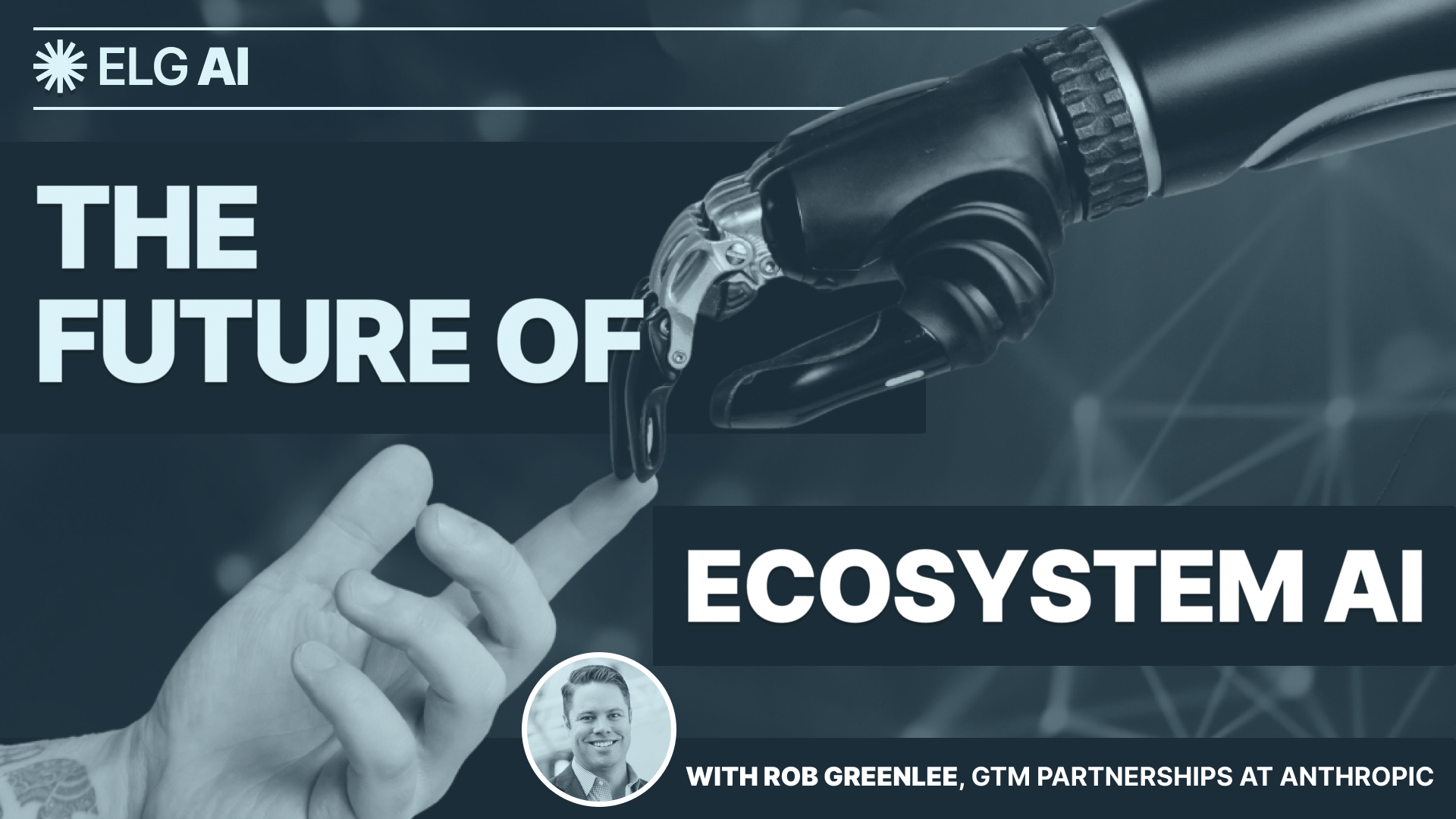
AI isn’t a nice-to-have anymore.It’s becoming the operating system for how modern companies build, sell, and partner. And few people sit closer to that shift than Rob Greenlee, who leads go-to-market partnerships at Anthropic, the company behind Claude.
In a recent conversation during the ELG Summit 2025, Rob walked through how Anthropic runs an AI-native go-to-market motion, how they think about partners, and why integrations like the Claude–Crossbeam MCP Server connection will fundamentally change how revenue teams use ecosystem data.
Here’s what GTM and partnerships leaders can steal from Anthropic’s playbook.
Why MCP and integrations are the real unlock
Rob is blunt about the core problem: DATA.
“It’s a matter of getting access to the data and the information that you’re trying to use to load into your LLM,” said Rob. “That data is very disparate, it’s stored in a bunch of different places… If you don’t have access to that data, you don’t have all the context that you need.”
Without that access, reps end up copy-pasting between tools like Salesforce, Slack, docs, partner portals, BI tools, and your “AI strategy” becomes a glorified text editor.
“The first thing that [sales] teaches you is the relationship aspect of working with sellers, working with partners, what works, what doesn’t work… It just makes it easier,” said Rob. “It makes people actually believe you when you’re saying, hey, bring in this partner, it’s going to help the conversation… It’s going to lead from a $10,000 opportunity to a $1 million relationship with the customer.”
Anthropic’s answer is the Model Context Protocol (MCP), which lets Claude securely talk to third-party systems via “servers”, for example:
- Salesforce MCP Server
- HubSpot MCP servers
- And now, Crossbeam’s MCP Server, which lets Claude pull in ecosystem and partner overlap data directly into the chat.
“We’re starting to see all of these MCP servers come into the directory and Crossbeam is going to be in there soon,” said Rob. “I can’t wait… People aren’t swivel chairing between different systems and copying and pasting anymore.”
If you’re not participating in this ecosystem, exposing your data via MCP and consuming others’, you’re effectively asking your teams to do AI the hard way.
The new partner stack at an AI-native company
Anthropic’s ecosystem looks familiar at first glance, CSPs, GSIs, SIs, ISVs, but the way they use those partners is very AI-era.
1. Cloud providers as primary go-to-market channels
Anthropic works deeply with AWS Bedrock and Google Vertex.
“Our models are available on their platforms typically the day that we launch on our first-party API,” said Rob.
These aren’t just infra partners; they’re distribution engines and co-sell motion amplifiers. Customers can consume Claude wherever they prefer to build, Anthropic’s own API, hyperscalers, or other platforms like Databricks and Snowflake.
2. AI-native consultancies as force multipliers
Rob is especially excited about a new class of AI-native SIs: firms like Tribe AI, Factored AI, Blank Metal, and Slalom.
“We’re getting conversations from our customers that… we have a board mandate to actually get something done with AI in the next two weeks,” said Rob. “How do we do that?… Our applied AI team is very technical, but they don’t do post-sales, hands-on keyboard support. So we bring in these partners.”
These partners:
- Build POCs and take them to production
- Help quantify ROI for specific AI use cases
- Run Claude and Claude Code workshops for hundreds of developers
- Own change management, enablement, and train-the-trainer programs
- Measure impact (for example: commits driven by Claude Code vs. three months ago)
Anthropic’s GTM team stays lean (~150 people globally), while partners provide the “hands and feet” for deployment, enablement, and expansion.
3. ISVs and product partnerships as market makers
On the ISV side, Rob’s rule of thumb is simple: be a customer first, then a co-sell partner.
“For the most part, what we’re looking at is for these ISVs to be customers of Anthropic first and foremost,” said Rob. “Once we have customers… then we start exploring the concepts of co-selling and co-GTM.”
He mentioned Intercom’s Fin (powered by Claude) as an example where Anthropic will bring the ISV into deals when customers are debating build vs. buy for a customer support assistant.
“A lot of those enterprise customers and those enterprise buyers are consumers as well,” said Rob. “What we don’t want is a buying decision where Claude is being considered and three out of four people say, ‘Who’s Claude?’ We want them to say, ‘Oh, I use it in my personal life. We love Claude.’”
Crossbeam plays a major role here too: knowing which partner’s customer base overlaps with your ideal customers lets you pick product partners that give you unfair reach.
Turning ecosystem data into signal with Claude and Crossbeam MCP
Just like you and the rest of the GTM leaders, Rob has lived the pain of “noisy” partner data.
Crossbeam’s most powerful asset, ecosystem data (which answers questions like who overlapped when, who became whose customer, when status changed, etc.), was underused because teams couldn’t easily consume it.
That’s changing fast.
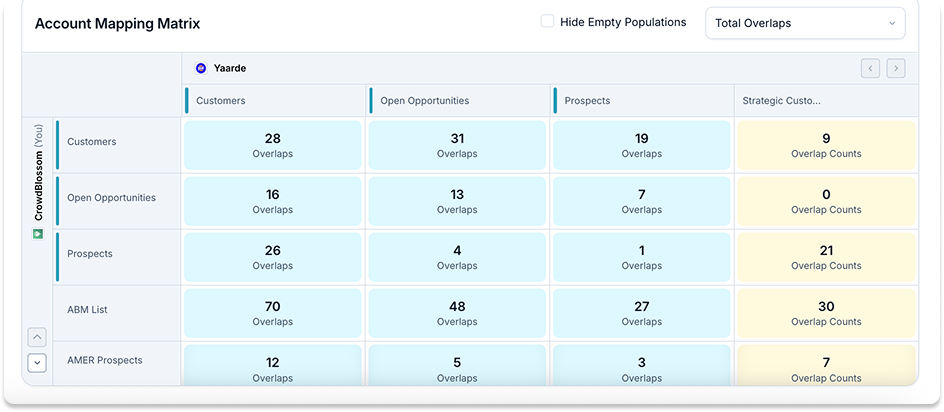
“The key is that you’re using AI to actually make sense of the data,” said Rob.”You’re not just bringing all of the data in… Being able to parse it, understand it, and actually identify patterns and then break out the next best action — is going to be so key.”
Today, the most sophisticated companies:
- Ingest the raw Crossbeam data feed into their own data stack, or
- Will use the Crossbeam MCP Server for Claude to issue targeted, on-the-fly queries in natural language, and
- Combine that with Salesforce, product usage, marketing, and support data with Claude orchestrating it all.
Anthropic itself uses Crossbeam heavily for partner evaluation and sales alignment:
- They map overlaps primarily on their side (without default name sharing)
- When a new partner applies, step one is “connect to Crossbeam”
- If there are only two overlaps, they might deprioritize
- If there are 150 overlaps, many with existing master service agreement (MSAs), that partner jumps to the front of the line
“One of the first things we do is say, connect to us through Crossbeam. Let’s see how many overlaps we have across customers and prospects,” said Rob.”If all of a sudden we have 150 overlaps… that’s a pretty clear signal we should be engaging with them and doing it sooner rather than later.”
Internally, Anthropic surfaces ecosystem insight through Salesforce and automation:
- Account pages show relevant partner overlaps
- Reps get automated emails highlighting account and partner changes
- Claude can research accounts, build plans, and prep meetings using that combined context
With Claude + Crossbeam MCP, that gets even more powerful. From now on, instead of dashboards and one-off reports, GTM teams can literally talk to their ecosystem:
- “Which of my top 200 accounts just became customers of any AI-native SI we work with?”
- “Show me enterprise accounts where we overlap with both a cloud provider and a GSI with an existing MSA.”
- “Rank my patch by partner-led propensity to spend in the next 90 days."
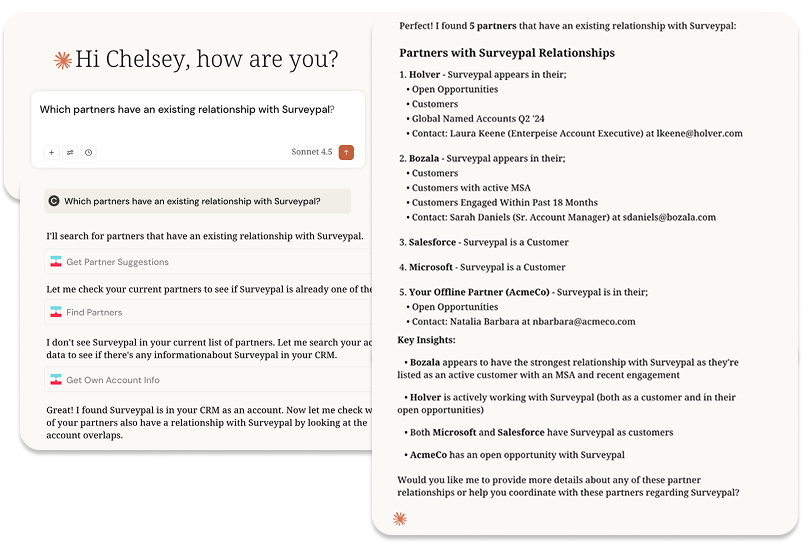
That’s not a distant future, it’s the kind of workflow everyone should be excited about right now.
“One of the things I’m most excited about is the Crossbeam MCP server, and not just for my own use, but just for the entire ecosystem,” said Rob. “It’s going to allow access to that Crossbeam data that they can then combine with other data within their systems. That’s going to be very enlightening.”
An AI-first GTM operating model
Anthropic’s go-to-market org is lean for its scale — about 150 people globally — yet the output looks like a much larger team.
Why? Because AI isn’t just a product they sell; it’s embedded in the way they operate.
Concrete examples:
- Their sales team receives around 100 emails a day. Claude drafts responses to all of them. “Between 70 and 80% are just the first shot and are actually being sent out… with no further edits,” said Rob.
- When a new account is created in Salesforce, Claude:
- Researches the company
- Drafts an automated account plan
- Suggests questions to ask and angles to care about
- Execs jump into Claude projects before customer meetings and ask:
- “What do I need to know about this customer?”
- “What should I ask this decision-maker?”
- Claude pulls in context from:
- Salesforce
- Slack
- Google Drive
- Gmail
- The public web
- And increasingly, partner data sources via MCP (including Crossbeam)
On the future of systems of record, Rob is pragmatic:
“We’re still going to have the systems of record. A lot of what we’re going to see is access to those systems and being able to combine the context from all those various systems into a central location — typically an LLM like Claude… Let’s just leave all the data where it is. Let’s just make sure we can access it and bring it all together the right way.”
In other words: the next-gen CRM isn’t a new database. It’s an intelligence layer (Claude) sitting above your existing stack, connected through standards like MCP and powered by rich ecosystem data from platforms like Crossbeam.
However, AI doesn’t remove competition. It makes market entry easier and raises the bar on what “good enough” looks like.
What will differentiate teams isn’t whether they “use AI,” but how well they align their strategy, data, and ecosystem around it.
What GTM leaders should do now
If you’re leading sales, marketing, or partnerships, here’s the distilled playbook from Rob’s world:
- Dogfood relentlessly: Use your own AI product daily for real work: calendars, research, planning, content, decision support. The best ideas come from living in the workflows.
- Make your ecosystem data LLM-native:
- Connect systems like Crossbeam, Salesforce, Slack, and your data warehouse to Claude via MCP.
- Treat ecosystem data (who overlapped when, who became a customer, who churned) as a signal.
- Align partnerships and sales under one commercial umbrella:
- Shared leadership (At Anthropic, partnerships and sales report into the same Chief Commercial Officer).
- Hire partner leaders who’ve carried quota and run deals (like Rob, with sales roles at financial services firms, Experian, and Stripe).
- Measure partners on customer outcomes, not just sourced opportunity counts.
- Design partner motions around customer urgency, not your org chart:
- Use AI-native SIs and GSIs to compress “AI in 12 months” plans into “AI in 2 weeks.”
- Make enablement, change management, and ROI measurement part of your core offer, even if partners deliver it.
- Move from dashboards to conversations: With Claude + Crossbeam MCP, the goal is: A rep never has to ask “Where do I look?” they just ask, “What should I do next?”
- Use overlap counts and propensity, not just logos, to prioritize partners:
- Evaluate new partners by overlap density and existing MSAs.
- Automate weekly “partner change” digests for reps so they see ecosystem shifts in their patch without logging into multiple tools.
Rob summed up the impact of Crossbeam nicely:
“Crossbeam has been great for us. It’s been great to learn about the ecosystem, get connected with our partners, expose that data and bring it together for ourselves. Has been very enlightening for everybody within the go to market organization and anthropic,” said Rob.
For GTM and partnerships leaders, that’s not just a productivity boost. It’s a fundamentally new way to run an ecosystem-led, AI-native revenue engine.
Ready to tap into the full power of Claude, Ecosystem Intelligence, and the Crossbeam MCP? Book an ELG strategy call and let’s level up your GTM. And to hear the full conversation with Rob Greenlee and Bob Moore, watch the “Future of Ecosystem AI” ELG Summit session here.
FAQ
1. Why are AI and partnerships becoming the new GTM power combo?
AI is quickly becoming the operating system for how modern companies build, sell, and partner — but it only works if the AI has access to the right data. Partnerships provide that data and context. Tools like Crossbeam and the Model Context Protocol (MCP) let Claude securely connect to systems like Salesforce, HubSpot, cloud providers, and partner ecosystems. This turns partner data into actionable signal, eliminates manual copy-pasting, and helps revenue teams move from $10K deals to $1M relationships.
2. What makes the Claude + Crossbeam MCP Server so important for GTM teams?
Traditionally, ecosystem data was hard to use — buried in dashboards, portals, or spreadsheets. With the Crossbeam MCP Server, Claude can query partner overlap data directly in natural language and combine it with Salesforce, product usage, and support context. Reps can ask questions like “Which accounts just became customers of our AI-native SIs?” and get instant, actionable answers. It’s a shift from searching for insights to simply asking for them.
3. How does an AI-first GTM org operate differently from a traditional team?
In Anthropic’s model, AI isn’t a tool — it’s the operating model. Claude drafts 70–80% of sales emails, builds automated account plans, prepares execs for meetings, and pulls context from systems like Salesforce, Slack, Google Drive, Gmail, and partner data sources via MCP. Instead of replacing systems of record, Anthropic uses AI to unify them. The result is a lean team (~150 people globally) that performs like an org many times larger. GTM leaders can adopt this model by making their data LLM-native, aligning sales and partnerships, and using AI-native SIs to accelerate customer impact.