Your ELG buy-in playbook: How to bring your org’s key players on board


Leveraging an ecosystem to drive sales can only thrive as a joint effort with leadership and every GTM function. Here's some help to bring them onto Team ELG.

Getting buy-in for a new strategy, tool, or anything that requires an investment of time and resources is often a catch-22: You need to demonstrate the value to get buy-in, but you need buy-in to get the resources to demonstrate the value.
This is particularly true for something like Ecosystem-Led Growth, a new go-to-market motion that leverages partnerships and relies on different kinds of internal and external collaboration than traditional approaches to revenue growth.
ELG is a powerhouse when sales, partnerships, customer success, marketing, and other GTM stakeholders engage in and support the process — so how can an ELG champion make that happen effectively and efficiently?
The first step could be as simple as naming the problem: While revenue goals are always going up, the traditional growth strategies aren’t working like they used to and we need to think differently about where and how to find more business. But “here’s another thing to throw against the wall” isn’t likely to get very far on its own.
While every organization will have its own structural, financial, and personal dynamics, here are buy-in plays that have worked for companies that have had big success with ELG as a core go-to-market strategy.
1. The FOMO play
“Do what other companies are doing” isn’t generally great advice, since what works for one business and its customers may very well not work for another (and who’s to say they have it all figured out anyway?). But it’s hard to ignore the consistently growing adoption of a core strategy by companies of all sizes, shapes, and industries.
When it comes to ELG, this growth isn’t just anecdotal. Every year, Crossbeam publishes the Ecosystem-Led Growth Index, a way to measure the penetration of ELG in tech services and companies.
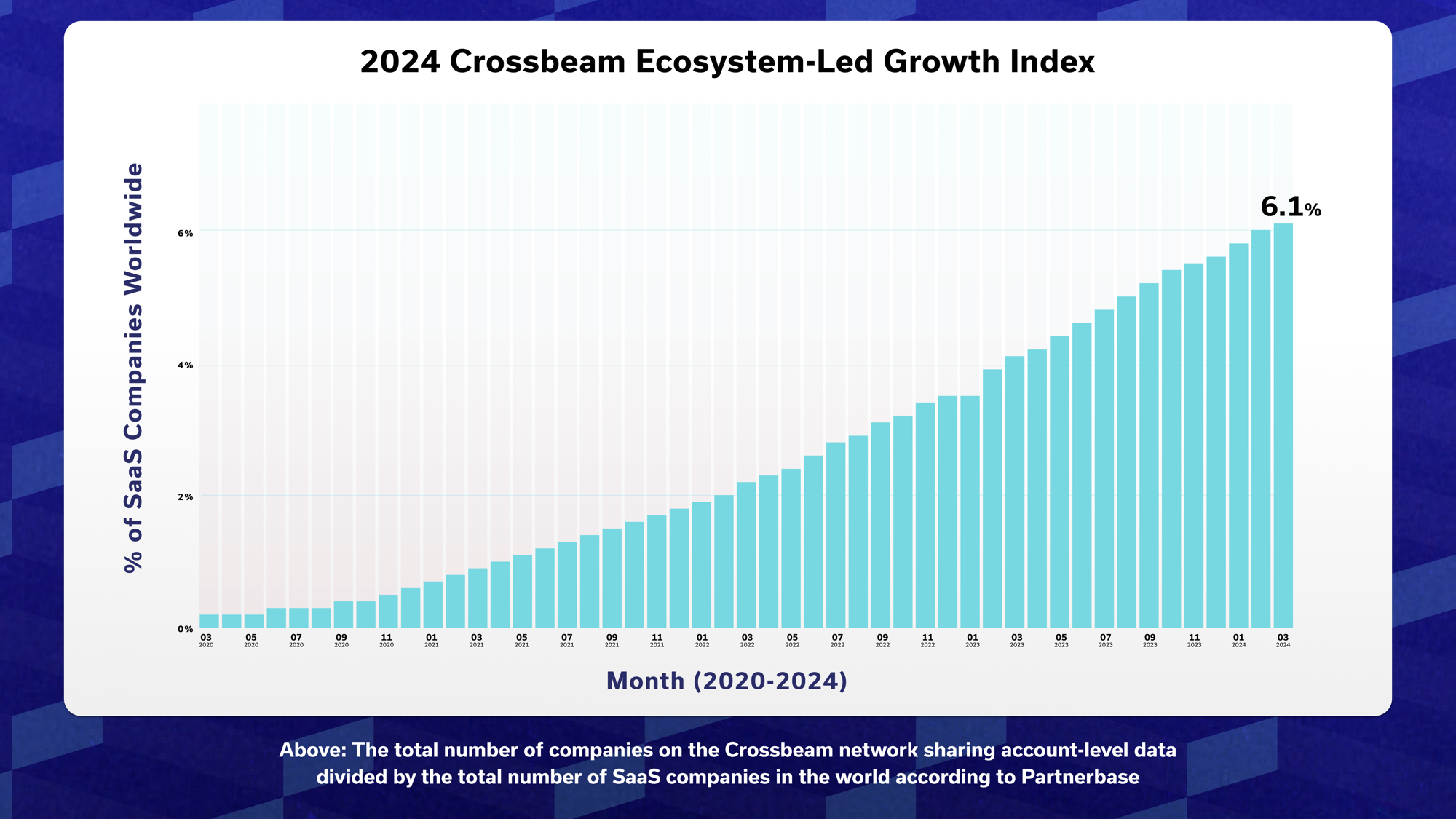
The index is determined by taking the total number of companies on the Crossbeam network sharing account-level data with partners, divided by the total number of SaaS companies in the world that use partnerships according to Partnerbase, the largest global database of companies and their partner ecosystems, created by Crossbeam.
ELG adoption is growing month-over-month and year-over-year as companies and their partners harness key data and work together to drive revenue. If your organization wants its boat to catch that rising tide, it’s time to take a serious look at the power of your ecosystem.
2. The always-be-enabling play
Let’s say you’ve started using ELG on a small scale with a few partners and reps, but you know it won’t reach its full potential without enthusiasm across both internal and external teams. You’ve created presentations and Slack posts and emails to get people on board, but it’s slow going because people are already so busy with their current strategies. This is when it’s time to take them to school.
This is how cybersecurity company Netskope built a culture of Ecosystem-Led Growth throughout its go-to-market teams. Two of the organization’s biggest ELG champions, Global Technology Alliances Director Kristen Kelly and Sales Director Keith McManigal, have worked together to ensure that sales team and partner onboarding, communication, and training includes a steady and thoughtfully planned drumbeat of ELG education and proof points that speak directly to these key stakeholders.
“When we rolled out Crossbeam as a foundational part of our ELG strategy, my tactic at first was to join large internal field enablement calls across the whole field,” says Kristen. “I found on those larger calls that it was a lot of just me presenting, showing some slides and not really getting many questions. So I fine tuned my approach and focused on regional teams, where there’s a smaller audience, people are more engaged, and people are less shy to ask questions — that’s when I started to get more traction. And then once I took it a step further, and started actually showing reports specific to the people in those regional team calls, that’s where it really hit home for them. So word of mouth started to take hold, that’s when we started to feel like okay now, people are realizing the value for themselves.”
Read more here about how Netskope built Ecosystem-Led Growth into their GTM strategy as well as their internal processes and communications.
Leading customer engagement platform Braze is also an ELG machine, thanks in part to providing sales teams with constant ecosystem data and enablement.
Braze has built an ELG strategy around their ELG Sales Tetrahedron, a framework that relies on a chain reaction between tooling, data, and buy-in. The latter piece of this means never stopping the important work of sales enablement and earning buy-in from leadership. And this isn’t just the responsibility of the partnerships team — it becomes part of the regular cadence of business in pipeline reviews, sales training sessions, SKOs, new employee onboarding, and more.
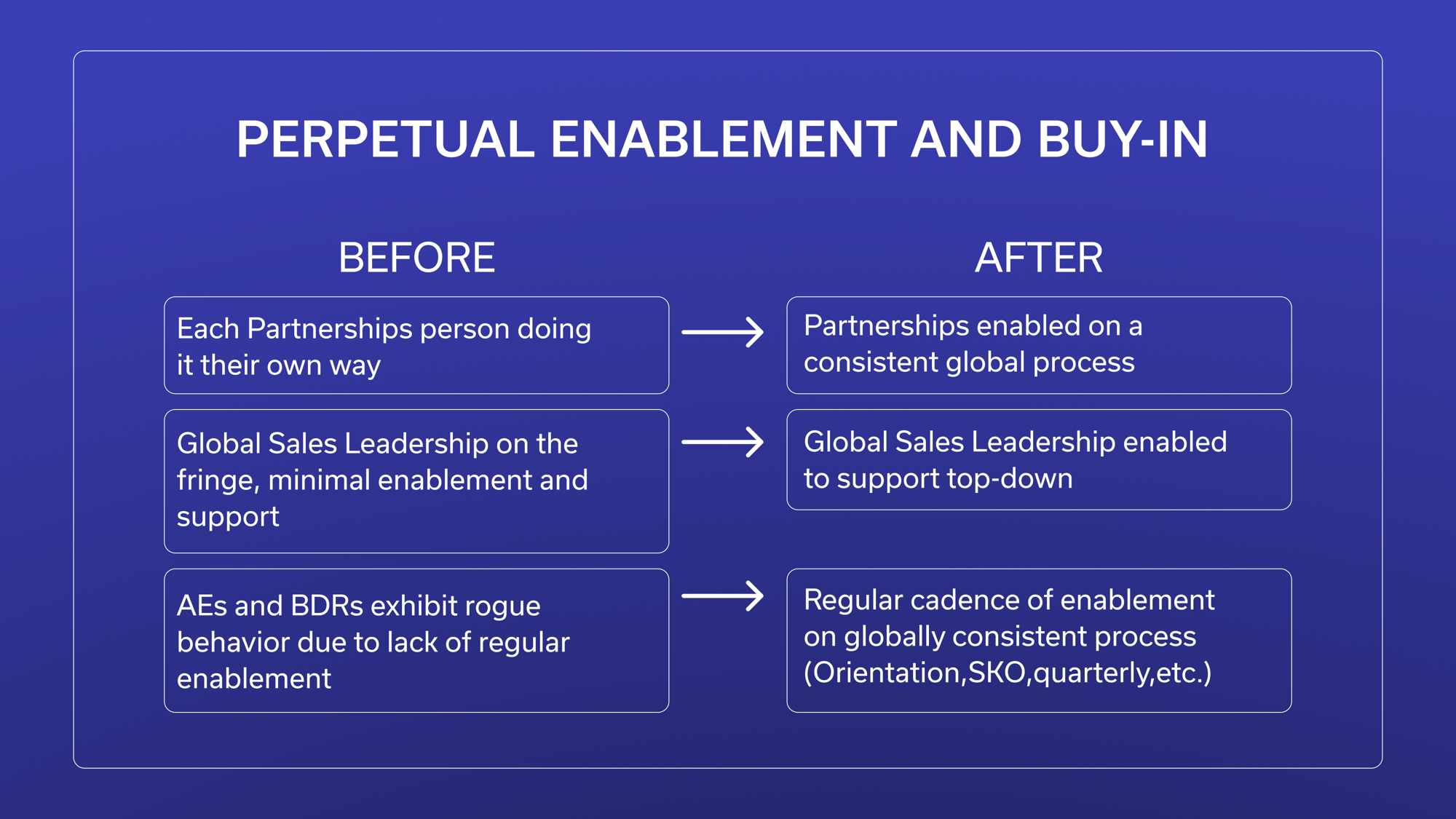
“I started in Sales and I can tell you with certainty that any new strategy has to be undeniable in its impact before it will be taken seriously,” says VP of Global Solutions Alliances Dave Goldstein. “So when we embark on the important step of bringing salespeople into the fold, we come armed with the data.”
At Braze, the impact the team can demonstrate has been immense. For instance, Braze has seen that leveraging partners has resulted in a higher deal close rate, larger average deal size and a powerful source of new pipeline generation.
Learn more about Braze’s ELG Sales Tetrahedron and how it drives meaningful growth.
3. The smarter attribution play
Getting leadership buy-in would be simple if it were a straightforward process to report the exact total of ecosystem-driven revenue. But as partnerships become responsible for more and more revenue, the challenges of measuring and attributing that revenue endure.
“How much pipeline does partnerships bring? How much do they source? How much do they influence? Everyone wants to know that, but it's such a nebulous number,” says Don Otvos, LeanData’s VP of Business Development and Alliances. “The partnership team is responsible for 15% of revenue, but that number is all over the place depending on when you run the report.”
With a long career in revenue operations, now working for a revenue orchestration platform, Don is a strong believer in automation, efficiency, and making things “bone-dead simple”.
Don decided that his team needed a more reliable and measurable KPI to reflect their contribution. He set up the tooling to measure the median value of deals in each business segment and set his team’s goal for that segment at 15% of the median. He then looked at how many deals it took on average to reach that dollar amount. Instead of trying to hit that number in actual dollars, which was nearly impossible to measure at any point in time, he proposed setting a threshold for the number of deals that had to get past a certain stage to roughly equal 15%.
“I want to be directionally correct on getting to that 15% number — I don't care about hitting it, per se, I just want to know that the partner team is heading in that direction,” says Don. “To do that, I’m going to look at the number of deals that get past a certain stage rather than scrambling to track down every dollar for attribution. It becomes a much more objective number, because you look at the date a deal reached a certain stage and you count it or you don’t.”
With this simplified attribution model, the role of a company’s ecosystem in sourcing and closing deals is much more clear cut, and that data doesn’t lie when it comes to making a case for ELG.
Read more about how Don Otvos applied his eye for efficiencies to accelerate LeanData's revenue growth.
4. The cool GIFs play
Ok, it’s a little more involved than sharing cool GIFs. But while numbers are powerfully persuasive, data visualization can bring the story of those numbers to life for key stakeholders in your ELG strategy.
One of our core values at Crossbeam is “feed the network”. That’s because the network of companies connected to and sharing data with their partners in Crossbeam is the most valuable asset for our customers to drive revenue with Ecosystem-Led Growth.
And that value isn’t limited to connections with direct partners. Partner ecosystems aren’t the hub and spoke of your company surrounded by its partners — they’re a network graph in which your partners have their own spokes, including you. This means that every time a new partnership is formed, the network graph grows by far more than that one connection.
In this visualization of the companies sharing data on Crossbeam’s platform over time, you can see what this robust network growth looks like:
Wild, huh? Without this visual representation, it would be very difficult to explain the scale of network growth and its potential impact on a single company.
Another source of data that we analyze for important patterns and insights is the network graph from Partnerbase, which includes all SaaS companies worldwide that have five or more partners (whether or not they are registered on the Crossbeam platform itself) — this amounts to over 90,000 companies with more than 300,000 partnerships between them.
In Partnerbase, you can see your partners, and your partners’ partners, and your partners’ partners’ partners…you get the idea. For every company, you can also see a dynamic visual network graph of its major partners, and drill down into the data from there.
With this visibility beyond your own network, you can discover potential partners that could fit and even help shape your growth strategy, and with whom you can connect through a mutual partner.
If you hit a sticking point in your internal ELG buy-in campaign, visualizations may help leaders and stakeholders understand the massive scale of the field of opportunity that your organization has yet to pursue.
Talk to our team to learn how to get buy-in on your ELG strategy.