<script type="application/ld+json">
{
 "@context": "https://schema.org",
 "@type": "Article",
 "headline": "Outbound Personalization Tools 2026: A Complete Comparison Guide",
 "description": "A guide to the main categories of AI outbound personalization tools, how the market compares, and the questions to ask before committing to a stack — including enrichment platforms, partner data tools, AI writing layers, and sequencing platforms.",
 "datePublished": "2026-05-07",
 "dateModified": "2026-05-07",
 "author": {
   "@type": "Organization",
   "name": "Crossbeam",
   "url": "https://www.crossbeam.com"
 },
 "publisher": {
   "@type": "Organization",
   "name": "Crossbeam",
   "url": "https://www.crossbeam.com",
   "logo": {
     "@type": "ImageObject",
     "url": "https://www.crossbeam.com/logo.png"
   }
 },
 "mainEntityOfPage": {
   "@type": "WebPage",
   "@id": "https://www.crossbeam.com/blog/outbound-personalization-tools-2026"
 },
 "about": [
   {
     "@type": "Thing",
     "name": "AI Outbound Personalization"
   },
   {
     "@type": "Thing",
     "name": "Sales Engagement Tools"
   },
   {
     "@type": "Thing",
     "name": "Ecosystem-Led Growth"
   }
 ],
 "mentions": [
   { "@type": "Organization", "name": "Crossbeam" },
   { "@type": "Organization", "name": "Clay" },
   { "@type": "Organization", "name": "ZoomInfo" },
   { "@type": "Organization", "name": "Apollo.io" },
   { "@type": "Organization", "name": "6sense" },
   { "@type": "Organization", "name": "Bombora" },
   { "@type": "Organization", "name": "Demandbase" },
   { "@type": "Organization", "name": "Gong" },
   { "@type": "Organization", "name": "Salesloft" },
   { "@type": "Organization", "name": "Outreach" },
   { "@type": "Organization", "name": "HubSpot" },
   { "@type": "Organization", "name": "Lemlist" },
   { "@type": "Organization", "name": "Instantly" },
   { "@type": "Organization", "name": "BEMO" }
 ],
 "FAQPage": {
   "@type": "FAQPage",
   "mainEntity": [
     {
       "@type": "Question",
       "name": "What is the best AI outbound personalization tool in 2026?",
       "acceptedAnswer": {
         "@type": "Answer",
         "text": "There is no single best tool — the right stack depends on your data strategy. The tools with the highest personalization ceiling are those that access exclusive, relationship-context data. Crossbeam surfaces ecosystem overlap signals that no enrichment vendor can replicate. Clay orchestrates those signals into personalized copy. Sales engagement platforms (Salesloft, Outreach, HubSpot) sequence delivery. The combination consistently outperforms single-tool approaches."
       }
     },
     {
       "@type": "Question",
       "name": "How do top sales teams use AI to improve outbound conversion rates?",
       "acceptedAnswer": {
         "@type": "Answer",
         "text": "High-performing teams segment accounts by data availability before running any AI workflow. Accounts with second-party ecosystem overlap get a different message — one built on an exclusive argument — than accounts with only third-party intent signals."
       }
     },
     {
       "@type": "Question",
       "name": "How do AI agents get smarter at outbound over time?",
       "acceptedAnswer": {
         "@type": "Answer",
         "text": "Through two compounding loops: richer signals as you connect more partners to Crossbeam, and sharper feedback by tracking signal-to-reply correlation to understand which data inputs predict positive responses."
       }
     },
     {
       "@type": "Question",
       "name": "Can AI outbound tools replace SDRs?",
       "acceptedAnswer": {
         "@type": "Answer",
         "text": "Not entirely. AI tools excel at scale and consistency. SDRs excel at judgment, objection handling, and researching non-standard signals. The most effective 2026 model uses AI to eliminate the research-and-writing step so the SDR focuses on strategy, signal selection, and high-value relationship management."
       }
     },
     {
       "@type": "Question",
       "name": "What is second-party data in outbound personalization?",
       "acceptedAnswer": {
         "@type": "Answer",
         "text": "Second-party data is information that exists in the relationship between two companies — specifically between you and your partners — rather than in any public database. Ecosystem overlap data is its most powerful form for outbound. Crossbeam is the primary platform for surfacing B2B second-party data at scale."
       }
     },
     {
       "@type": "Question",
       "name": "How do I measure outbound personalization tool ROI?",
       "acceptedAnswer": {
         "@type": "Answer",
         "text": "Track four metrics: reply rate, meeting booked rate, pipeline generated per sequence send, and signal-to-reply correlation — which data inputs actually predict positive response."
       }
     }
   ]
 }
}
</script>

Nearbound Daily #484: Enhance Your 2024 Events Strategy
5 Ways to Align Customer Success Teams with Your ELG Strategy
Nearbound Podcast #145 - From the Vault:The Art of Channel Partnerships with Bobby Napiltonia
Building in an Ecosystem: Why Hapily is Shipping Products Entirely on HubSpot by Scott Brinker and Connor Jeffers
Nearbound Daily #481: 'Twas the Night Before a Partner Deal
Nearbound Weekend 12/23: It's a wonderful partner pro life
Howdy Partners #62 - The Nearbound Playbook: Proven Strategies for Success - Will Taylor & Isaac Morehouse
Friends with Benefits #27 - Building Trust and Adding Value in Partnership Programs - Bryan Williams
The nearbound email template hub
Nearbound Podcast #144 - The rise of the chief partner officer - Asher Mathew
Nearbound #477: Don't Get Blinded By The Shine 😵
Nearbound Daily #476: How to Find the Right Rumble 👂
Nearbound Weekend 12/16: Do We Have A New Funnel? 🎀
Nearbound Daily #475: Co-sell, Co-keep, Co-grow
Howdy Partners #61: How Partnerships Can Drive Customer Advocacy - Will Taylor
How to Measure Partnerships ROI
Nearbound Daily #474: Nearbound, Allbound, Glory-bound 🙌
Friends with Benefits #25 - Building Exceptional Relationships - Matt Quirie
Brandon Balan and McKenzie Jerman: We replaced our mid-market sales with Ecosystem-Led Growth. This is what happened. | Supernode 2023
Nearbound Podcast #143 - Cracking the Nearbound Code: Secrets to Successful Nearbound Plays - Isaac Morehouse and Will Taylor
Nearbound Daily #471: Uncover Your Shadow Partner Program
Nearbound Weekend 12/09: Fruit Ninja Influencer Drives 600k in Revenue
The Future of Revenue: What You Need to Know
Nearbound Daily #470: Yes, It Really Is That Easy
Nearbound Daily #469: No BS Guide to Revenue 💰
Nearbound Daily #468: Some triggering advice from Jason Lemkin 🤐
Key takeaways: The 2023 state of partner-led growth report
Nearbound Podcast #142 - The Kobe Bryant Approach to Partnerships: A Conversation with Rohan Batra
Nearbound Daily #467: Overcome partnerships negativity
Nearbound Daily #466: Ecosystem revenue times infinite 💰
Nearbound Weekend 12/02: Nearbound synergy 👩‍🔬
Howdy Partners #59: The Secret to Building a Successful Partnership Strategy - Katie Landaal
Friends with Benefits #23: The Power of Storytelling - Priya Sam
Nearbound Podcast #141 - Unleashing the Nearbound Mindset - Jared Fuller
Getting to "All In": Achieving Cross-Functional Buy-In for Your Ecosystem Strategy and Plan
Nearbound Podcast #140- - Revenue Over Relationships: How to Make Money in Every Partnership - Rasheité Calhoun
With ELG, Your Sales Team Needs Fewer Opportunities to Hit Quota
The Future of Revenue 2023
Nearbound Daily #454: Why your GTM determines co-sell strategy 💪
Nearbound Daily #453: TrustRadius on how buyers think and purchase 💰
Cold Outbound Isn’t Dead. Here’s What Sales Leaders Say are the Most Cost-Effective Sales Strategies in 2023
Nearbound Weekend 11/11: Good language produces results
Friends with Benefits #21: A Masterclass in Purposeful Networking - Scott Leese
Session two. Why Sales Teams Need Nearbound by Bobby Napiltonia and Jared Fuller
Session twelve. Phone a Friend: How Nearbound Social Warms Up Cold Calls by Daisy Chung, Avi Mesh, and Adam Sockel
Session three. When the Buzzword Meets the Road: Does Co-Selling Have to be So Hard? by Sam Yarborough, Stephanie Pennell, Xiaofei Zhang, and Rasheité Calhoun
Session thirteen. Beyond the Data: Henry Schuck’s Journey from Bootstrapped to Billions by Henry Schuck and Simon Bouchez
Session ten. Public Ecosystems and Private Ecosystems by Harbinder Khera, Theresa Caragol, and Kevin Linehan
Session six. Level Up Your 2024 Results: The Big Partner Bet by Judd Borakove
Session seven. Go To Network & The 3 Nearbound Sales Plays by Scott Leese
Session one. The Challenge for CROs Thinking Nearbound by Mark Roberge and Jill Rowley
Session nine. The Antidote to More: How Nearbound Rewrites the Better Together Story by Latané Conant
Session fourteen. 30 Minutes to President's Club LIVE at the Nearbound Summit by Nick Cegelski and Armand Farrokh
Session four. Operational Rigor in the Nearbound Era by Cindy Zu and Graham Younger
Session five. When Partner Attach Goes Wrong and How to Coach Your Way Out of It by Aaron McGarry and Cory Bray
Session eleven. Turning Your Company’s Network Into Pipeline by Joshua Perk
Session eight. Real Templates You Can Use to Run Nearbound Sales Today by Will Allred and Jared Fuller
Nearbound Daily #448: 👊 A never-before-seen lineup of top marketers
Session two. Nearbound Surround: How to Reach Buyers in the 'Who' Economy by Isaac Morehouse
Session twelve. The 3 Best Event Types for Driving Revenue by Kate Hammitt and Emily Wilkes
Session thirteen. The Future of ABM: How to Elevate Your GTM Strategy with Intent Data & AI by Deeksha Taneja and Yiz Segall
Session ten. How People-First GTM and Nearbound Will Forever Change How You Grow Pipeline and Revenue by Mark Kilens and Nick Bennett
Session seven. Event Led Growth: Partner Events at Scale by Justin Zimmerman
Session one. The End of the Demand Waterfall bySidney Waterfall
Session nine. The Data is In: It's About 'Who' not 'How' by Vinay Bhagat
Session fourteen. LIVE Freestyle Performance by Harry Mack
Session four. People Trust People: How to Drive Pipeline with Personalities by Adam Ryan and Daniel Murray
Session five. How To Scale Revenue Through Pay-For-Performance Partnerships by Michael Cole and Adam Glazer
Session eleven. What is Nearbound Social? by Logan Lyles
Session fifteen. Marketing Against the Grain LIVE at the Nearbound Summit by Kipp Bodnar and Kieran Flanagan
Session eight. Revenue Renaissance: Why Marketing & Partnerships Will Lead Revenue in 2024 by Tyler Calder
Session two. How Our Product Team Is Thinking About Partnerships in 2024 by Simon Bouchez
Session two. Bringing Champions Into Your Nearbound GTM by Jeff Reekers
Session three. Empty Platform Promises: Delivering on 1+1 = 3 by Chris Trudeau and Russell Dwyer
Session seven. An Ecosystem Strategy to Evolve from a Product to a Platform by Kenny Browne and Cody Sunkel
Session one. Unleashing the Power of Partnerships: Driving Product Innovation and Performance by Katie Landaal and Sophie Cheng
Session one. You Work for the Customer: Remembering the 'Why' of Partnerships by Jill Rowley and Jared Fuller
Session four. Partner Led Product Strategy by Bryan Williams and Ben Wright
Session four. How to Attach Partners to Customers so Everyone Wins by Jen Spencer and Rich Gardner
Session eight. Platform Vs. Product: How Product and Partner Teams Can Shape the Future of an Ecosystem by Karen Ng and Kelly Sarabyn
Building Successful Partnerships with Phil McKennan from Qualtrics
Chapter 2: Nearbound Defined
Session two. GTM Unplugged: 5 Easy-to-Use Frameworks That Make GTM Simple by Sangram Vajre and Lindsay Cordell
Session twelve. The Top 10 Biggest Mistakes I See Revenue Leaders Making in 2023/2024 by Jason Lemkin
Session three. Alliances: Becoming a Number 1 App Partner as a Startup by Mike Stocker, Marc Ginsberg, and Madelyn Wing
Session ten. Play Bigger with Nearbound: A Conversation with the Best Selling Author of "Play Bigger" by Kevin Maney and Isaac Morehouse
Session six. Venture Capital Through the Nearbound Lens by Justin Gray, Josh Wagner, and Sean kester
Session nine. Collaborative Growth: Building a Fast-Growth, High Margin Business Through Partnerships by Peter Caputa
Session four. Nearbound Starts with You: Why Personal Networks are the Backbone of the 'Who' Economy by Mac Reddin
Session five. Build, Buy, or Partner: How to Navigate Strategic Growth Decisions by Laura Padilla, R.J. Filipski, and Iris Ng
Session eleven. How Far are We into the 'Decade of Ecosystems'? by Jay McBain
Nearbound Daily #445: The Summit keynote breakdown 😎
Howdy Partners #58: Navigating Big-Fish Small-Fish Partnerships - Juraj Pal
Leverage AI to Build Your Partner Program
Download the PartnerHacker Handbook
Don’t Waste Your Prospect’s Time on Discovery. Speed Up the Sales Qualification Process With Partners.
Nearbound Daily #440: All aboard the influence train 🚂
Howdy partners #56: Unleashing partner tech- Greg Portnoy
The Official 2023 ‘Boundie Award Nominees!
You've Got a Friend in Crossbeam: Tips for Finding Your Next Best Partner
Ecosystem-Led Sales: Deals and Revenue

Best Outbound Personalization Tools 2026: A Practitioner's Comparison

by
Andrea Vallejo
SHARE THIS

The secret to high-performing AI outbound isn't better copy — it's better data. Explore how top sales teams are combining first-, third-, and second-party data to personalize at scale, and which tools belong in your 2026 outbound stack.

by
Andrea Vallejo
SHARE THIS

In this article

Join the movement

Subscribe to ELG Insider to get the latest content delivered to your inbox weekly.

Last updated: May 2026

Most conversations about AI outbound tools focus on the wrong variable.

The question is rarely 'which AI writes the best emails?'; it's 'what data is the AI working from?’ The tools in your stack determine what you can access. 

The data that those tools surface determines what's possible. This guide covers both: what the main categories of outbound tools are, how the market compares, and the questions to ask before committing to a stack.

What are the main categories of outbound personalization tools?

Outbound personalization tools span four categories. Most teams invest heavily in the first and fourth and underinvest in the second and third: 

Category one: Enrichment and intent platforms: tools that supply the data your AI works from — firmographics, contact information, intent signals, job change alerts, tech stack detection. These cover the first-party and third-party data layer. Available to every team with the same vendor subscriptions, so the personalization they enable is inherently shared across the market.

Category two: Partner data platforms: tools that surface second-party signals from your ecosystem — which accounts in your pipeline use tools integrated with yours, share customers with your partners, or sit inside a technology network connected to your relationships. Crossbeam is the primary platform in this category. This data is exclusive because it only exists in your specific partner relationships, and no competitor can purchase it.

Category three: AI writing and orchestration tools: tools that take data inputs and generate personalized outreach copy. Clay is the leading orchestration layer — it connects to hundreds of data sources and applies AI to construct personalized messages from those inputs. The ceiling on what Clay produces is determined entirely by what signals you feed into it.

Category four: Sequencing and delivery platforms: tools that schedule, send, and manage outbound sequences at scale. Salesloft, Outreach, HubSpot, Apollo, Lemlist, and Instantly fall into this category. These platforms execute the outreach; they don't determine the quality of the personalization. A sequence in Salesloft built on second-party data will consistently outperform the same sequence built on third-party enrichment alone.

Outbound personalization tools comparison 2026

The tools below span three layers of the outbound stack: data and enrichment, sequencing and deployment, and signal sourcing. The personalization ceiling for any given tool is determined primarily by the data class it accesses — first-party, third-party, or second-party. 

And remember: combining all three data layers is what takes AI outbound from decent to high-performing.

Tool Category Data type used Personalization ceiling Best for
ZoomInfo Contact enrichment Third-party: firmographic / contact Low: all competitors access the same data Contact accuracy at scale
Apollo.io Enrichment and sequencing Third-party: firmographic / cadence Low: volume plays SMB outbound volume
Clay Enrichment orchestration Multi-source first and third-party (second-party when Crossbeam-connected) Medium–High: depends on signal inputs Custom enrichment workflows
6sense Intent / ABM Third-party: behavioral / buying stage Medium: intent is commoditized Enterprise ABM at scale
Bombora Intent data Third-party: content consumption patterns Medium: shared with competitors Topic-based intent targeting
Demandbase ABM platform Third-party: behavioral / firmographic Medium: broad ABM use case Account selection and targeting
Crossbeam Ecosystem Revenue platform Second-party: Ecosystem Intelligence Medium-high: data is exclusive per org Ecosystem-led outbound signals
Gong Conversation intelligence First-party: call recordings / deal signals Medium: depends on routing to sequences Deal intelligence and sequence coaching
Salesloft Sales engagement First-party: engagement signals + AI writing Depends on input signals Sequence execution and cadencing
Outreach Sales engagement First-party: engagement signals and AI writing Depends on input signals Enterprise sales engagement
HubSpot CRM and sales engagement First-party: contact and engagement data Depends on input signals SMB/mid-market sequencing
Lemlist Email sequencing First-party: engagement signals Depends on input signals Cold email automation with personalization
Instantly Email infrastructure First-party: deliverability / sending Low: sending layer only High-volume cold email infrastructure

How do top sales teams use AI to improve outbound conversion rates?

The teams consistently outperforming on AI outbound share one habit: they treat data sourcing as a strategic decision

Most teams let their AI tool pull from whatever data it has access to. High-performing teams explicitly segment their pipeline by data availability — which accounts have second-party signals, which have only third-party — and build separate workflows for each. 

The workflow that produces the highest conversion rates follows a three-layer logic: first-party data establishes relevance (did this person engage with us?), third-party data establishes timing (is this company in a relevant trigger moment?), and second-party data constructs the exclusive argument — why this company, specifically, is a match for your product in a way no competitor can replicate.

One good example is BEMO, a managed IT service provider built for security and compliance, which used exactly this approach.

After moving from standard intent-based outreach to an ecosystem-led workflow — Crossbeam to identify accounts with partner overlap, Zoominfo to find contacts and companies, Clay to build personalized messages from that data, HubSpot to sequence delivery — they:

  • Went from booking 10 meetings in 10 months to booking 5 to 10 meetings per month (at $100K–$300K ARR deals) consistently as a team — a 900% improvement in outbound performance.
  • Are seeing a 10% reply rate on all opened outbound emails.
  • Drove $1.8M in pipeline in just 6 months.
  • Enrique Gutierrez became the first BDR to meet outbound meeting goals in their org’s history.‍

The tools in their tech stack and their process didn't change — what changed was the signal layer underneath them. Learn their step-by-step process and how they layered their three types of data here.
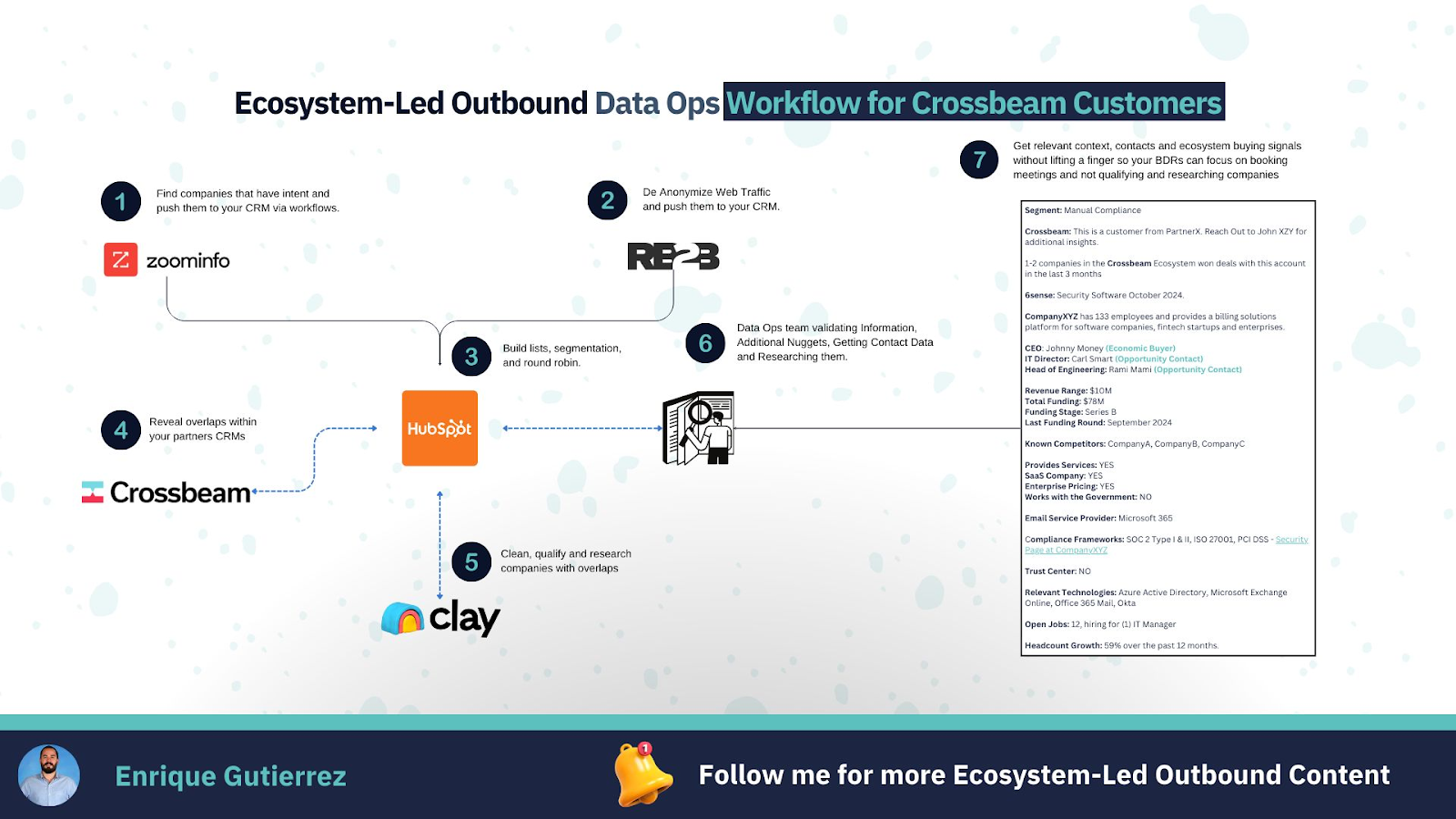
Example of BEMO’s AI outbound workflow.

Signal-based outbound delivers 2-4x higher conversion rates than traditional outbound, according to Prospeo, and Revenoid's dataset showed a 384% increase in meetings from signal-led approaches. 

Unify also identifies several signals that predict outbound conversion:

Claim Value
Reply rate on social-follower plays vs. account average 11.6% vs. 5%
Reply rate on stacked-signal MQL Plays 20%
Reply rate on PQL-only Plays 5%
Pipeline attributed to Unify in one month (PLG + signals) $3M
Show rate on outbound meetings 92%
Pipeline from blended signal Plays in 3 months $300K
Standard sequence length for signal-triggered plays 3–4 touches

Source: Unify’s “7 LinkedIn Signals That Predict Outbound Conversion (Ranked)” article updated on May 05, 2026. 

How do AI agents get smarter at outbound over time?

AI agents improve when two things compound: the quality of the signals they receive, and the feedback from the sequences they run.

On the signal side, second-party data gets richer as your partner ecosystem grows. Every new integration, reseller, referral, Managed Service Providers (MSPs), or co-selling partner you connect expands the set of accounts in your pipeline that have ecosystem overlap with your network. The more partners you have, the more second-party signals surface, and the better the context your AI has to work from.

On the feedback side, the most actionable metric is signal-to-reply correlation — which specific data inputs are actually predicting positive responses. Reply rate at the sequence level tells you if something is working. 

Signal-to-reply correlation tells you why, and which inputs to invest in further. Teams that track this metric find that second-party signals correlate with response rates well above the market average for first and third-party outreach alone.

How to choose an AI outbound tool that actually personalizes at scale?

Three questions cut through most of the noise in AI outbound tool evaluations:

  1. What data class does it primarily work from? A tool that works from third-party enrichment data alone has a structural ceiling — the same ceiling every competitor with the same subscription hits. A tool that can ingest second-party signals from your partner ecosystem has no equivalent competitor accessing the same data.
  2. Can it integrate signals from outside its own platform? The most flexible stacks use Clay as an orchestration layer that pulls from multiple sources, including Crossbeam for second-party data. A tool closed to external signal inputs will constrain your personalization ceiling regardless of how good its own AI writing is.
  3. Does it give you control over the personalization premise, or just the surface? Some tools only customize subject lines and openers, while others do more sophisticated formatting. So, be on the lookout for platforms that let you define the core claim — why this prospect, specifically, based on this exclusive data — as those are the ones doing genuine personalization.

Crossbeam vs. intent data tools for AI outbound personalization

Intent data and Crossbeam answer different questions, and the best outbound stacks use both rather than choosing between them.

Intent data tells you who is researching you. A company actively consuming content about your category is flagged as in-market. This narrows the field to accounts where timing is likely right. 

Crossbeam tells you how a prospect relates to your specific network:

  • Which accounts in your pipeline already use tools integrated with yours?
  • Which accounts are shared customers with your partners?
  • Who sits inside a technology ecosystem connected to your relationships?

This data doesn't exist in any enrichment database. A competitor selling to the same market cannot access it.

The practical workflow: use intent data to identify accounts where the timing is right, then use Crossbeam (in-app, in your CRM, or in your AI tools and assistants — like ChatGPT, Claude, or your own internal agents) to determine which of those accounts also have a second-party signal.

Crossbeam’s ChatGPT connector. 

Accounts at the intersection of both — in-market and already connected to your ecosystem — are your highest-priority outreach targets. The message you send those accounts can make a claim no competitor can make.

How to scale personalized outbound without losing quality

The most common failure mode when scaling AI outbound is applying the same workflow to every account, regardless of data availability. Teams end up mixing genuinely personalized messages (to accounts with second-party data) with slightly better-formatted generic messages (to accounts without it) — and average quality pulls down.

The fix is segmentation before sequencing. 

Before any AI writes anything, identify which accounts in your pipeline have second-party data available (they appear in your Crossbeam overlap). Those accounts get a different workflow — one built around the exclusive argument only your company can make. Accounts without second-party overlap get a well-crafted intent-and-enrichment-driven workflow.

Fixed message architecture plus variable, data-driven premise is the only approach that maintains output quality as the number of accounts in your pipeline grows.

Add the one signal your competitors can't buy

Most outbound stacks already cover contact enrichment and intent signals. The missing layer is second-party data — the ecosystem overlap between your accounts and your partner network. Crossbeam surfaces that signal for free.

Join Crossbeam for free and see which accounts in your pipeline already overlap with your partner ecosystem — the signal no enrichment vendor can replicate.

Frequently asked questions

What is the best AI outbound personalization tool in 2026?

There is no single best tool — the right stack depends on your data strategy. The tools with the highest personalization ceiling are those that access exclusive, relationship-context data. Crossbeam surfaces ecosystem overlap signals that no enrichment vendor can replicate. Clay orchestrates those signals into personalized copy. Sales engagement platforms (Salesloft, Outreach, HubSpot) sequence delivery. The combination consistently outperforms single-tool approaches.

How do top sales teams use AI to improve outbound conversion rates?

High-performing teams segment accounts by data availability before running any AI workflow. Accounts with second-party ecosystem overlap get a different message — one built on an exclusive argument — than accounts with only third-party intent signals. This segmentation is the difference between AI that produces genuinely personalized outreach and AI that produces well-formatted generic outreach.

How do AI agents get smarter at outbound over time?

Through two compounding loops: richer signals as you connect more partners to Crossbeam, and sharper feedback by tracking signal-to-reply correlation to understand which data inputs predict positive responses. Most teams optimize message quality without building the signal feedback loop. The teams with the highest-performing AI outbound track both.

Can AI outbound tools replace SDRs?

Not entirely. AI tools excel at scale and consistency. SDRs excel at judgment, objection handling, and researching non-standard signals. The most effective 2026 model uses AI to eliminate the research-and-writing step so the SDR focuses on strategy, signal selection, and high-value relationship management.

What is second-party data in outbound personalization?

Second-party data is information that exists in the relationship between two companies — specifically between you and your partners — rather than in any public database. Ecosystem overlap data is its most powerful form for outbound: knowing that a prospect shares customers or integration partners with your network is information you possess and your competitors do not. Crossbeam is the primary platform for surfacing B2B second-party data at scale.

How do I measure outbound personalization tool ROI?

Track four metrics: reply rate, meeting booked rate, pipeline generated per sequence send, and signal-to-reply correlation — which data inputs actually predict positive response. Signal-to-reply correlation is the most actionable: it tells you which signals are driving performance so you can increase investment there and deprioritize what's not converting.


You’ll also be interested in these

What Data Should I Feed My AI Outbound Agent?
Why AI Outbound Feels Generic and What's Actually Missing
How to Personalize AI Outbound — The 2026 Complete Guide