

What Is Second-Party Data (and Why It Matters for GTM)?


Second-party data is another company's first-party data, shared directly and with consent. Here's what it is, how it differs from first- and third-party data, and why AI-driven GTM depends on it.
Second-party data is another company's first-party data, shared directly with you, with their consent. That's the whole definition. If a partner tells you which of their customers overlap with your target accounts, that's second-party data. If a partner flags that one of your shared accounts just expanded budget, same thing.
Everyone in GTM knows first-party and third-party data by heart. Second-party data gets skipped over, usually because it doesn't fit neatly into a line item on a martech budget.
That's a mistake, and it's about to become an expensive one. AI agents are now making GTM decisions based on whatever data you feed them, and most teams are feeding them the same type of data every competitor already has, thinking it's unique.
Your ecosystem is the one data source that actually is: your competitors can buy the same firmographics and the same intent data you did, but they can't buy your partner relationships.
That's your AI edge, if you bother to use it.
What is second-party data?
Second-party data is data that belongs to someone else, shared with you on purpose because you have a trusted relationship. The distinction that matters is source and consent.
- First-party data is what you collect yourself: your customers, your website, your product usage.
- Third-party data is aggregated from sources you have no relationship with, then sold to whoever pays for it.
- Second-party data sits between the two: it comes from a real partner relationship, it's shared, and it's not for sale to your competitors.
Crossbeam’s CEO, Bob Moore, has a framework for this that's worth borrowing: plot any data source on two axes, commodity versus proprietary, and actionable versus self-referential.
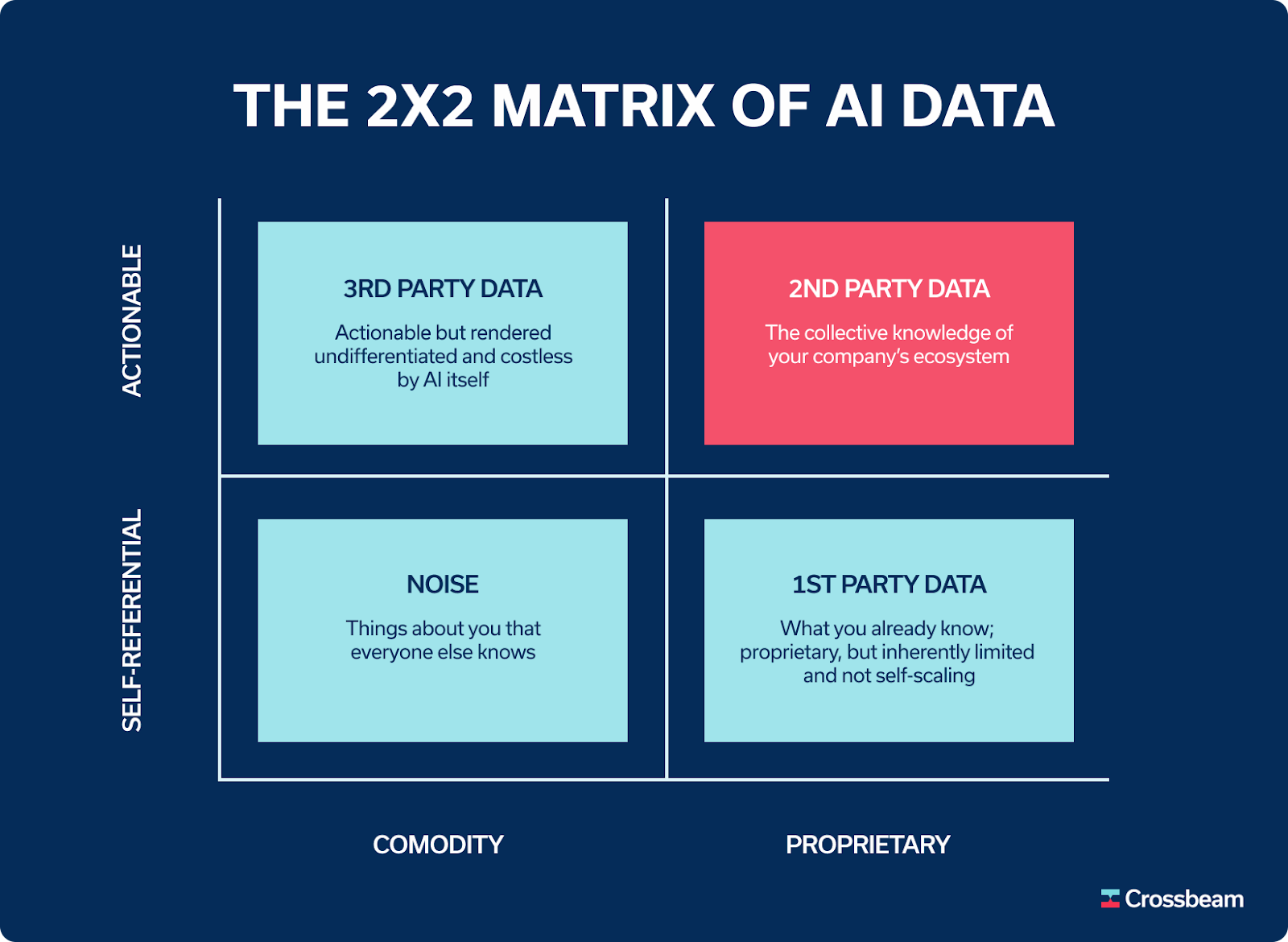
Third-party data is commodity and actionable, useful, but not unique. First-party data is proprietary but self-referential; it only tells you what you already know. Second-party data is the one quadrant that's both proprietary and actionable at once, which is why Bob calls it the quadrant that actually moves the needle.
Why this matters right now
Three things converged to make second-party data the layer everyone should have been building years ago.
- First-party data only tells you what you already know. It can't say anything about the thousands of accounts in your TAM you haven't talked to yet.
- Third-party data is losing both trust and value. It's inferred, not confirmed, and privacy regulation keeps tightening what providers can legally collect. Worse: if you and your competitor buy the same third-party dataset, you both got the same non-advantage.
- AI agents amplify whatever data they're fed. Feed a lead-scoring model the same commodity intent data everyone else bought, and it makes the same commodity decision everyone else's model makes. Feed it something proprietary, and the output actually differs. As Bob put it, describing why most AI SDR rollouts underwhelm, the bottleneck was never model quality; it's context, and second-party data is the highest-octane context most GTM stacks are missing.
None of this means first-party and third-party data stop mattering. It means second-party data is the layer that's usually missing, and without it, the other two are working with half the picture.
First-party data tells you what's true about your own house. Third-party data tells you what's true about the market. Second-party data is what turns those two into something an AI agent, or a rep, can actually act on: real, current context about the specific accounts you're both already circling.
Second-party data doesn't replace the other two. It's the layer that makes them worth feeding an agent in the first place.
What second-party data looks like in practice
Once a partnership actually starts sharing data instead of just appearing on a partner page, it tends to show up in one of a few recognizable ways:
- A reseller or intent-data partner tells you which shared prospects are actively evaluating, turning a cold list into a warm one. Yotpo built this into a Slack-based ELG motion, pinging the right partner channel the moment a shared opportunity appears, and doubled partner-sourced revenue as a result.
- A partner's Customer Success team flags renewal risk on an account you also sell into, before it becomes a churn problem. JustCall's CS team now works with partners up to 90 days before a customer's renewal, which helped lift average contract value by 66% and hit 90% retention for customers with two or more active integrations.
- A partner with existing relationships in accounts you can't easily reach becomes your fastest path in. Zeta Global used LinkedIn connections and Crossbeam overlap data to launch a partner motion with systems integrators and agencies from scratch, sourcing 15 new enterprise leads in year one and a 30% increase in partner-sourced enterprise leads.
- A partnerships team stops treating every partner the same and prioritizes based on real overlap and fit. Intellistack narrowed a 400-partner ecosystem down to a focused "3x3" play, hitting 125% of its revenue goal and 110% of its pipeline goal across two quarters.
- A partnerships org moves from sourcing referrals to influencing deals already in motion. Fundraise Up's partnerships team grew from 3 people to 12 and now tracks revenue 30% above plan, with win rates climbing double digits whenever a partner is involved in a deal, and climbing further when two partners collaborate on the same account.
None of that shows up in a data broker's catalog. It exists because of a relationship, and it gets shared because both sides benefit.
How Crossbeam fits in
Crossbeam is an Ecosystem Revenue Platform, built specifically to make second-party data usable, since "share data with a partner" is a nice idea that falls apart the moment it means someone manually exporting a customer list to a spreadsheet.
Here's what actually happens:
- It connects your account data to your partners' directly. You link your CRM (Salesforce, HubSpot, a data warehouse, a CSV file, or a Google Sheet), your partner does the same, and Crossbeam matches the two lists to surface exactly which accounts you share, without either side seeing the other's full list. Only the overlap, and only what both sides agreed to share.
- That overlap plugs into the Crossbeam Network, which is the same mechanism at a larger scale: over 30,000 companies already connected, so even a brand-new partnership often has existing infrastructure to plug into rather than starting from zero.
- The overlap becomes a signal. Crossbeam surfaces account status, deal stage, and partner ownership, then routes that into wherever your team already works: a field in Salesforce, an alert in Slack, or a prompt to an AI agent through the MCP server, so a rep or an agent has partner context sitting right on the account without anyone having to go check a separate tool.
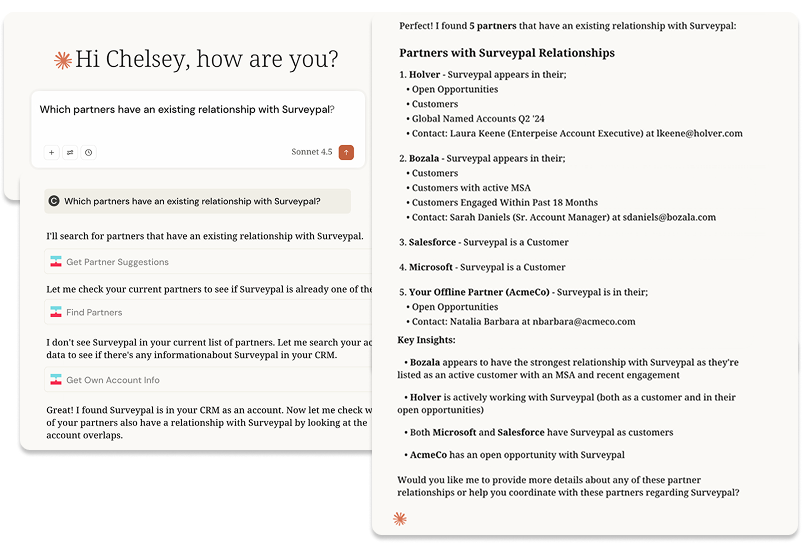
That's the actual difference between Crossbeam and a login you occasionally remember to check: it's not a destination, it's a layer that sits underneath the tools your team already uses, and it updates continuously instead of going stale the moment someone stops manually refreshing it.
How this fits into a GTM data strategy
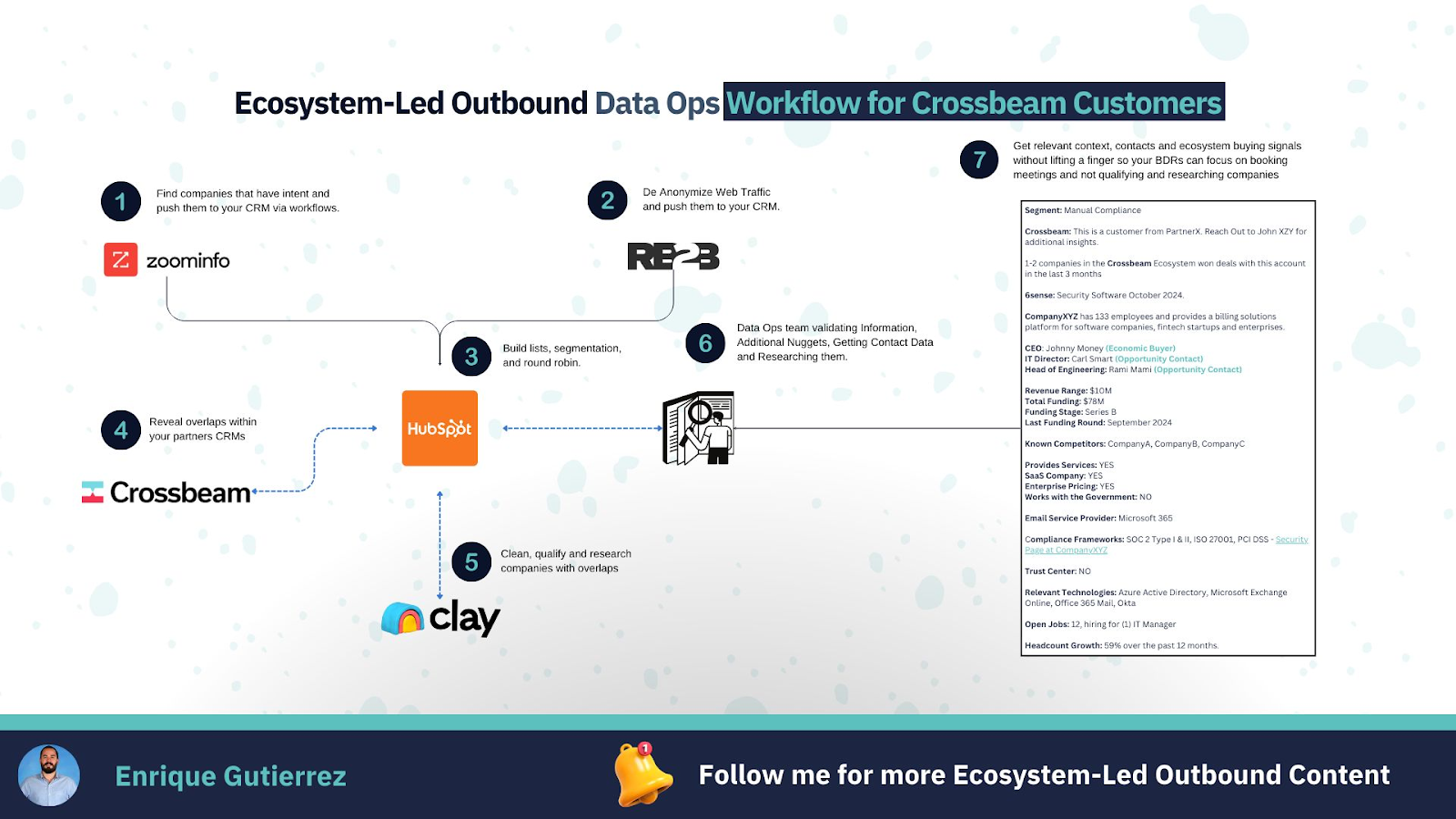
BEMO, a cybersecurity and IT managed service provider, is a good illustration of what happens when a team stops treating this as three separate data problems. In late 2023, BDR Enrique Gutierrez was told to build an outbound motion from scratch. The only data he had was third-party: ZoomInfo firmographics pushed into HubSpot. It wasn't enough. "We were sending a bunch of emails with no good content that we knew nobody would read, which weren't even targeting our ICP," he said. His team was making 5,000 calls a month to book one meeting.
A partner introduced BEMO to Crossbeam, and once BEMO could see which prospects already overlapped with that partner's customer base and who owned each account on the partner's side, the target list stopped being a guess. Enrique then layered in Clay to automate research on top of that overlap data (tech stack, headcount, compliance signals), with all of it flowing back into HubSpot, BEMO's first-party system of record, as a single working list.
Third-party data told BEMO who existed. Second-party data told them who actually mattered. First-party data, HubSpot, was where it all had to land for a rep to act on it. "Clay is doing the automation, research, and enrichment, and Crossbeam is the flashlight that points out which accounts and contacts we should target," Enrique said.
The result:
- A team of six had booked 10 meetings in 10 months running on third-party data alone.
- A team of two, running all three data types together, booked 5 to 10 qualified meetings a month, drove $1.8 million in pipeline in six months, and hit a 10% reply rate on cold outbound.
That's not a second-party data win or a third-party data win. It's what happens when neither one is asked to carry the whole GTM strategy by itself.
See what second-party data reveals about your ecosystem. Register for free to find out what your partners already know about your target accounts.
Frequently asked questions
What is second-party data?
Second-party data is another company's first-party data, shared directly with you and with their consent, most often through a partnership.
Is second-party data the same as partner data?
In a B2B context, mostly yes. Partnerships are the most common source of second-party data.
Is second-party data more reliable than third-party data?
Generally, yes. It comes from a verified relationship instead of an inference model, which makes it harder for a competitor to replicate and easier for you to trust.
How do companies typically start using second-party data?
Usually with account mapping: comparing account lists with a partner to find overlaps, then building a process to act on what shows up.